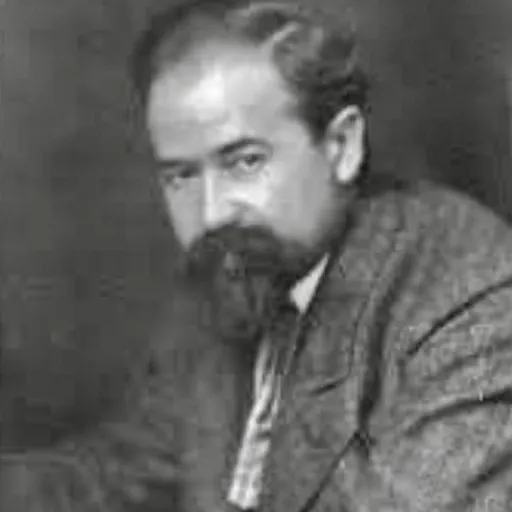
About Alfred Weber
Lived 1868 – 1958 (aged 89). Alfred Weber was a German economist, pedagogue, sociologist, university teacher, political economist and philosopher of culture, known for Weber problem.
Carl David Alfred Weber (; 30 July 1868 – 2 May 1958) was a German economist, geographer, sociologist, philosopher, and cultural theorist whose work was influential in the development of modern economic geography.
His other work focused on the sociology of knowledge and the role of intellectuals in society. In particular, he introduced the concept of free-floating intelligentsia (Freischwebende Intelligenz).
He was the brother of influential sociologist Max Weber.
Life Alfred Weber, younger brother of the well-known sociologist Max Weber, was born in Erfurt and raised in Charlottenburg. From 1907 to 1933, he was a professor at Heidelberg University. Weber started his career as a lawyer and worked as a sociologist and cultural philosopher.
Work Weber supported reintroducing theory and causal models to the field of economics, in addition to using historical analysis. In this field, his achievements involve work on early models of industrial location. He lived during the period when sociology became a separate field of science.
Though his theory on 'Industrial Location' was strictly economic during his time it is widely studied in the field of geography now, mostly as a theoretical concept in the subdomain of economic geography. found the first direct (non iterative) numerical solution of the Fermat and Weber triangle problems. Long before Von Thünen's contributions, which go back to 1818, the Fermat point problem can be seen as the very beginning of space economy. It was formulated by the famous French mathematician Pierre de Fermat before 1640. As for the Weber triangle problem, which is a generalization of the Fermat triangle problem, it was first formulated by Thomas Simpson in 1750, and popularized by Alfred Weber in 1909.
In 1985, in a book entitled Économie spatiale: rationalité économique de l'espace habité, Tellier formulated an all-new problem called the "attraction-repulsion problem", which constitutes a generalization of both the Fermat and Weber problems. In its simplest version, the attraction-repulsion problem consists in locating a point D with respect to three points A1, A2 and R in such a way that the attractive forces exerted by points A1 and A2, and the repulsive force exerted by point R cancel each other out. In the same book, Tellier solved that problem for the first time in the triangle case, and he reinterpreted spatial economics theory, especially, the theory of land rent, in the light of the concepts of attractive and repulsive forces stemming from the attraction-repulsion problem. That problem was later further analyzed by mathematicians like Chen, Hansen, Jaumard and Tuy (1992), and Jalal and Krarup (2003). The attraction-repulsion problem is seen by Ottaviano and Thisse (2005) as a prelude to the New Economic Geography that developed in the 1990s, and earned Paul Krugman a Nobel Memorial Prize in Economic Sciences in 2008.
The least cost theory made by Alfred Weber describes how firms select their sites of production; it involves locating the most profitable sites of production by minimising the total costs associated with the production activities, especially transport costs and labour costs. Introduced in Theory of the Location of Industries (1909) , the model considers that the location of firms is in search of the most cost-efficient location in a given geographical space, taking into consideration the spatial distribution of raw materials, markets and labour .
The locational triangle is the key part of Alfred’s theory, which denotes the relative locations of sources of raw materials and the market. Firms are assumed to be located at some point inside this triangle where the cost of transport is minimum. Weber stressed that transport cost was dependent on both distance and the weight of the goods, and was thus an important determinant of where industry is to be located.
The idea of the material index (MI) is a further refinement of this analysis. The material index has been defined as the ratio of the weight of the localised raw material to the weight of the final product. If the MI is greater than one, then production is said to be material-oriented, i.e., firms locate close to sources of raw materials in order to minimise transport costs. If the MI is less than one, the production is market-oriented, and companies are situated closer to consumers in order to save the cost of the distribution of finished goods . In addition to transport expenses, Weber added labour expenses as a secondary variable as well that can alter the optimal location. If there is a location with much cheaper labour, then the firms may move away from the minimum of transport cost, as long as the savings in labour exceed the increase in transport cost. This points out the effect of regional wage differences on patterns of industrial location.
Weber also noticed the importance of agglomeration economies, where those that group together tend to create shared infrastructure, pooled labour markets and knowledge spillovers, and all of those have the ability to lower costs and improve efficiency. At the same time, deglomeration forces (such as congestion or increasing price of land) may promote dispersion of firms. Although the least-cost theory is an exercise based on simplifying assumptions (such as fixed locations of raw materials and markets), it has had a long-lasting influence on economic geography and urban and regional economics. Later theories, such as those of agglomeration economics and of the 'new economic geography' linked to Paul Krugman, have responded to Weber's insights by adding increasing returns, market structure and spatial interactions . While some of today's methods emphasise other aspects such as globalisation, technology, and network effects, Weber's main ideas, especially the trade-offs between transport, labour, and agglomeration, continue to find relevance in the research of contemporary location analysis and remain useful to the analysis of industrial clustering and regional development.
Works Über den Standort der Industrie (Theory of the Location of Industries) 1909 Ideen zur Staats - und Kultursoziologie (1927) Kulturgeschichte als Kultursoziologie (1935) Farewell to European History or the Conquest of Nihilism (1947) Einführung in die Soziologie (1955)
Don’t just read it —
keep it.
Full-length biographies made to live with: read them, listen on the way to work, watch them tonight.
- E-book
- Audio
- Video
Instant download · yours to keep · every purchase keeps this site free
Important facts
People in Alfred Weber's life
Named in this biography and alive at the same time



Related people
Same field, nearest in time



Contemporaries
People whose lives overlapped Alfred Weber's



Frequently asked questions
Who was Alfred Weber?
German geographer and economist (1868–1958)
When was Alfred Weber born?
Alfred Weber was born on 30 July 1868 in Erfurt.
When did Alfred Weber die?
Alfred Weber died on 2 May 1958 in Heidelberg.
What was Alfred Weber's occupation?
Alfred Weber was an economist, pedagogue, sociologist, university teacher, political economist and philosopher of culture.
What was Alfred Weber known for?
Alfred Weber was known for Weber problem.
What nationality was Alfred Weber?
Alfred Weber was German.
Sources & further reading
Cite this page
APA: Biography.guide. (2026). Alfred Weber. https://biography.guide/alfred-weber/
MLA: "Alfred Weber." Biography.guide, https://biography.guide/alfred-weber/.
Chicago: "Alfred Weber." Biography.guide. https://biography.guide/alfred-weber/.
Data last updated: 2026-09-23 · Spot an error? Report a correction.
Portrait: Wikimedia Commons · author & licence
Page generated 2026-09-27 05:05 UTC