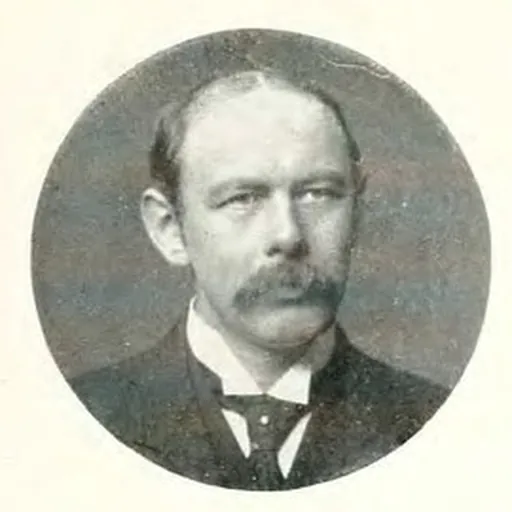
About William Somervell
Lived 1860 – 1934 (aged 74). William Somervell was a British politician and businessperson.
William Henry Somervell (5 April 1860 – 26 September 1934) was an English businessman, philanthropist and Liberal politician.
Family and education William Somervell was born at Kendal in Westmorland on 5 April 1860, the son of John Somervell and Rachel Wilson. He was educated at Stramongate School, Kendal and the Grove House School, Tottenham. In 1889, he married Florence Howard of Bickley, near Chislehurst in Kent. They had two sons and a daughter. One of his sons, Howard Somervell (1890–1975), was medical missionary for the London Missionary Society (LMS) hospital at Neyyoor, Travancore in southern India
In religion Somervell was a Congregationalist; an elder of the Zion Congregational Church at Kendal and for many years the superintendent of the Sunday School there. and was regarded as an influential lay member of the country's Christian churches. He twice (in 1913 and again in 1922) was a member of an LMS deputation to India. As a dedicated teetotaller, Somervell was a keen advocate of the LMS' work to promote temperance. He was selected to fight the seat again at a by-election on 18 March 1913 occasioned by the death of the sitting Tory MP Josceline Bagot. He failed to win the seat however and explained his defeat, and the doubling of the Unionist majority, by claiming that his opponent, Colonel John Wakefield Weston (who stood as an Independent Unionist) had been selected because he was a 'semi-Liberal' and a popular local man. To underline this, it was speculated that when the new member took his seat in the House of Commons he would be introduced not by the Conservative whips but by Lord Henry Cavendish-Bentinck and another private member.
Keighley
Somervell got his chance to enter the House Commons at another by-election, this time in the Liberal seat of Keighley in the West Riding of Yorkshire. The seat had been Liberal held since its creation for the 1885 general election and became vacant on the death of the sitting MP, Sir Swire Smith on 16 March 1918. At the election, Somervell, stood as the candidate of the Coalition government and did not face Conservative or Labour opponents. There was an Independent 'Peace by Negotiation' candidate, William Bland, (who is also referred to in some reference books as an Independent Labour Party candidate) but Somervell was returned easily with a majority of 2,524 votes and well over 50% of the poll. Nevertheless, Bland managed to attract nearly 30% of the vote and one historian has argued that this was an indication of a growing and substantial body of public opinion favouring a negotiated peace settlement with Germany following the publication of the Lansdowne letter and an increasing sign of war-weariness.
However, Somervell's stay in Parliament lasted just 232 days. At the general election of December 1918 he was opposed by Robert Clough for the Conservatives, who appears to have been granted the Coalition Coupon, and Bland again who this time stood as an official Labour Party candidate. Somervell seems to have fallen foul of the Lloyd George Coalition Liberals and their Conservative allies mainly because of his failure to vote for the government in the Maurice Debate, although there were other minor policy differences too. Clough took the seat from Somervell with a majority of 1,111 votes in a close three-cornered contest. Somervell did not stand for Parliament again.
Appointments Somervell served for many years as a Justice of the Peace in Westmorland and Kendal Borough. and the Contemporary Art Society.
Don’t just read it —
keep it.
Full-length biographies made to live with: read them, listen on the way to work, watch them tonight.
- E-book
- Audio
- Video
Instant download · yours to keep · every purchase keeps this site free
Important facts
People in William Somervell's life
Named in this biography and alive at the same time







Related people
Same field, nearest in time



Contemporaries
People whose lives overlapped William Somervell's

Frequently asked questions
Who was William Somervell?
British politician (1860-1934)
When was William Somervell born?
William Somervell was born on 5 April 1860.
When did William Somervell die?
William Somervell died on 26 September 1934.
What was William Somervell's occupation?
William Somervell was a politician and businessperson.
What nationality was William Somervell?
William Somervell was British.
Sources & further reading
· Wikipedia: William Somervell
Cite this page
APA: Biography.guide. (2026). William Somervell. https://biography.guide/william-somervell/
MLA: "William Somervell." Biography.guide, https://biography.guide/william-somervell/.
Chicago: "William Somervell." Biography.guide. https://biography.guide/william-somervell/.
Data last updated: 2026-09-20 · Spot an error? Report a correction.
Portrait: Wikimedia Commons · author & licence
Page generated 2026-09-27 04:57 UTC