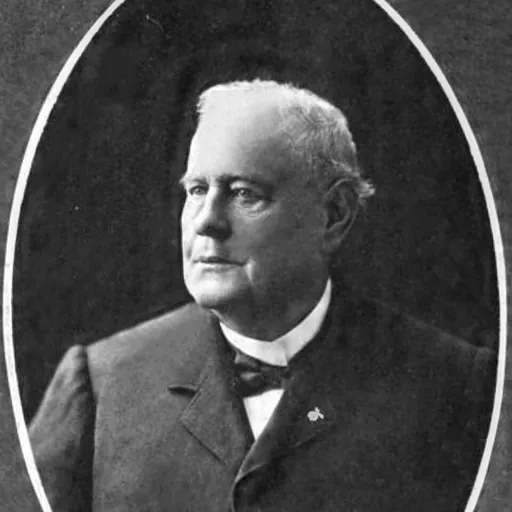
About William H. Perry
Lived 1832 – 1906 (aged 74). William H. Perry was a politician.
William Hayes Perry (1832–1906) was a 19th-century lumber merchant and financier in Los Angeles. He was known as "a masterful man whose influence and backing has been felt for fifty years in the development of Southern California." It was the first transcontinental sheep drive, taking a year to complete.
He arrived in Los Angeles either in 1853 Perry later recounted that after his long trip he was "worn out, dead broke and almost naked." He walked into a store and asked the merchant for "the cheapest suit of clothes you have, and my face must be my security for payment until I get a start." The proprietor offered him two suits on credit — one for work and a more expensive one for church.
Perry died October 29, 1906. His widow, Elizabeth M. Perry, received half the community property, and Perry's will provided that on her death the estate should go to his children or their heirs. A son, Charles Frederic Perry, and his wife, Ada, adopted Marion Rebecca Perry, and after both Charles Frederic and Ada had died, 15-year-old Marion's claim for a share of the estate was contested by W.H. Perry's children, Mamie B. Modini-Wood and Florence Johnson. There being no law bearing on the case, a settlement was reached: Marion had asked for the sum of $318,740.95.
He was buried in Evergreen Cemetery after services at his residence, 20 St. James Park. William Mulholland was one of his pallbearers.
Vocation
Lumber
Business
In less than a year after his arrival in Los Angeles, Perry opened the first furniture store in the city, selling some articles that he made himself and some that were shipped from San Francisco. He had no competition in the city for years, and partnered with James Brady, whom Wallace Woodworth bought out in 1858. In 1873 the firm opened a lumber yard and mill on Commercial Street. In its later expansion, the company purchased its own timberlands and organized lumber companies up and down the Pacific Coast and had logging camps, sawmills, vessels, wharves and spur tracks to railroads.
In 1858 Masonic Lodge 42 lent Perry, who was a Mason, and Brady enough money to construct a new building at 426 North Main Street for their "carpentry and furniture-making business", after which the lodge rented the second floor for its own use. The building, which has a symbolic "Masonic eye" below the parapet, is now part of the El Pueblo de Los Angeles Historical Monument.
The firemen were greatly handicapped by the meager water supply. Most of the water pipes in the vicinity were laid thirty years ago, and the mains are only of four inches diameter. . . . The best hydrant in the district, the one at Alameda and Commercial streets, could not be utilized at first, on account of the intense heat from the burning flour mill. Engines were stationed at every available hydrant, however, and 13,000 feet of hose, of various kinds and qualities, some of it very bad, were laid. The hose burst frequently and caused the firemen much inconvenience.
After being told by a fellow worker that the man he had just spoken to was the company president, young William went to the main office to hand in his resignation. But the president, William Hayes Perry, was so impressed by Mulholland's attention to the job that he promoted him to foreman. That same year he purchased the Turnverein Hall property on Spring Street for $100,000.
Public service
Perry was elected to the Los Angeles Common Council, the governing body of the city, on December 7, 1868. The new councilmen drew lots for either a one- or a two-year term.
Legacy
The Mount Pleasant House was built in 1876 by Perry in Boyle Heights and later relocated to the Heritage Square Museum in the Montecito Heights area of Los Angeles. One of his children, Mamie Perry (1861–1949), studied voice in Italy, performed there to excellent reviews and, upon her permanent return to Los Angeles, became one of the public's favored sopranos. Hollywood and television actor Robert Stack (1919–2003) was a great-grandchild.
References and notes
Don’t just read it —
keep it.
Full-length biographies made to live with: read them, listen on the way to work, watch them tonight.
- E-book
- Audio
- Video
Instant download · yours to keep · every purchase keeps this site free
Important facts
People in William H. Perry's life
Named in this biography and alive at the same time


Related people
Same field, nearest in time




Contemporaries
People whose lives overlapped William H. Perry's


Frequently asked questions
Who was William H. Perry?
banker
When was William H. Perry born?
William H. Perry was born on 7 October 1832 in Newark.
When did William H. Perry die?
William H. Perry died on 29 October 1906.
What was William H. Perry's occupation?
William H. Perry was a politician.
Sources & further reading
· DBpedia: William H. Perry (businessman)
Cite this page
APA: Biography.guide. (2026). William H. Perry. https://biography.guide/william-h-perry/
MLA: "William H. Perry." Biography.guide, https://biography.guide/william-h-perry/.
Chicago: "William H. Perry." Biography.guide. https://biography.guide/william-h-perry/.
Data last updated: 2026-09-23 · Spot an error? Report a correction.
Portrait: Wikimedia Commons · author & licence
Page generated 2026-09-27 05:05 UTC