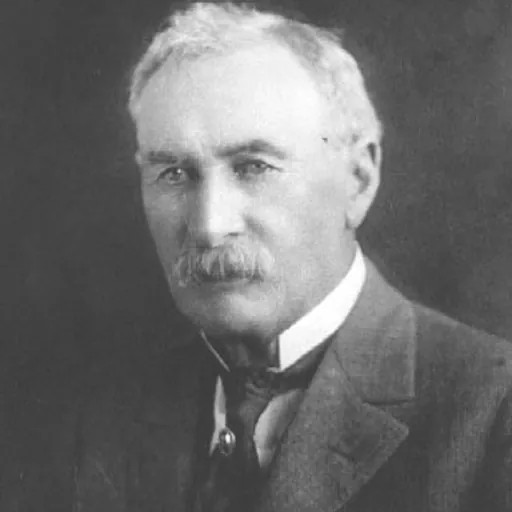
William Mulholland
Engineer and builder of the Los Angeles Aqueduct
About William Mulholland
Lived 1855 – 1935 (aged 79). William Mulholland was an Irish engineer and civil engineer, known for Water infrastructure.
Los Angeles Aqueduct
Mulholland envisioned Los Angeles growing much larger. The limiting factor to its growth was its water supply, because it has a semiarid climate with unreliable rainfall. "If you don't get the water, you won't need it," Mulholland famously remarked.
Mulholland shared the vision of a much larger Los Angeles with Frederick Eaton, the mayor of Los Angeles from 1898 through 1900. They had worked together in the private Los Angeles Water Company in the 1880s. In 1886, Eaton became city engineer and Mulholland became superintendent of the water company. When Eaton was elected mayor of Los Angeles, he was instrumental in converting the water company to city control in 1902. Ten years later it had tripled to almost 320,000.
To create this expansion, Eaton and Mulholland realized that the large amount of runoff from the Sierra Nevada in Owens Valley could be delivered to Los Angeles through a gravity-fed aqueduct. Mulholland misled Los Angeles public opinion by dramatically understating the amount of water then available for Los Angeles' growth. Los Angeles Aqueduct, inaugurated in November 1913, required 3900 workers at its peak and involved the digging of 164 tunnels. Construction began in 1908. The complexity of the project has been compared to the building of the Panama Canal. Water from the Owens River reached a reservoir in the San Fernando Valley on November 5, 1913. From a hydrological point of view, the San Fernando Valley was ideal; its aquifer could serve as free water storage without evaporation. By 1915, the initial annexations were completed, and by 1926, the land area of Los Angeles had doubled, making it the largest city in the United States by area. Areas that opted to join the municipal water network were Owensmouth (Canoga Park) (1917), Laurel Canyon (1923), Lankershim (1923), Sunland (1926), La Tuna Canyon (1926), and the incorporated city of Tujunga (1932).
The water from Mulholland's aqueduct also shifted farming from wheat to irrigated crops such as corn, beans, squash, and cotton; orchards of apricots, persimmons, and walnuts; and major citrus groves of oranges and lemons. These continued within the city environs until the next increment of development converted land use into suburbanization. A few enclaves remain, such as the groves at the Orcutt Ranch Park and CSUN campus.
Professional recognition
Mulholland, who was self-taught, became the first American civil engineer to use hydraulic sluicing to build a dam while constructing the Silver Lake Reservoir in 1906. This new method attracted nationwide attention of engineers and dam builders. Government engineers adopted the method when building Gatun Dam, on which Mulholland was a consultant, in the Panama Canal Zone.
In 1914, the University of California, Berkeley, awarded Mulholland an honorary doctoral degree. The inscription on the diploma read, "Percussit saxa et duxit flumina ad terram sitientum" (He broke the rocks and brought the river to the thirsty land). That October, with construction of the dam underway, San Francisco's city engineer, Michael O'Shaughnessy, wrote negatively of Mulholland in a letter to John R. Freeman, an engineer who had assisted the city in its pursuit of permission to construct the Hetch Hetchy reservoir and water system in Yosemite National Park. O'Shaughnessy expressed the view that Mulholland and F. C. Hermann, chief engineer for the SVWC, were "so intensely conceited that they imagine all they might do should be immune from criticism."
Indicating construction details or practices that he thought incorrect, O'Shaughnessy wrote of what was, in his view, sloppiness and recklessness at the Calaveras dam site; he said, "another feature which made objectionable impressions" on him was "the flippant manner in which the young college boys in charge of the work and Mulholland, with his swollen ideas of accomplishment, have undertaken this very serious engineering project."
On March 24, 1918, the dam suffered a partial collapse of the upstream slope. At the time, the water in the reservoir was 55 feet deep; no water was released.
Owens Valley conflict The remains of Owens River at Bishop Tuff: In 1913, the watercourse was diverted for irrigation and drinking water in Los Angeles.
After the Los Angeles Aqueduct was completed, the San Fernando investors demanded so much water from the Owens Valley that it started to transform from "the Switzerland of California" into a desert.
By 1924, farmers and ranchers rebelled. A series of provocations by Mulholland was , in turn, followed by corresponding threats from local farmers, and the destruction of Los Angeles property.
St. Francis Dam collapse
Mulholland's career effectively ended on March 12, 1928, when the St. Francis Dam failed 12 hours after his assistant, assistant chief engineer and general manager Harvey Van Norman and he had personally inspected the site. Within seconds after the collapse, only what had been a large section of the central part of the dam remained standing and the reservoir's 12.4 billion gallons (47 million m3) of water began moving down San Francisquito Canyon in a torrent at 18 miles per hour (29 km/h). In the canyon, it demolished the heavy concrete Powerhouse Number Two (a hydroelectric power plant) and took the lives of 64 of the 67 workmen and their families living there.
The waters traveled south and emptied into the Santa Clara riverbed, flooding parts of present-day Valencia and Newhall. Following the riverbed, the water continued west, flooding the towns of Castaic Junction, Piru, Fillmore, Bardsdale and Santa Paula in Ventura County. It was almost two miles (3 km) wide, and still traveling at 5 miles (8 km) per hour when it reached the ocean at 5:30 am; emptying its victims and debris into the Pacific Ocean near Montalvo, 54 miles (87 km) from the reservoir and dam site. Many of the bodies that had been washed out to sea were recovered from the sea, some as far south as the Mexican border; others were never found.
Santa Paula received some of the worst damage, especially the lowland areas nearer the riverbed. Here, in many areas, only foundations or rubble marked where many homes had been. Rescue efforts were hampered and walking was made hazardous by a thick layer of mud that covered the area.
Recovery crews worked for days to dig out bodies and clear away the mud from the flood's path. The final death toll is estimated to be at least 431, of whom at least 108 were minors.
Mulholland took full responsibility for what has been called the worst US man-made disaster of the 20th century During the Los Angeles coroner's inquest, Mulholland said, "this inquest is very painful for me to have to attend, but it is the occasion of what is painful. The only ones I envy about this whole thing are the ones who are dead." In later testimony, after responding to a question, he added, "Whether it is good or bad, don't blame anyone else, you just fasten it on me. If there was an error in human judgment, I was the human, I won't try to fasten it on anyone else."
The inquest jury concluded that responsibility for the disaster lay in an error in engineering judgment about the suitability of the area's geology as a stable foundation for the dam, and in errors in public policy. They recommended that Mulholland not be held criminally responsible, as they stated in their verdict, "We, the Jury, find no evidence of act of criminal act or intent on the part of the Board of Water Works and Supply of the City of Los Angeles, or any engineer or employee in the construction or operation of the St. Francis Dam..."
Nonetheless, his critics pointed out that another dam on which Mulholland had acted as a consultant collapsed, and the city abandoned a dam project in San Gabriel before completion.
Later life and death Mulholland spent the rest of his life in relative seclusion, devastated by the tragedy. In retirement, he began writing an autobiography, but never completed it. Shortly before his death, he was consulted on the Hoover Dam and Colorado River Aqueduct projects. He died in 1935 from a stroke, and is buried at Forest Lawn Memorial Park Cemetery in Glendale, California.
Legacy
In his book Water and Power, historian William L. Kahrl summed up Mulholland's public legacy to the principle of public water development in writing:
The harshest judgement of Mulholland's actions lay in the damage he had done to the principle of public water development. More than any other individual, William Mulholland, through the building of the aqueduct and the formation of the Metropolitan Water District, established the principle of public ownership of water indelibly on California's history. But the furor that followed upon the mistakes made in the last seven years of his public service discredited the man and thereby gave aid to the enemies of the ideal he had labored all his life to establish. Mulholland Highway and Mullholland Middle School are named for Mulholland.
In popular culture Singer/songwriter Frank Black recorded two songs about the life and works of William Mulholland: "Olé Mulholland", from Teenager of the Year (1994) and "St. Francis Dam Disaster", from Dog in the Sand (2001). William Mullholland and the California water wars are the subject of the BBC Northern Ireland television documentary Patrick Kielty's Mulholland Drive. The program was broadcast in the UK in February 2016 and presented by Irish comedian and television personality Patrick Kielty. In the 1974 film Chinatown, the character of Hollis Mulwray is based loosely on Mulholland. Mulholland was portrayed by Jack Black in an episode of Comedy Central's Drunk History that parodied his legacy.
Don’t just read it —
keep it.
Full-length biographies made to live with: read them, listen on the way to work, watch them tonight.
- E-book
- Audio
- Video
Instant download · yours to keep · every purchase keeps this site free
Important facts
People in William Mulholland's life
Named in this biography and alive at the same time


Related people
Same field, nearest in time


Contemporaries
People whose lives overlapped William Mulholland's




Frequently asked questions
Who was William Mulholland?
engineer and builder of the Los Angeles Aqueduct (1855-1935)
When was William Mulholland born?
William Mulholland was born on 11 September 1855 in Belfast.
When did William Mulholland die?
William Mulholland died on 22 July 1935 in Los Angeles.
What was William Mulholland's occupation?
William Mulholland was an engineer and civil engineer.
What was William Mulholland known for?
William Mulholland was known for Water infrastructure.
What nationality was William Mulholland?
William Mulholland was Irish.
Sources & further reading
· Wikipedia: William Mulholland
Cite this page
APA: Biography.guide. (2026). William Mulholland. https://biography.guide/william-mulholland/
MLA: "William Mulholland." Biography.guide, https://biography.guide/william-mulholland/.
Chicago: "William Mulholland." Biography.guide. https://biography.guide/william-mulholland/.
Data last updated: 2026-09-22 · Spot an error? Report a correction.
Portrait: Wikimedia Commons · author & licence
Page generated 2026-09-27 05:01 UTC