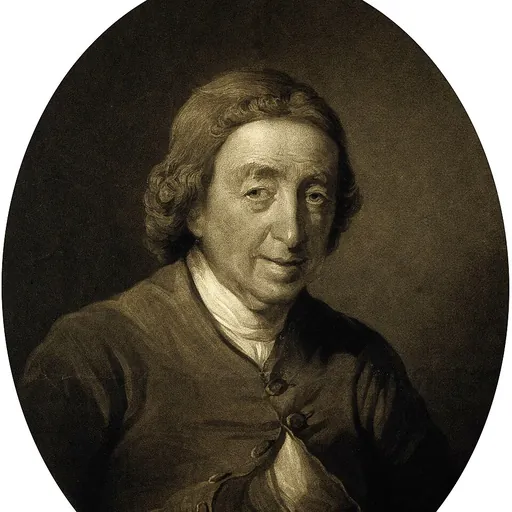
About William Emerson
Lived 1701 – 1782 (aged 81). William Emerson was a British mathematician.
William Emerson (14 May 1701 – 20 May 1782) was an English mathematician. He was born in Hurworth, near Darlington, where his father, Dudley Emerson, also a mathematician, taught a school.
Biography
William himself had a small estate in Weardale called Castle Gate situated not far from Eastgate where he would repair to work throughout the summer on projects as disparate as stonemasonry and watchmaking. Unsuccessful as a teacher, he devoted himself entirely to studious retirement. Emerson published many works which are singularly free from errata.
In The Principles of Mechanics (1754) he shows a wind-powered vehicle in which the vertically mounted propeller gives direct power to the front wheels via a system of cogs. In mechanics he never advanced a proposition which he had not previously tested in practice, nor published an invention without first proving its effects by a model. He was skilled in the science of music, the theory of sounds, and the ancient and modern scales; but he never attained any excellence as a performer. He died on 20 May 1782 at his native village, where his gravestone bears epitaphs in Latin and Hebrew.
Emerson dressed in old clothes and his manners were uncouth. He wore his shirt back to front and his legs wrapped in sacking so as not to scorch them as he sat over the fire. He declined an offer to become FRS because it would cost too much after all the expense of farthing candles he had been put to in the course of his life of study. Emerson rode regularly into Darlington on a horse like Don Quixote's, led by a hired small boy. In old age, plagued by the stone, he would alternately pray and curse, wishing his soul 'could shake off the rags of mortality without such a clitter-me-clatter.'
Like his fellow County Durham savant John Bird, Emerson makes an appearance in Mason and Dixon by Thomas Pynchon.
Works
Emerson's works include:
The Doctrine of Fluxions (1748); 3rd edition (1768) The Projection of the Sphere, Orthographic, Stereographic and Gnomical (1749) The Elements of Trigonometry (1749); 3rd edition (1788) The Principles of Mechanics (1754); 3rd edition (1773) A Treatise of Navigation (1755) A Treatise of Algebra, in two books (1764) The Arithmetic of Infinites, and the Differential Method, illustrated by Examples (1767) Mechanics, or the Doctrine of Motion (1769) The Elements of Optics, in four books (1768) A System of Astronomy (1769) The Laws of Centripetal and Centrifugal Force (1769) The Mathematical Principles of Geography (1770) Tracts (1770) Cyclomathesis, or an Easy Introduction to the several branches of the Mathematics (1770), in ten volumes A Short Comment on Sir Isaac Newton's Principia; to which is added, A Defence of Sir Isaac against the objections that have been made to several parts of his works (1770) A Miscellaneous Treatise containing several Mathematical Subjects (1776).
He contributed to the mathematical journals of his day, but usually under a pseudonym.
It is notable to remark that in "The Doctrine of Proportionality" Emerson was first to introduce ∝ as the symbol for proportionality.
Don’t just read it —
keep it.
Full-length biographies made to live with: read them, listen on the way to work, watch them tonight.
- E-book
- Audio
- Video
Instant download · yours to keep · every purchase keeps this site free
Important facts
People in William Emerson's life
Named in this biography and alive at the same time

Related people
Same field, nearest in time




Contemporaries
People whose lives overlapped William Emerson's



Frequently asked questions
Who was William Emerson?
British mathematician (1701-1782)
When was William Emerson born?
William Emerson was born on 14 May 1701 in Hurworth-on-Tees.
When did William Emerson die?
William Emerson died on 20 May 1782 in Hurworth-on-Tees.
What was William Emerson's occupation?
William Emerson was a mathematician.
What nationality was William Emerson?
William Emerson was British.
Sources & further reading
· DBpedia: William Emerson (mathematician)
Cite this page
APA: Biography.guide. (2026). William Emerson. https://biography.guide/william-emerson/
MLA: "William Emerson." Biography.guide, https://biography.guide/william-emerson/.
Chicago: "William Emerson." Biography.guide. https://biography.guide/william-emerson/.
Data last updated: 2026-09-22 · Spot an error? Report a correction.
Portrait: Wikimedia Commons · author & licence
Page generated 2026-09-27 05:04 UTC