
About William Dunbar
Lived 1460 – 1520 (aged 59–60). William Dunbar was a Scottish poet, catholic priest and writer.
Title page of Dunbar's The Goldyn Targe in the Chepman and Myllar Prints of 1508. (National Library of Scotland). William Dunbar (1459 or 1460 – by 1530) was a Scottish makar, or court poet, active in the late fifteenth and early sixteenth centuries. He was closely associated with the court of King James IV and produced a large body of work in Scots distinguished by its great variation in themes and literary styles. He was probably a native of East Lothian, as assumed from a satirical reference in The Flyting of Dumbar and Kennedie. His surname is also spelt Dumbar.
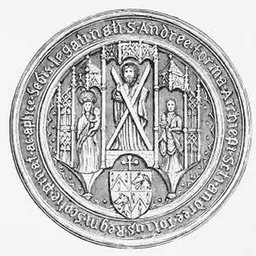
Biography Dunbar first appears in the historical record in 1474 as a new student or determinant of the Faculty of Arts at the University of St Andrews. Since the customary age for entering a Scottish university at this time was fourteen, a birth-date of 1459 or 1460 has been assumed. At St Andrews, he obtained a bachelor's degree in 1477 and a master's degree in 1479. In 1501 and 1502, he participated in an embassy to England in the staff of Andrew Forman, Bishop of Moray.
In 1510, his pension was set at the substantial annual sum of eighty pounds Scots.
The poem "In Honour of the City of London", of the medieval urban description genre, was made into a cantata of the same name by William Walton in 1937.
Religious and moral works Dunbar was an ordained priest of the Roman Catholic Church in Scotland and several of his works have religious subject matter. Rorate Celi Desuper, Of the Passioun of Christ and Done is a Battell on the Dragon Blak deal with the Nativity, Passion and Resurrection respectively. Ane Ballat of Our Lady is a hymn in praise of the Blessed Virgin. The Table of Confession discusses sin and confession.
Court entertainment Many of the poet's pieces appear to provide entertainment for the King, the Queen and his fellow courtiers with comic elements as a recurring theme. The well known Ane Dance in the Quenis Chalmer is a comic satire of court life. The notorious flyting with Kennedy was an exchange of outrageous poetic insults with his fellow makar Walter Kennedy while The Dance of the Seven Deadly Sins is a series of comic scenes set in Hell.
Some of Dunbar's satirical poems are preserved in the Bannatyne Manuscript, including The Dregy of Dunbar, The Twa Cummeris, and The Flyting of Dumbar and Kennedie to name a few.
Elsewhere, Dunbar seemed to reveal other aspects of his private life. His famous Memento mori poem Lament for the Makaris eulogised his fellow Scottish poets who had died. Meditatioun In Wyntir considers ageing and the poet's frustrated ambitions while On His Heid-Ake is apparently an attempt to excuse a lack of productivity by recounting a migraine.
Dunbar's chief allegorical poems are The Goldyn Targe and The Thrissil and the Rois. The motif of the former is the poet's futile endeavour, in a dream, to ward off Dame Beauty's arrows by Reason's "scheld of gold." When wounded and made prisoner, he discovers the true beauty of the lady: when she leaves him, he is handed over to Heaviness. The noise of the ship's guns, as the company sails off, wakes the poet to the real pleasures of a May morning. Dunbar works on the same theme in a shorter poem, known as Beauty and the Prisoner. The Thrissil and the Rois is a prothalamium in honour of King James and Queen Margaret.
The greater part of Dunbar's work is occasional – personal and social satire, complaints, orisons and pieces of a humorous character. His best-known orison, usually remembered as Timor mortis conturbat me which is repeated as the fourth line of each verse, is titled Lament for the Makaris and takes the form of prayer in memory of the medieval Scots poets.
The humorous works show Dunbar at his finest. The best specimen of this work, of which the outstanding characteristics are sheer whimsicality and topsy-turvy humour, is The Ballad of Kynd Kittok. This strain runs throughout many of the occasional poems, and is not wanting in odd passages in Dunbar's contemporaries; and it has the additional interest of showing a direct historical relationship with the work of later Scottish poets, and chiefly with that of Robert Burns. Dunbar's satire often becomes invective. Examples of this type are The Satire on Edinburgh, The General Satire, the Epitaph on Donald Owre, and the powerful vision of The Dance of the Sevin Deidlie Synnis. Two satirical ballads lampoon a colleague at court, the would-be aviator John Damian. In The Flyting of Dunbar and Kennedy, an outstanding specimen of a favourite northern form, analogous to the continental estrif, or tenzone, he and his rival reach a height of scurrility which is certainly without parallel in English literature. This poem has the additional interest of showing the antipathy between the Middle Scots-speakers in the Lothians and the Galwegian Gaelic-speaking population of Carrick, in the south of Ayrshire, where Walter Kennedy was from.
"Back to Dunbar" For the Scottish Literary Renaissance in the mid-twentieth century, Dunbar was a touchstone. Many tried to imitate his style, and "high-brow" subject matter, such as Hugh MacDiarmid and Sydney Goodsir Smith. As MacDiarmid himself said, they had to go "back to Dunbar". To make Dunbar more accessible to the modern reader Selected Poems of William Dunbar: An Interlinear Translation was published by Lawrence Siegler in 2010.
Dunbar is commemorated in Makars' Court, outside The Writers' Museum, Lawnmarket, Edinburgh.
Works Ane Dance in the Quenis Chalmer The Dregy Of Dunbar The Fenyeit Freir of Tungland The Flyting of Dumbar and Kennedie The Twa Cummeris The Goldyn Targe He Is Na Dog, He Is a Lam On His Heid-Ake Of Ane Blak-Moir Of James Dog Lament for the Makaris (Timor mortis conturbat me) Meditatioun In Wyntir The Petition of The Gray Horse, Auld Dunbar Remonstrance to the King (Schir, ye have mony servitouris) The Thrissil and the Rois The Tua Mariit Wemen and the Wedo
Don’t just read it —
keep it.
Full-length biographies made to live with: read them, listen on the way to work, watch them tonight.
- E-book
- Audio
- Video
Instant download · yours to keep · every purchase keeps this site free
Important facts
People in William Dunbar's life
Named in this biography and alive at the same time


Related people
Same field, nearest in time

Contemporaries
People whose lives overlapped William Dunbar's



Frequently asked questions
Who was William Dunbar?
medieval Scottish poet and civil servant
When was William Dunbar born?
William Dunbar was born in 1460 in East Lothian.
When did William Dunbar die?
William Dunbar died in 1520 in Edinburgh.
What was William Dunbar's occupation?
William Dunbar was a poet, catholic priest and writer.
What nationality was William Dunbar?
William Dunbar was Scottish.
Sources & further reading
Cite this page
APA: Biography.guide. (2026). William Dunbar. https://biography.guide/william-dunbar-poet/
MLA: "William Dunbar." Biography.guide, https://biography.guide/william-dunbar-poet/.
Chicago: "William Dunbar." Biography.guide. https://biography.guide/william-dunbar-poet/.
Data last updated: 2026-09-20 · Spot an error? Report a correction.
Page generated 2026-09-27 05:19 UTC