
Federico da Montefeltro
Condottiere of the Italian Renaissance, and lord of Urbino
About Federico da Montefeltro
Lived 1422 – 1482 (aged 60). Federico da Montefeltro was a condottiero and patron of the arts.
Federico da Montefeltro, also known as Federico III da Montefeltro KG ( 7 June 1422 – 10 September 1482), was one of the most successful mercenary captains (condottieri) of the Italian Renaissance. He became the lord of Urbino in 1444, and ruled the city as its duke from 1474 until his death. In addition to his considerable reputation for martial skill and honor, he was a renowned intellectual humanist and civic leader. Montefeltro commissioned the construction of a great library, perhaps the largest of Italy after the Vatican's, complete with a team of scribes in its scriptorium. He also assembled a large humanistic court in his Ducal Palace, designed by Luciano Laurana and Francesco di Giorgio Martini.
Biography
Federico was born in Castello di Petroia in Gubbio. Guidantonio da Montefeltro, lord of Urbino, Gubbio and Casteldurante, and Duke of Spoleto acknowledged Federico as his illegitimate son. Two years later he was legitimized by Pope Martin V, with the consent of Guidantonio's wife, Caterina Colonna, who was Martin's niece. However, there were persistent rumours that Federico was not Guidantonio's son, but his grandson. Guidantonio had an illegitimate daughter named Aura, who, in 1420, married Bernardino Ubaldini della Carda, a captain in Guidantonio's employ. It was rumoured that, being without a son and heir at the time, Guidantonio took his daughter's firstborn son soon after birth and passed the child off as his own. This rumour was recorded by various commentators during Federico's lifetime, including Pope Pius II.
In the aftermath of the Peace of Ferrara (see Wars in Lombardy) in 1433, he lived in Venice and Mantua as a hostage. In 1437 he was knighted by Holy Roman Emperor Sigismund, and in the same year, he married Gentile Brancaleoni in Gubbio.
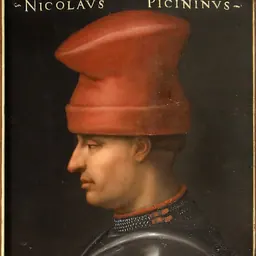
At sixteen, he began a career as condottiero under Niccolò Piccinino.
On 22 July 1444, his half-brother Oddantonio da Montefeltro, recently created Duke of Urbino by Pope Eugene IV, was assassinated in a conspiracy: Federico, whose participation in the plot has never been firmly established, subsequently seized the city of Urbino. However he was recognized only as Count of Urbino because not heir of the ducal title created for Oddantonio (Federico was created Duke only in 1474), the financial situation of the small dukedom being in disarray, he continued to wage war as a condottiero. His first condotta was for Francesco I Sforza, with 300 knights: Federico was also one of the few condottieri of the time to have a reputation for inspiring loyalty among his followers. In the pay of the Sforza—for Federico never fought for free—he transferred Pesaro to their control, and, for 13,000 florins, received Fossombrone as his share, infuriating Sigismondo Pandolfo Malatesta. Despite Federico's efforts, the Sforza sovereignty in the Marche was dismantled in the following years. When Sforza left for Lombardy, Sigismondo instigated a riot in Fossombrone, but Federico reconquered it three days later.
After six years in the service of Florence, Federico was hired in 1450 by Sforza, now Duke of Milan. However, he could not perform his duties as he lost his right eye during a joust. After the loss of the eye, Federico had surgeons remove the bridge of his nose (which had been injured in the incident) and eyelid.
In 1453 Federico himself risked losing his healthy eye as the wound reopened. Battista Sforza, the second wife of Federico. Portrait by Piero della Francesca This painting by Fra Carneval, representing an ideal Roman city, was commissioned for the palace of Montefeltro. However, after the death of his beloved second wife Battista Sforza (daughter of Elisabetta Malatesta and Alessandro Sforza), who died from pneumonia after giving birth to their seventh child at 25 years old, he spent much of his time in the magnificent palace in Urbino. The Duke had lost the mate he described as "the delight of my public and private hours"; a contemporary, speaking of their relationship, had called them two souls in one body. In 1482 he was called to command the army of Ercole I of Ferrara in his war against Venice, but was struck by fever and died in Ferrara in September.
Federico's son, Guidobaldo, was married to Elisabetta Gonzaga, the daughter of Federico I Gonzaga, lord of Mantua. With Guidobaldo's death in 1508, the duchy of Urbino passed through Giovanna to the papal family of Della Rovere—nephews of Guidobaldo.
Achievements
Arts patronage Federico, nicknamed "the Light of Italy", is a landmark figure in the history of the Italian Renaissance for his contributions to enlightened culture.
Role in society
His academic interests were the classics, particularly history and philosophy.
All his personal and professional achievements were financed through mercenary warfare. Commentators insist on his dedication to the well-being of his soldiers explaining why his men proved loyal to him and why Federico technically never lost a war. He was decorated with almost every military honor. Edward IV of England made him a Knight of the Most Noble Order of the Garter; he wears the Garter bound round his left knee in the portrait by Pedro Berruguete.
Don’t just read it —
keep it.
Full-length biographies made to live with: read them, listen on the way to work, watch them tonight.
- E-book
- Audio
- Video
Instant download · yours to keep · every purchase keeps this site free
Important facts
Family & relationships
People in Federico da Montefeltro's life
Named in this biography and alive at the same time

Related people
Same field, nearest in time

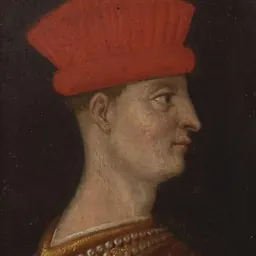
Contemporaries
People whose lives overlapped Federico da Montefeltro's
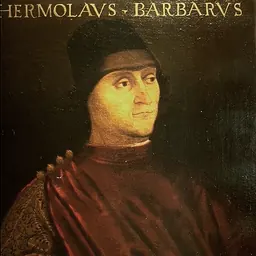



Frequently asked questions
Who was Federico da Montefeltro?
condottiere of the Italian Renaissance, and lord of Urbino
When was Federico da Montefeltro born?
Federico da Montefeltro was born on 7 June 1422 in Gubbio.
When did Federico da Montefeltro die?
Federico da Montefeltro died on 10 September 1482 in Ferrara.
What was Federico da Montefeltro's occupation?
Federico da Montefeltro was a condottiero and patron of the arts.
What nationality was Federico da Montefeltro?
Federico da Montefeltro's recorded nationality: Duchy of Urbino.
Sources & further reading
· Wikipedia: Federico da Montefeltro
· DBpedia: Federico da Montefeltro
Cite this page
APA: Biography.guide. (2026). Federico da Montefeltro. https://biography.guide/federico-da-montefeltro/
MLA: "Federico da Montefeltro." Biography.guide, https://biography.guide/federico-da-montefeltro/.
Chicago: "Federico da Montefeltro." Biography.guide. https://biography.guide/federico-da-montefeltro/.
Data last updated: 2026-09-20 · Spot an error? Report a correction.
Page generated 2026-09-27 05:31 UTC