
About Thomas Murner
Lived 1475 – 1537 (aged 61–62). Thomas Murner was a German poet, writer, translator, university teacher and catholic priest.
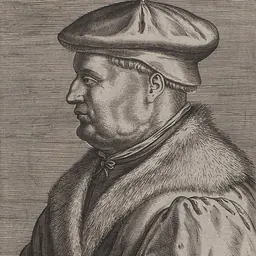
Thomas Murner as chancellor of the Gäuchmatt. Ambrosius Holbein Thomas Murner, OFM (24 December 1475) was an Alsatian satirist, poet and translator.
Early life and education He was born at Oberehnheim (Obernai) near Strasbourg. In 1490 he entered the Franciscan order, and in 1495 began travelling, studying and then teaching and preaching in Freiburg-im-Breisgau, Paris, Cracow and Strasbourg itself. The emperor Maximilian I crowned him in 1505 poeta laureatus; in 1506, he was created doctor theologiae. In 1508, while a preacher of the St.Martin church in Freiburg, he defied a recently died and relative of Ulrich Zasius as well as the scribe of Freiburg. Since, both shall have let Murner know of their enmity. He hoped that in their native language, the students would have a better understanding of the jurisprudence before often learned from books in a foreign language. In April 1519, he published the Instituten in warer ursprung, where the foreword and text were held in the German language and the chapters printed in Latin. But also the chapters counted with a translation into the German language.
John Headley credits Murner for making More aware of the radical nature of Martin Luther's ecclesiology. Henry VIII felt that Murner was an important orthodox influence in Strasbourg and gave him £100 and a letter to the city magistrates.
After this stay, and a journey to Italy, he again settled in Strasbourg, but, disturbed by the Protestant Reformation, went into exile at Lucerne in Switzerland in 1526. In 1533 he was appointed priest of Oberehnheim, where he died in 1537, or, according to some accounts, in 1536.
Murner was an energetic and passionate character, but made enemies wherever he went. There is little human kindness in his satires, which were directed against the corruption of the times, the Reformation, and especially against Martin Luther. His most powerful satire—the most virulent German satire of the period—is Von dem grossen Lutherischen Narren wie ihn Doctor Murner beschworen hat ("On the Great Lutheran Fool", 1522). Others included Die Narrenbeschwörung (1512); Die Schelmenzunft (1512); Die Gäuchmatt, which treats of enamoured fools (1519), and a translation of Virgil's Aeneid (1515) dedicated to the emperor Maximilian I. Murner also wrote the humorous Chartiludium logicae for the teaching of logic (1507) and the Ludus studentum Friburgensium (1511), besides a translation of Justinian's Institutiones (1519).
Murner's satires were edited in the 1840s by Johann Scheible.
Don’t just read it —
keep it.
Full-length biographies made to live with: read them, listen on the way to work, watch them tonight.
- E-book
- Audio
- Video
Instant download · yours to keep · every purchase keeps this site free
Important facts
People in Thomas Murner's life
Named in this biography and alive at the same time
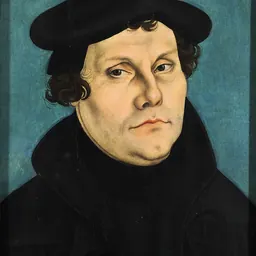
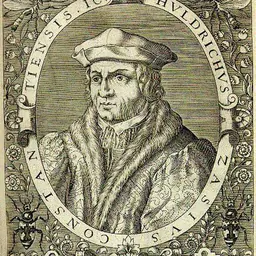

Related people
Same field, nearest in time
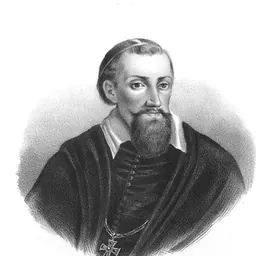

Contemporaries
People whose lives overlapped Thomas Murner's




Frequently asked questions
Who was Thomas Murner?
German writer (1475-1537)
When was Thomas Murner born?
Thomas Murner was born on 24 December 1475 in Obernai.
When did Thomas Murner die?
Thomas Murner died in 1537 in Obernai.
What was Thomas Murner's occupation?
Thomas Murner was a poet, writer, translator, university teacher and catholic priest.
What nationality was Thomas Murner?
Thomas Murner was German.
Sources & further reading
Cite this page
APA: Biography.guide. (2026). Thomas Murner. https://biography.guide/thomas-murner/
MLA: "Thomas Murner." Biography.guide, https://biography.guide/thomas-murner/.
Chicago: "Thomas Murner." Biography.guide. https://biography.guide/thomas-murner/.
Data last updated: 2026-09-26 · Spot an error? Report a correction.
Page generated 2026-09-27 05:15 UTC