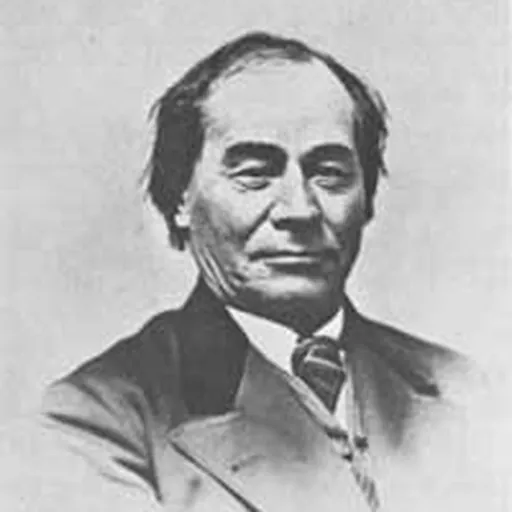
About William Bent
Lived 1809 – 1869 (aged 59). William Bent was an American rancher and merchant.
William Wells Bent (May 23, 1809 – May 19, 1869) was a frontier trader and rancher in the American West, with forts in Colorado. He also acted as a mediator among the Cheyenne Nation, other Native American tribes and the expanding United States. With his brothers, Bent established a trade business along the Santa Fe Trail. In the early 1830s Bent built an adobe fort, called Bent's Fort, along the Arkansas River in present-day Colorado. Furs, horses and other goods were traded for food and other household goods by travelers along the Santa Fe trail, fur-trappers, and local Mexican and Native American people. Bent negotiated a peace among the many Plains tribes north and south of the Arkansas River, as well as between the Native American and the United States government.
In 1835 Bent married Owl Woman, the daughter of White Thunder, a Cheyenne chief and medicine man. Together they had four children. Bent was accepted into the Cheyenne tribe and became a sub-chief. In the 1840s, according to the Cheyenne custom for successful men, Bent took Owl Woman's sisters, Yellow Woman and Island, as secondary wives. He had his fifth child with Yellow Woman. After Owl Woman died in 1847, Island cared for her children. Each of the sisters left Bent and, in 1869, he married the young Adaline Harvey, the educated mixed-race daughter of Alexander Harvey, a friend who was a prominent American fur trader in Kansas City, Missouri. Bent died shortly after their marriage, and Adaline bore their daughter, his sixth child, after his death.
Early years William Wells Bent was born May 23, 1809 St. Louis, Missouri, a son of Silas Bent and his wife, Martha (nee Kerr) Bent. His father was later appointed as a justice of the Missouri Supreme Court. William was one of the Bents' eleven children. The first three were born in Charleston, Virginia, present-day West Virginia and the remaining children were born in St. Louis after the family migrated there.
His uncle (Martha Kerr's brother), James Kerr, served in the Missouri House of Representatives and Missouri State Senate and later led colonization, military, and political matters in Texas.
Three of William's brothers, George, Charles, and Robert, partnered with him in trading with Native Americans in the West. Robert and George died at Bent's Fort (1846 and 1841, respectively). Charles was the oldest son, born in 1799, and the remaining brothers were born in or after 1806. Later based in Santa Fe, Charles Bent lived in Taos. He served briefly as the first territorial governor of New Mexico.
Bent trading empire
Trapping, stockades and trading Charles, George, Robert, and William Bent partnered in the fur trade with Ceran St. Vrain, also a St. Louis native. The city had several major fur trading families. They left Missouri about 1826 to explore what is now southern Colorado along the upper Arkansas River to trap for furs and establish a trade business. Within a couple of years, the Bents and St. Vrain had built two stockades, one near the present town of Pueblo, Colorado and the other stockade either at the mouth of the Purgatoire River, or on the northern side of the Arkansas River. The historian Grinnell suggested that William Bent was likely trapping furs before the first stockade was built. St. Vrain and his older brother, Charles, made the round trips to St. Louis, a regional trading center, to sell furs and return with supplies.
To set up their trading venture, the brothers used a legacy of their father, Judge Silas Bent. The brothers reinvested the substantial profits of their enterprise to develop their business.
Bent's Old Fort
By around 1832, although possibly as late as 1834, the partners built a permanent trading post called Bent's Fort. The elaborate adobe construction could accommodate 200 people, and had been built on the northern "Mountain Route" of the Santa Fe Trail, by then open for business. The partners picked this location after discussions with the Cheyenne;
William and Charles Sometimes referred to as Fort William, the post was in "the perfect place at the perfect time"
The historian Anne Hyde has dated the moment when the Cheyenne chief White Thunder realized a common interest with Bent. In November 1833, they talked together as a meteor shower lit up the sky over the plains. Many Cheyenne believed that the celestial event was a signal of the end of the world; it was subsequently referred to as "the Night the Stars Fell". White Thunder saw it as a new beginning. He sought a truce with the Pawnee and the return of the four sacred arrows which they had captured in a battle with the Cheyenne earlier that year. To achieve this, White Thunder made a solo, unarmed visit to the Pawnee village to seek peace and returned with two of the arrows and an agreement. and he was known as Little White Man by the native tribes.
Life at Bent's Old Fort
The fort, and the area immediately outside it, comprised a multi-cultural, multi-lingual center with permanent inhabitants from many nations and visitors. Native tribes in the area for trading, such as the Sioux, Apache and Kiowa, as well as Comanche and Cheyenne also established temporary camps outside the fort. It was the hub of a trading area that encompassed a radius. It was also a stop each year for hundreds of wagons of European Americans traveling the Santa Fe Trail. Hyde writes in Empires, Nations and Families that
Bent's Fort was the one spot on the Santa Fe trail where exchanges with Indians were welcomed and encouraged, and the effects of those conversations on both sides were far-reaching ... archaeological evidence tells us that people sat in the courtyard together and smoked—a lot".#tag:ref|Archeological surveys have recovered 1526 pipes in the courtyard of the fort alone. As many as 20,000 Native Americans camped near the fort in the fall for seasonal trading.
European-American travelers sometimes stayed for as long as three weeks at the fort before resuming their journeys. From fall through spring, the fort was busy with people coming to trade, and travelers resting and restocking supplies. The Bents had up to 100 employees, depending on the season, who had a variety of skills: clerks, guards, traders, teamsters, trappers, a tailor, blacksmith, carpenter and herders. Caravans took goods to trade with regional Native American tribes.
The fort was usually relatively empty during the summer months. During that period, Bent often made the six-month round trip on the trail to and from Westport, Missouri (present-day Kansas City) to trade the furs and goods gathered over the previous winter. He would purchase goods to replenish the stocks of the fort for the forthcoming hunting season. Westport Landing was an ideal terminus for the Bents' trade. Located on the Missouri River, it was a port for steamboats that hauled goods eastward to St. Louis. Sometimes five or six steamboats would be unloading goods for the Santa Fe trade at one time; dried buffalo meat, buffalo robes and furs would be loaded onto the boats for the return east. Westport was a boom town until a cholera epidemic in the mid-1840s reduced the town's population by 50%. In 1853 Westport was renamed Kansas City. While Bent and the pack trains were away, the fort managed with a skeleton crew of herders, clerks, traders and laborers for Native Americans and travelers.
William and Charles Bent had brought three slaves from St. Louis to work in their households: the brothers Andrew and Dick Green, and Dick's wife Charlotte, who served as a cook. In 1848 Charlotte Green described herself to George Ruxton as "de only lady in de whole damn Injun country". Her cooking won her a high reputation among the fur traders and travelers. One person called her a "culinary divinity". George and William Bent freed Dick Green for his heroic efforts in an Indian revolt in 1847 at Taos, during which their brother Charles was killed. Green had gone north with American soldiers to defend Bent's Taos home. He bravely led a skirmish against a group of Taos Pueblo and other warriors. Green was severely wounded but survived a trip back to Bent's Fort. Also allowing Charlotte Green to leave with her husband, the Bents gave her an informal freedom.
Bent's new fort
Daniel Jenks traveled to Colorado territory in 1859 in search of gold. While there, he made this sketch of Bent's New Fort, which is one of the earliest known images of the fort." Photo courtesy Library of Congress, Prints and Photographs Dept. As the demand for furs declined, business dropped at the fort. An 1849 cholera epidemic among the Cheyenne took the lives of half the tribe, including Tall Woman, Bent's mother-in-law.
Bent wanted to build a new fort closer to Big Timbers, near the winter grounds for many tribes. Unable to agree on a selling price for the old fort, after removing his inventory of goods, Bent blew up and set fire to the old fort. In 1853 he established a stone fort in the Big Timbers area.
Other forts Bent, Vrain & Company had other forts, including Fort Saint Vrain (also called Fort George), built about 1837 near present-day Greeley, Colorado, at the confluence of the South Platte River and St. Vrain Creek. It was the center for trading with the Sioux, Arapaho and Northern Cheyenne. From this point, mail and packages were transported south to Taos. Adobe Walls, built in 1848 for trade with the Comanche, Kiowa and Prairie Apache. This was the site in 1864 of Kit Carson's greatest battle.
Kansas City, Missouri farm On April 6, 1858 In 1871, two years after Bent's death, Adaline sold the Westport farm to Seth Ward, a prosperous businessman. In 1835 Bent married Owl Woman (Mis-stan-stur), the oldest daughter of White Thunder and Tail Woman, in a Cheyenne ceremony. Her father was an influential Cheyenne leader and medicine man. He was the tribe's "Keeper of the Arrows," four arrows thought to have a sacred or medicinal role. The prestige of his position as a medicine man meant that his daughters also had high status.
Owl Woman As a part of the marriage ritual, Owl Woman was carried into a lodge which was constructed for them in the Cheyenne village near the fort, while Bent dispensed numerous gifts to her people. Bent later became a "Cheyenne sub-chief", as he was given tribal membership with his marriage to Owl Woman.
The marriage was important for both Bent and Owl Woman's father White Thunder. For Bent, the marriage reinforced his relationship with the Cheyenne. White Thunder believed the marriage would strengthen his alliance with Bent and provide protection for the Cheyenne. On a personal level, it enhanced his prestige within the tribe.
Owl Woman and Bent had the following children, named in English and Cheyenne: Mary, named for Bent's favorite sister, was born January 22, 1838. Her Cheyenne name was Ho-ka. Robert, named for Bent's youngest brother, was born about 1840–1841. His Cheyenne name was Octavi-wee-his. George, was born July 7, 1843, named after Bent's brother. He was also named Ho-my-ike. He fought with the Dog Soldiers band of Cheyenne warriors after surviving the Sand Creek Massacre. Julia or Um-ah was born in 1847; she was named in English for Bent's oldest sister, and married the French-Cheyenne merchant, rancher and interpreter Edmund Guerrier, whose father William Guerrier worked for Julia's father William Bent.
As a successful man, Bent followed Cheyenne custom and by 1844 took Owl Woman's two younger sisters, Yellow Woman and Island, as secondary wives. He had another son with Yellow Woman: Charles (Charley) was born in 1845. His Cheyenne name was Pe-ki-ree, meaning White Hat.
George, Julia, and Charley all survived the Sand Creek Massacre. After this, Bent destroyed his old fort and built a new stone one at Big Timbers.
Island became the primary caregiver for Owl Woman's children. She did not want to stay in the Bents' new stone fort, nor did she want the children there. In February 1854, she had her lodge moved to just outside the new fort. That winter, William's oldest son George Bent, then age 11, was sent to Kansas City to attend an Episcopal boarding school. In the following years, he was separated from his family for much of the time in order to attend school. Island later left Bent for Joe Baraldo.
In 1864 Yellow Woman also left Bent. She left with their son Charley Bent, then 19, who joined the Dog Soldiers. This group of warriors formed to retaliate for the Sand Creek Massacre that year, when US forces attacked and killed numerous Cheyenne.
Adaline Harvey After Yellow Woman and Island had both left him, Bent married Adaline Harvey, the 20-year-old mixed-race daughter of his friend Alexander Harvey, a fur trader based in Kansas City and a Blackfeet mother. Harvey traded in the Upper Missouri region; his company was named Harvey, Primeau & Company. Adaline Bent inherited her husband's property in Kansas City in 1869 and sold it in 1871.
Family life at Bent's Fort Life at the fort, called the "mud castle of the plains", reflected the heritage of both Owl Woman and Bent. The children's clothes included linen shirts and soft-leather moccasins. They ate on fine china and, according to Cheyenne custom, slept on the ground in soft hides. The furnishings and household goods included items from the United States, Mexico and overseas nations. The children enjoyed pumpkin pie and pancakes made by Charlotte Green, an enslaved cook whose husband was also held by the Bents. Chipita, the French-Mexican wife of a Bent worker, made taffy for the children. She performed housekeeping and laundry services at the fort.
Owl Woman's mother Tall Woman taught the children to be respectful and courteous to their elders. They gave discipline by stern glances and waving fingers. In their multi-cultural environment, the children learned to speak many languages; George learned to speak Cheyenne, English, Spanish, Comanche, Kiowa and Arapaho. The boys learned to ride horses bareback, to hunt and to be warriors. The girls learned to assist in the household, assessing the dryness of wood for gathering, learning to recognize the varieties of berries and other plants, and their uses. Girls were taught to be gracious, generous hosts. Later George Bent recalled of his childhood at the fort:
Something was always going on, and we children had no lack of amusements. In the fall and winter there was always a large camp of Indians just outside the fort – Cheyenne and Arapahos, and sometimes Sioux, Kiowas, Comanches, and Prairie Apaches. While Owl Woman was alive, Bent typically left the fort in April for the six-month supply train roundtrip journey to Missouri. During the summer months, he went back and forth between the fort and the nearby Cheyenne village to see his wife and children. By autumn, the family lived within the fort. Big Timbers – Seasonally the Cheyenne moved down the Arkansas River to Big Timbers.#tag:ref|Bent later built a new fort at this site. His original fort was destroyed in 1849, around the time of the Oklahoma cholera epidemic. During the Cheyenne's winter visit to Big Timbers, Bent accompanied his family there with goods for trading.
Native American relationships and negotiations
Background In the 1820s, the central plains area was subject to political and economic turmoil resulting from the Mexican War of Independence. The Arkansas River delineated the border, with Mexico to the south and the United States northward. The people looked for new opportunities for trade alliances, in part to replace those that had involved the now-deposed Spanish governors. United States settlers and military forces began to arrive in the area as people were exploring the west.
The Native American tribes of the central and southern plains were also defining or redefining their territories. Tribes moved to new lands within the plains for various reasons: they may have been displaced in their previous land, had internal disputes that caused them to relocate, sought better hunting or gathering grounds, or sought land that supported their way of life. The Comanche, Kiowa, Cheyenne and Arapaho were among the competing tribes. The Cheyenne likely moved into the plains in the 17th and 18th century from Minnesota. By the mid-1800s, they lived with the Arapaho north of the Arkansas River near the site later developed as Bent's Fort in Colorado.
The Comanche came to the grasslands of southern plains for a better life but competed for resources and territory with other tribes. In an agreement reached with the Cheyenne, "The Great Peace of 1840", they agreed to stay south of the Arkansas River and the Cheyenne and Arapaho north of it.
Negotiations
The long-settled and the recently settled tribes had different views of the traders, which exacerbated inter-tribal rivalries. In 1833 White Thunder led the Cheyenne into a fight with the Pawnee; his people lost many warriors, and the Pawnee captured the four sacred arrows. White Thunder and his tribe lost much respect as a result.
During the mid-1830s, the Cheyenne and the Arapaho had become eager to work with the incoming trade caravans, and notably those associated with Bent. They saw the trade caravans as an opportunity for enrichment rather than as a threat.
In contrast, the Comanche had resisted traders and other incursions. They had for many years protected their territory to the south of the Arkansas River against almost all who attempted to move into it. They had built up their power with a deep knowledge of their territory, shrewd trading arrangements, and their willingness to raid those who threatened or breached the arrangements. Their grip on the territory to the south of the river was one of the reasons why Bent's Fort had been constructed to the north. Although the Comanche continued to assert their power after Mexican independence, the influx of displaced tribes, the westward push of European-American settlers, and the development of the Santa Fe Trail generated new conflicts. Raids and battles resulted in many fatalities. The Comanche raided the fort and its surroundings north of the river in 1839, provoking a retaliatory raid by the Cheyenne.
Great Peace of 1840, inter-tribal negotiations The trading environment improved after 1840, when Bent's Fort became the site of a truce between the Comanche, Apache and Kiowa tribes of the north and the Cheyenne and Arapaho of the south. Hyde describes this as a "network of enormous significance." The tribes negotiated a peace over several weeks during the summer of 1840.
Bent hosted the various camps and their celebrations. Hyde has said that
George Ruxton described in 1848 how the council room at the fort was used: "Chiefs of the Shain [sic], Kioway and Araphó sit in solemn conclave with the head traders, and smoke the calumet over their real and imaginary grievances."
Treaty of 1861 Black Kettle, chief of the Southern Cheyenne, wanted peace with the United States. He and other chiefs signed a treaty in 1861 which resulted in his tribes being assigned to a reservation along Sand Creek, although the area was nearly devoid of game. White settlers continued to trespass upon Cheyenne land. Unable to feed their families, some Cheyenne begged for food from settlers; others returned to old hunting grounds. Still others raided settlers and wagon trains for food.
Sand Creek Massacre The Pike's Peak gold rush of 1858 led to increasing conflicts. American miners and settlers gradually encroached on Cheyenne lands until fighting broke out in 1864. Black Kettle asked Bent to persuade the Americans to negotiate peace and, briefly, it appeared possible. But, Governor John Evans and Colonel John Chivington (who was planning a run for U.S. Congress) had based their political futures on ending the Native American threat. They had amassed troops from Washington, D.C. Charles, Julie and George Bent were all inside Black Kettle's village when Chivington and his forces arrived.
Regular Army officers were horrified by the massacre at Sand Creek. Both the Congress and Army investigated, and General Ulysses S. Grant called Chivington's actions murder, but no one was punished. The Committee on the Conduct of the War reported:
As part of the treaty, four of Bent's children, as Cheyenne, were each awarded 640 acres land on a reservation south of the Arkansas River, between Red Creek and Buffalo Creek: Mary Bent Moore and her three children: Adia Moore, William Bent Moore and George Moore George Bent Charles Bent (He was later killed by US Indian scouts; in 1869 most of the Dog Soldiers band was killed during the Battle of Summit Springs by Pawnee scouts and US forces.) Julia Bent
William Bent assisted in the negotiation of the treaty with the Kiowa and Comanche on October 18, 1865.
Later years
Las Animas, Colorado ranch In 1869, following his marriage to Adaline Harvey, Bent moved with her to his ranch in Las Animas, Colorado, on the Purgatoire River, south of the Arkansas River. (Note: Source above for the year is the 1869 marriage record, from official records.) From there he managed his freighting business.
Death While on a supply trip from Colorado to Missouri in 1869, Bent stopped off to see his daughter Mary and son-in-law, R. M. Moore, a judge. They had built a house on his ranch land in Kansas City. Contracting pneumonia, Bent died on May 19, 1869. He is interred at the Las Animas Cemetery south of Las Animas, Colorado.
Adaline Harvey Bent gave birth to their daughter, after his death. She lived most of her life in Colorado, where she died February 26, 1905, at the Pueblo Women's Hospital.
Legacy and honors Seth Ward house in Westport, Missouri, on former Bent property; historic marker notes "Bent and Ward Houses" The William Bent house in Westport/Kansas City was preserved as an outbuilding after Seth Ward built a large brick mansion on the property. The property (and houses) is now part of the Country Club District of Kansas City. Much of the former farm's grazing land was taken by the city to create Loose Park. In the twentieth century, both the houses were listed on the National Register of Historic Places. The site is marked as the "Bent and Ward Houses".
Don’t just read it —
keep it.
Full-length biographies made to live with: read them, listen on the way to work, watch them tonight.
- E-book
- Audio
- Video
Instant download · yours to keep · every purchase keeps this site free
Important facts
Family & relationships
People in William Bent's life
Named in this biography and alive at the same time




Related people
Same field, nearest in time
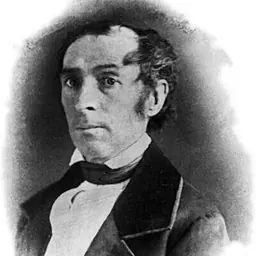


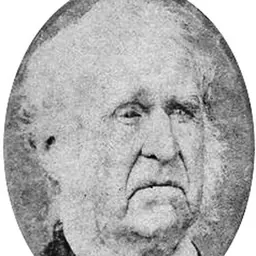

Contemporaries
People whose lives overlapped William Bent's




Frequently asked questions
Who was William Bent?
American rancher (1809–1869)
When was William Bent born?
William Bent was born on 23 May 1809 in St. Louis.
When did William Bent die?
William Bent died on 19 May 1869 in Colorado Territory.
What was William Bent's occupation?
William Bent was a rancher and merchant.
What nationality was William Bent?
William Bent was American.
Sources & further reading
Cite this page
APA: Biography.guide. (2026). William Bent. https://biography.guide/william-bent/
MLA: "William Bent." Biography.guide, https://biography.guide/william-bent/.
Chicago: "William Bent." Biography.guide. https://biography.guide/william-bent/.
Data last updated: 2026-09-22 · Spot an error? Report a correction.
Portrait: Wikimedia Commons · author & licence
Page generated 2026-09-27 04:57 UTC