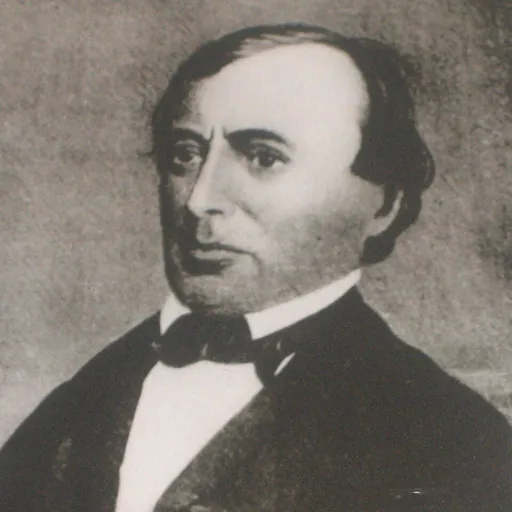
About Charles Bent
Lived 1799 – 1847 (aged 47). Charles Bent was an American politician, businessperson and governor.
Charles Bent (November 11, 1799 – January 19, 1847) was an American businessman and politician who served as the first civilian United States governor of the United States provisional government of New Mexico, newly invaded and occupied by the United States during the Mexican-American War by the Military Governor, Stephen Watts Kearny, in September 1846 until his death.
Bent had been working as a fur trader in the region since 1828, with his younger brother, William, and later partner Ceran St. Vrain. Though his office was in Santa Fe, Bent maintained his residence and a trading post in Taos, New Mexico Territory, in present-day New Mexico. On January 19, 1847, Bent was scalped and killed by Pueblo warriors, during the Taos Revolt.
Early life Charles Louis Bent was born in Charleston, Virginia, the oldest of the ten children of Judge Silas Bent, and his wife Martha Kerr.
The other children were: Juliannah, Joh, Lucy, Dorcas, William, Mary, George, Robert, Edward, and Silas.
Career
U.S. Army and Bent & St. Vrain Company After leaving the army, in 1828, Charles and his younger brother, William, took a wagon train of goods from St. Louis to Santa Fe. There they established mercantile contacts and began a series of trading trips back and forth over the Santa Fe Trail. In 1832, he formed a partnership with Ceran St. Vrain, another trader from St. Louis, called Bent & St. Vrain Company. In addition to its store in Taos, New Mexico, the trading company established a series of "forts", fortified trading posts, to facilitate trade with the Plains Indians, including Fort Saint Vrain on the South Platte River and Bent's Fort on the Arkansas River, both in Colorado, and Fort Adobe on the Canadian River. Bent's Fort, outside La Junta, Colorado, has been restored and is now a National Historic Site.
Territorial Governor Following the occupation of New Mexico as part of the Mexican-American War, many of the inhabitants of New Mexico were not happy about the new American rule. Some mourned the loss of the old connection with Mexico, others feared the loss of their private goods, and others hated Bent, the New Mexican Territorial Governor who served under the U.S. war-time occupation, because of his negative attitude towards Mexicans. In December 1846, the influential families in the state started to plan a revolt against their new rulers. Governor Bent and Colonel Sterling Price found out about the conspiracy and some of the leaders of the movement were arrested, but two important ones were able to escape.
Torture and death In January 1847, while serving as territorial governor, Bent traveled to his home Taos without military protection. After arriving, he was scalped alive and murdered in his home by a group of Hispano and Pueblo attackers during the Taos Revolt. Bent is buried in the National Cemetery in Santa Fe.
Upon entering the Bent home, the insurgents clubbed Bent’s wife Ignacio and shot and killed a Navajo servant girl who lived with Bent’s family as she attempted to protect Ignacio, while other members of the household fled to safety next door through a hole in the parlor wall.
In the following months, Colonel Price was able to quell the uprising, which ended in July 1847. Most of the rebels were caught and some of them were executed.
Personal life In 1835, Charles "Carlos" Bent married Maria Ignacia Jaramillo, who was born in Taos, New Mexico. Maria's younger sister, Josefa Jaramillo, would later marry Kit Carson.
Charles and Maria had five children: Alfred, Estifina, Teresina, George (died as infant), and Virginia (died as infant). Alfred was murdered at Taos on December 9, 1865. Yiorgos Caralambo (a.k.a. Greek George) was allegedly hired as the assassin by people with interests in the Maxwell Land Grant, 1/4 of which Alfred and his two sisters inherited from their father Charles. Lucien B. Maxwell, Charles Beaubien, and Guadalupe Miranda held large other portions of the grant.
Slave Owner Charles Bent owned Charlotte and Dick Green, who worked at Bent's Fort. William Bent freed the couple after Dick fought with the posse that avenged Charles's assassination.
Legacy
Bent Street, which runs in front of what had been his home in Taos, and Martyr's Lane, which runs behind it, are named for him.
The Governor Charles Bent House is now a museum. An elementary school in northeast Albuquerque is named in Bent's honor.
Works Bent documented the indigenous peoples of New Mexico in an essay which was published posthumously in Henry Schoolcraft's study of American Indians:
Don’t just read it —
keep it.
Full-length biographies made to live with: read them, listen on the way to work, watch them tonight.
- E-book
- Audio
- Video
Instant download · yours to keep · every purchase keeps this site free
Important facts
People in Charles Bent's life
Named in this biography and alive at the same time



Related people
Same field, nearest in time



Contemporaries
People whose lives overlapped Charles Bent's






Frequently asked questions
Who was Charles Bent?
American politician (1799-1847)
When was Charles Bent born?
Charles Bent was born on 11 November 1799 in Charleston.
When did Charles Bent die?
Charles Bent died on 19 January 1847 in Taos.
What was Charles Bent's occupation?
Charles Bent was a politician, businessperson and governor.
What nationality was Charles Bent?
Charles Bent was American.
Sources & further reading
Cite this page
APA: Biography.guide. (2026). Charles Bent. https://biography.guide/charles-bent/
MLA: "Charles Bent." Biography.guide, https://biography.guide/charles-bent/.
Chicago: "Charles Bent." Biography.guide. https://biography.guide/charles-bent/.
Data last updated: 2026-09-20 · Spot an error? Report a correction.
Page generated 2026-09-27 05:10 UTC