
About Willem Reuter
Lived 1642 – 1681 (aged 38–39). Willem Reuter was a Belgian painter.
Willem Reuter (c.1642 in Brussels – 1681 in Rome) was a Flemish painter of cityscapes, genre paintings and history paintings who was primarily active in Rome, where he was known as Guglielmo Reuter. He was part of the circle of Dutch and Flemish genre painters in Rome who are referred to as the 'Bamboccianti' and were known for their scenes depicting the lower classes in Rome.
Life
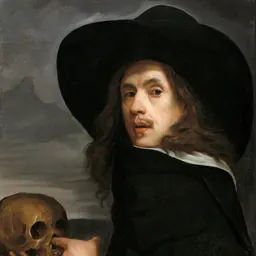
Very little is known about Reuter’s early life in Flanders. He trained with the Brussels painter Michiel Sweerts. Sweerts had lived in Rome for ten years where he had moved into the circle of Flemish and Dutch genre painters around Pieter van Laer who are commonly referred to as the ‘Bamboccianti’. The Bamboccianti brought existing traditions of depicting peasant subjects from sixteenth-century Netherlandish art with them to Italy and generally created small cabinet paintings or etchings of the everyday life of the lower classes in Rome and its countryside.
It is not clear when Reuter travelled to Rome where he resided in the "casa dei pittori fiamminghi" near the Piazza del Popolo.
Work
Only a small number of paintings have been ascribed to Willem Reuter with any level of certainty. His chronology is difficult to determine as he never dated his work. His paintings usually depict market scenes or processions in Roman piazzas and occasionally historic or religious events set in landscape settings. An example of a depiction of a historical event is the Celebration on the Piazza di Spagna, which probably depicts the birth of the Spanish infant Don Carlos in the year 1661 (in the collection of the Academy of Fine Arts Vienna, Vienna in 1992).
Willem Reuter’s Roman panoramic market scene dated 1669 referred to as A Roman market (Norton Simon Museum) is an example of his bustling market scenes. The picture is built up of many different scenes and anecdotes such as a commedia dell’arte performance, a beggar receiving alms and an overturned cart carrying fragile crockery. The carefully orchestrated composition of the work makes each event clearly legible. In particular, the vertically-oriented buildings provide a stable backdrop for the loosely arranged groupings of people placed on the piazza's background to foreground. A strong light helps clarify the figures and their interactions.
His work, although superficially similar to the Bamboccianti in the use of Roman settings populated with many figures, can be distinguished from the paintings of this group of genre painters, as Reuter did not adopt the typology of the Bamboccianti and represents the cityscape more in the form of a veduta. Unlike other Bamboccianti, Reuter paid more attention to the precise rendering of nature. He borrowed from his master Sweerts (who was in turn influenced by Caravaggio) the use of chiaroscuro and a preference for the use of red tones.
He influenced Peeter Bolckman.
Don’t just read it —
keep it.
Full-length biographies made to live with: read them, listen on the way to work, watch them tonight.
- E-book
- Audio
- Video
Instant download · yours to keep · every purchase keeps this site free
Important facts
People in Willem Reuter's life
Named in this biography and alive at the same time
Related people
Same field, nearest in time




Contemporaries
People whose lives overlapped Willem Reuter's




Frequently asked questions
Who was Willem Reuter?
Flemish painter (1642–1681)
When was Willem Reuter born?
Willem Reuter was born in 1642 in Brussels.
When did Willem Reuter die?
Willem Reuter died on 26 September 1681 in Rome.
What was Willem Reuter's occupation?
Willem Reuter was a painter.
What nationality was Willem Reuter?
Willem Reuter was Belgian.
Sources & further reading
Cite this page
APA: Biography.guide. (2026). Willem Reuter. https://biography.guide/willem-reuter/
MLA: "Willem Reuter." Biography.guide, https://biography.guide/willem-reuter/.
Chicago: "Willem Reuter." Biography.guide. https://biography.guide/willem-reuter/.
Data last updated: 2026-09-20 · Spot an error? Report a correction.
Page generated 2026-09-27 05:27 UTC