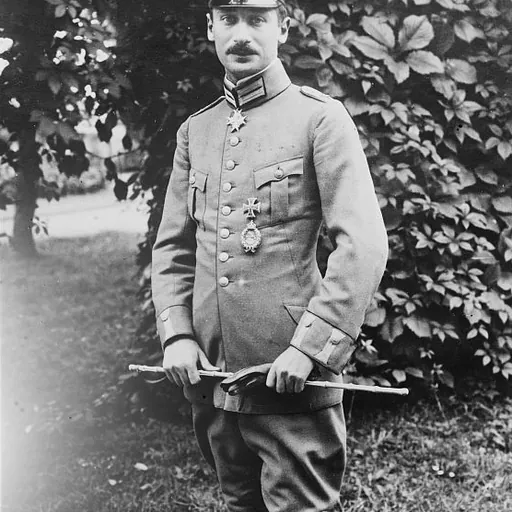
About Wilhelm Frankl
Lived 1893 – 1917 (aged 23). Wilhelm Frankl was a flying ace.
Wilhelm Frankl (20 December 1893 – 8 April 1917), Pour le Mérite, Royal House Order of Hohenzollern, Iron Cross, was a World War I fighter ace credited with 20 aerial victories. He scored his first aerial victory with a carbine on 10 May 1915, before the Fokker Eindecker, the world's first dedicated fighter airplane, came into use. Once Frankl was equipped with an Eindecker, he became part of Germany's air superiority offensive, the Fokker Scourge, shooting down eight more enemy airplanes. He became one of the first eight aces in Germany's service, and one of its first winners of the prestigious Pour le Mérite. As such, he was appointed to lead one of the world's first fighter squadrons, Jagdstaffel 4. Although he died fighting for Germany on 8 April 1917, in later years the Nazis would ignore his wartime conversion to Christianity, and expunge his heroic record because he was Jewish.
Personal life Frankl was born the son of a Jewish businessman in Hamburg on 20 December 1893. He later moved to Frankfurt am Main, and then to Berlin. After he graduated from school, he pursued an interest in flying by attending Germany's hotbed of prewar aviation at Johannisthal. His instructor was Germany's first female pilot, Melli Beese. On 20 July 1913, Frankl earned pilot's license number 49.
The outbreak of World War I sparked Frankl's volunteering to fly for his country. His flying ability and his personality both commended him to his superiors. While his professional life took off, so did his personal life. He fell in love with the daughter of Austrian Naval Kapitän zur See Edmund Stroll. Frankl converted to Christianity and married his love in early 1917. On 1 January 1917, he succeeded to command of the squadron.
Four wins in September and two in October made him a triple ace. In late December 1916, Frankl succeeded to command of Jasta 4. Then, after a six-month hiatus, he scored a quadruple victory on 6 April 1917, and his twentieth win on the following day.
Killed in action Frankl's end came on 8 April 1917. While battling Bristol F.2 Fighters of No. 48 Squadron RFC, his Albatros D.III lost its lower wing under the stress of combat manoeuvres, and he and his collapsed craft fell . He died between the communes of Vitry and Sailly in France. The "Wilhelm-Frankl-Kaserne" is home to the Bundesluftwaffes Taktisches Luftwaffengeschwader 74.
Don’t just read it —
keep it.
Full-length biographies made to live with: read them, listen on the way to work, watch them tonight.
- E-book
- Audio
- Video
Instant download · yours to keep · every purchase keeps this site free
Important facts
Related people
Same field, nearest in time


Contemporaries
People whose lives overlapped Wilhelm Frankl's


Frequently asked questions
Who was Wilhelm Frankl?
German flying ace (1893–1917)
When was Wilhelm Frankl born?
Wilhelm Frankl was born on 20 December 1893 in Hamburg.
When did Wilhelm Frankl die?
Wilhelm Frankl died on 8 April 1917 in Pas-de-Calais.
What was Wilhelm Frankl's occupation?
Wilhelm Frankl was a flying ace.
What nationality was Wilhelm Frankl?
Wilhelm Frankl's recorded nationality: German Reich.
Sources & further reading
Cite this page
APA: Biography.guide. (2026). Wilhelm Frankl. https://biography.guide/wilhelm-frankl/
MLA: "Wilhelm Frankl." Biography.guide, https://biography.guide/wilhelm-frankl/.
Chicago: "Wilhelm Frankl." Biography.guide. https://biography.guide/wilhelm-frankl/.
Data last updated: 2026-09-22 · Spot an error? Report a correction.
Portrait: Wikimedia Commons · author & licence
Page generated 2026-09-27 05:03 UTC