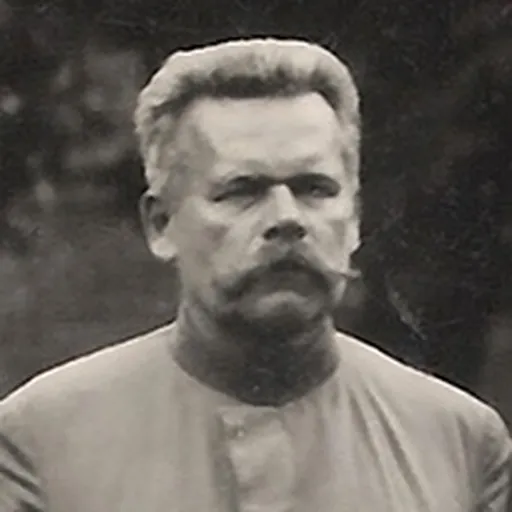
Wilhelm Anderson
Baltic German astronomer and astrophysicist
About Wilhelm Anderson
Lived 1880 – 1940 (aged 59). Wilhelm Anderson was an Estonian and Russian physicist, astronomer, astrophysicist, university teacher and teacher, known for Stoner-Anderson equation and White dwarf.
Wilhelm Robert Karl Anderson ( – 26 March 1940) was a Russian-Estonian astrophysicist of Baltic German descent who studied the physical structure of the stars.
Life Wilhelm Anderson was born in Minsk (now in Belarus) into a Baltic German family. His younger brothers were the well known mathematician Oskar Anderson (1887–1960) and the folklorist Walter Anderson (1885–1962). Anderson spent some of his youth in Kazan, where his father Nikolai Anderson (1845–1905) was a university professor for Finno-Ugric languages.
He studied at the University of Kazan, where he graduated from the department of mathematics and science in 1909. Between 1910 and 1920, he worked as a physics teacher first in Samara and then from 1918 in Minsk. Together with his brother Walter Anderson, he moved to Tartu (Estonia) in 1920. At the University of Tartu, he first gained a Masters degree in Astronomy in 1923 and then a Doctorate in 1927. In 1934 he became a habilitation candidate at the university, and in 1936 he received an assistant professorship there, but early in 1939 he suffered a mental breakdown which left him unable to work. where he died in the Sanatorium of Meseritz-Obrawalde, shortly thereafter. It has been suggested that Anderson may have been a victim of the National Socialist "euthanasia" program. extending Edmund Stoner's earlier work by relativistic amplification (1929, Tartu), The Stoner-Anderson equation of state, a result of Anderson's correspondence with Stoner, is named after him. The white dwarf mass limit was further refined by Subrahmanyan Chandrasekhar and is now known as the Chandrasekhar limit. Die physikalische Natur der Sonnenkorona. PhD Thesis published in six parts in Zeitschrift für Physik (in German): I. Z. Phys. 33, 1925, II. Z. Phys. 34, 1925, III. Z. Phys. 35, 1926, IV. Z. Phys. 37, 1926, V. Z. Phys. 38, 1926, VI. Z. Phys. 41, 1927, Gewöhnliche Materie und strahlende Energie als verschiedene "Phasen" eines und desselben Grundstoffes. Zeitschrift für Physik 54, Berlin, 1929. Über die Grenzdichte der Materie und der Energie. Zeitschrift für Physik 56, Berlin, 1929.
Don’t just read it —
keep it.
Full-length biographies made to live with: read them, listen on the way to work, watch them tonight.
- E-book
- Audio
- Video
Instant download · yours to keep · every purchase keeps this site free
Important facts
People in Wilhelm Anderson's life
Named in this biography and alive at the same time




Related people
Same field, nearest in time


Contemporaries
People whose lives overlapped Wilhelm Anderson's




Frequently asked questions
Who was Wilhelm Anderson?
Baltic German astronomer and astrophysicist (1880-1940)
When was Wilhelm Anderson born?
Wilhelm Anderson was born on 28 October 1880 in Minsk.
When did Wilhelm Anderson die?
Wilhelm Anderson died on 26 March 1940 in Międzyrzecz.
What was Wilhelm Anderson's occupation?
Wilhelm Anderson was a physicist, astronomer, astrophysicist, university teacher and teacher.
What was Wilhelm Anderson known for?
Wilhelm Anderson was known for Stoner-Anderson equation and White dwarf.
What nationality was Wilhelm Anderson?
Wilhelm Anderson was Estonian and Russian.
Sources & further reading
Cite this page
APA: Biography.guide. (2026). Wilhelm Anderson. https://biography.guide/wilhelm-anderson/
MLA: "Wilhelm Anderson." Biography.guide, https://biography.guide/wilhelm-anderson/.
Chicago: "Wilhelm Anderson." Biography.guide. https://biography.guide/wilhelm-anderson/.
Data last updated: 2026-09-22 · Spot an error? Report a correction.
Portrait: Wikimedia Commons · author & licence
Page generated 2026-09-27 05:04 UTC