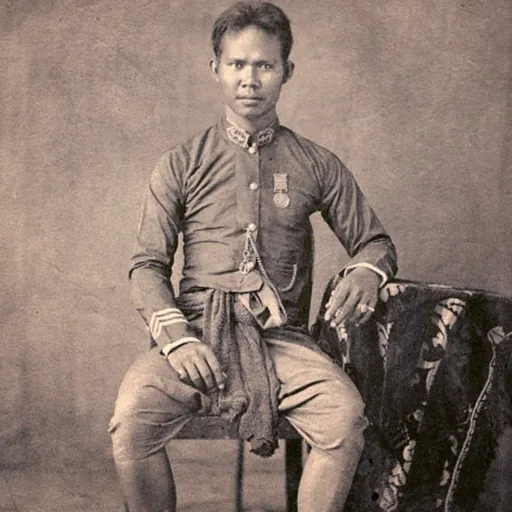
About Wichaichan
Lived 1838 – 1885 (aged 47). Wichaichan was a Thai monarch.
Wichaichan (6 April 1838 – 28 August 1885) was a Siamese prince and member of the Chakri dynasty. He was the eldest son of Viceroy Pinklao and Princess Aim, and thus nephew to King Mongkut (Rama IV). Wichaichan succeeded his father by being appointed the Front Palace and Viceroy of Siam in 1868, during the reign of his cousin King Chulalongkorn (Rama V). During his tenure the office of Front Palace was extremely powerful and rivalled that of the monarch's own. Inevitably the two forces clashed in the Front Palace crisis. Wichaichan was defeated and the power of the Front Palace was greatly diminished. After his death in 1885, the last vestiges of the title were abolished in favour of a crown prince. Notably, he is the only Front Palace that was elected by the council, not appointed by the king in accordance with the royal tradition, which is still considered as controversial and unorthodox practice to this day.
Early life Phra Ong Chao Yodyingyot Bovorn Rachorod Rattana Rachakumarn (พระองค์เจ้ายอดยิ่งประยุรยศบวรราโชรสรัตนราชกุมาร) was born on the 6 April 1838, the eldest son of Prince Chutamani and Princess Aim. It was said that his father gave him an English name in honour of his personal hero, the first President of the United States, George Washington. Therefore, he is sometimes referred to as Prince George Washington or Prince George. In May 1851 Prince Yodyingyot's father was elevated as Second King Pinklao or the Front Palace by his older brother King Mongkut (Rama IV). Pinklao also received from his brother all the styles, titles and honour of a monarch, despite never having been crowned himself.
After King Pinklao's death in 1866, King Mongkut decided not to appoint another Front Palace due to the fact that his own son Prince Chulalongkorn was only 12 years old. This meant that the position which was also that of the heir presumptive was left unoccupied (Siam had no law of succession at the time, but the Viceroy was seen as the strongest claimant). Fearing instability, Chao Phraya Sri Suriwongse (Chuang Bunnag) the Kalahom (one of the Prime Ministers of Siam) tried to persuade the King to appoint Prince Yodyingyot to succeed King Pinklao. Sri Suriwongse was a member of the powerful Bunnag family, which had dominated the running of the Siamese government since the reign of King Phutthaloetla Naphalai (Rama II). The King refused to appoint Yodyingyot, instead he elevated the Prince to Krom Muen Bowon Wichaichan or Prince Bowon Wichaichan in 1867. This meant Wichaichan was only made a Prince of the Front Palace but not the actual title of Front Palace.
Reign
In August 1868 King Mongkut contracted malaria whilst on an expedition to see a solar eclipse in Prachuap Khiri Khan province, six weeks later he died on 1 October. The young Chulalongkorn (who was only 15 years old at the time) was unanimously declared king by a council of high-ranking nobility, princes of the Chakri dynasty and monks.
During the meeting, when one of the princes nominated Wichaichan as the next Front Palace, many in the council objected. The most notable objection of this nomination came from Prince Vorachak Tharanubhab. On 11 November 1868, Wichaichan's cousin Chulalongkorn was crowned Supreme King of Siam at the Grand Palace.
Since the elevation of King Pinklao twenty years earlier, the office of Front Palace had gained considerable amount of power and prestige. The viceroy had his own army of over 2,000 men, western trained and western armed. He also controlled a naval forces of several steam powered gunboats. The prince also had a large share of state revenues, over one-third of which is given directly to him for the maintenance of his officials, retinue, court, concubines, and advisors.
Front Palace crisis Photograph of Prince Yodyingyot, later Bowon Wichaichan. In foreign accounts, The Prince is usually referred to as "Prince George Washington". He was appointed Front Palace in 1868.
When Chulalongkorn came of age in 1873, he and his western-educated brothers were intent on creating a modern absolutist state. Siamese government during previous reigns were dominated by the aristocracy, with many elements of feudalism still in existence. In order to modernize and centralize the state, Chulalongkorn must consolidate the royal government's control over finances and the bureaucracy. First, he created the Auditing Office and then, a year later, the Privy Council of Siam. These two reforms quickly drew the ire of the aristocracy and Wichaichan, whose powers were slowly being eroded.
The conflict between Chulalongkorn and Wichaichan over these reforms erupted in open confrontation, after Wichaichan received an anonymous letter threatening his life. On 28 December 1874, a fire erupted in the Grand Palace. Wichaichan's reluctance to help quell the flames gave Chulalongkorn the excuse he needed to lay siege to the Front Palace. As a result, on the night of 2 January 1875, Wichaichan fled to the British consulate to the south of Bangkok to seek refuge from the king. Negotiations between the two cousins began, however no clear conclusions were reached. With Wichaichan under the impression that his life was in danger, he refused all reconciliation.
By February, the crisis has reached stalemate. Si Suriwongse decided to advise the British acting-Consul to invite an influential person to intervene and end the crisis. Invitations were made to Sir Andrew Clarke the Governor of the Straits Settlements. Clarke arrived in Bangkok on 18 February. After some deliberations with various factions, he decided to support the young king over Wichaichan. On the evening of 24 February, Clarke forced the humiliated Wichaichan to accept Chulalongkorn's terms in full.
The terms of the settlement stripped Wichaichan of all of his powers. He was able to keep only 200 guards of small weaponry and was also forced to abdicate his title of viceroy. In 1881 Wichaichan met King Kalākaua of the Hawaiian Islands, who made a stop in Siam on his world tour. The king noted that Wichaichan was well educated and spoke English fluently.
Death
Wichaichan died on 28 August 1885 at the age of 47. Prince Bovorn Wichaichan was cremated with great ceremony on the field of Sanam Luang on 14 June 1886. The Front Palace compound itself was partly demolished, parts that remain were given to Wichaichan's consorts, daughters and sisters as residences (sons were excluded).
After his death the office of Front Palace was left vacant until On 14 January 1886, when Chulalongkorn's son with Princess Consort Savang Vadhana was made Crown Prince Maha Vajirunhis or Somdet Phra Boromma-orasathirat Sayam Makutrajakuman. The title of Front Palace, which was first created in 1688 by King Petracha of Ayutthaya was thus abolished and replaced with an heir apparent, whose succession is to be based on the principle of male primogeniture. The new invented title brought Siamese succession in line with the European tradition.
Family During his lifetime Wichaichan fathered 28 children with various consorts and concubines. With Chao Chom Manda Prik Lek, he had a son, Prince Karnchananophas Rasmi, the Prince of Chanchai Bovornyod, whose descendants use the surname: Kanchanawichai and with Consort Leam: Prince Rajani Chamcharas, the Prince Bidyalongkorn, whose descendants use the surname: Rajani. One of Prince Rajani Chamcharas' descendants is Mom Chao Bhisadej Rajani, the President of the Royal Projects of King Bhumibol Adulyadej (Rama IX), a grandson of King Chulalongkorn.
Royal titles and decorations
Title
• 1838-unknown : His Serence Highness Prince George Washington Unknown−1867: His Royal Highness Prince Yodying Prayurayot 1867−1868: His Royal Highness Prince Yodying Prayurayot, the Prince Bowon Wichaichan 1868−1885: His Royal Highness The Viceroy of Siam
Decorations Prince Wichaichan received the following honours from the Siamese honour system:
Ancestry
Don’t just read it —
keep it.
Full-length biographies made to live with: read them, listen on the way to work, watch them tonight.
- E-book
- Audio
- Video
Instant download · yours to keep · every purchase keeps this site free
Important facts
Family & relationships
People in Wichaichan's life
Named in this biography and alive at the same time



Related people
Same field, nearest in time

Contemporaries
People whose lives overlapped Wichaichan's


Frequently asked questions
Who was Wichaichan?
Siamese prince (1838–1885)
When was Wichaichan born?
Wichaichan was born on 6 April 1838 in Bangkok.
When did Wichaichan die?
Wichaichan died on 28 August 1885 in Bangkok.
What was Wichaichan's occupation?
Wichaichan was a monarch.
What nationality was Wichaichan?
Wichaichan was Thai.
Sources & further reading
Cite this page
APA: Biography.guide. (2026). Wichaichan. https://biography.guide/wichaichan/
MLA: "Wichaichan." Biography.guide, https://biography.guide/wichaichan/.
Chicago: "Wichaichan." Biography.guide. https://biography.guide/wichaichan/.
Data last updated: 2026-09-22 · Spot an error? Report a correction.
Portrait: Wikimedia Commons · author & licence
Page generated 2026-09-27 05:02 UTC