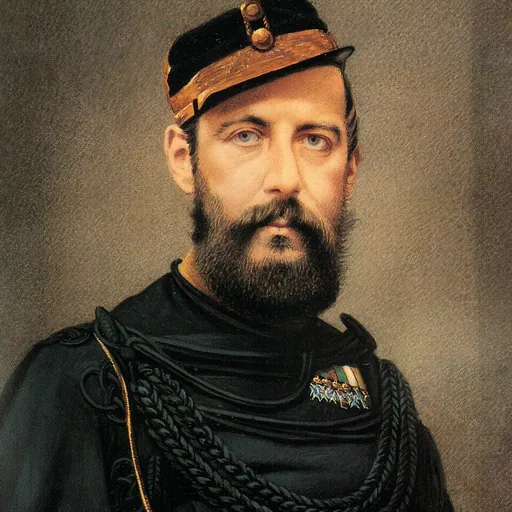
About Carl XV of Sweden
Lived 1826 – 1872 (aged 46). Carl XV of Sweden was a Swedish monarch, painter, poet and military personnel.
Charles XV and IV (Carl Ludvig Eugen; ; 3 May 1826 – 18 September 1872) was King of Sweden and King of Norway, there often referred to as Charles IV , from 8 July 1859 until his death in 1872. Charles was the third Swedish monarch from the House of Bernadotte. He was the first one to be born in Sweden, the first to grow up speaking Swedish as his first language, and the first to be raised from birth in the Lutheran faith.
Biography
Adjutant Daniel Nordlander (upper left), with Adjutant Fritz von Dardel, Ordonnance Officer Ferdinand-Alphonse Hamelin, General Henri-Pierre Castelnau, King Charles XV of Sweden and Prince Oscar, future King Oscar II, at the International Exposition (1867) in Paris, France.
Early life He was born in Stockholm Palace, Stockholm, in 1826 and dubbed Duke of Scania at birth. Born the eldest son of Crown Prince Oscar of Sweden and his wife Crown Princess Josephine, he would be second in line to the throne of his grandfather, the ruling King Charles XIV John. During his childhood he was placed in the care of the royal governess, Countess Christina Ulrika Taube. When he was 15, he was given his first officer's commission in 1841 by his grandfather the king.
Crown Prince The aging King Charles XIV John would suffer a stroke on his 81st birthday in 1844, dying little more than a month later. His successor would be his son, Charles's father Oscar, who ascended the throne as King Oscar I of Sweden and Norway. Upon his father's accession to the throne in 1844, the youth Charles was made a chancellor of the universities of Uppsala and Lund, and in 1853 chancellor of Royal Swedish Academy of Arts. On 11 February 1846, he was made an honorary member of the Royal Swedish Academy of Sciences.
The Crown Prince was Viceroy of Norway briefly in 1856 and 1857. He became Regent on 25 September 1857, and king on the death of his father on 8 July 1859.
Reign
As Crown Prince, Charles's brusque manner had led many to regard his future accession with some apprehension, yet he proved to be one of the most popular of Scandinavian kings and a well-respected follower of the constitution. His reign was appreciated for its manifold and far-reaching reforms. Sweden's existing municipal law (1862), ecclesiastical law (1863) and criminal law (1864) were enacted appropriately enough under the direction of a king whose motto was: Land skall med lag byggas – "With law shall the land be built".
Though known as King Charles XV (15th) in Sweden (and also on contemporary Norwegian coins ), he was actually the ninth Swedish king by that name, as his predecessor Charles IX (reigned 1604–1611) had adopted a numeral according to a fictitious history of Sweden.
Charles, like his father Oscar I, was an advocate of Scandinavianism and the political solidarity of the three northern kingdoms, and his friendship with Frederick VII of Denmark, it is said, led him to give half promises of help to Denmark on the eve of the war of 1864, which, in the circumstances, were perhaps misleading and unjustifiable. In view, however, of the unpreparedness of the Swedish army and the difficulties of the situation, Charles was forced to observe a strict neutrality. On behalf of Charles, Dirk de Graeff van Polsbroek, Dutch diplomat in Japan, concluded a "Vänskaps-, handels- och sjöfartstraktat" ("Friendship, Trade and Maritime Treaty") between Sweden-Norway and Japan on 11 November 1868 (see the Treaty of Yokohama). The treaty opened Hakodate, Yokohama, Nagasaki, Kobe and Osaka to trade for Swedish and Norwegian traders (Article 3). The treaty also gave Sweden-Norway the opportunity to send consuls to the newly opened ports, where they were given the right to exercise jurisdiction over Swedes and Norwegians (consular jurisdiction).
Plagued by ill-health for the last years of his life, Charles succumbed to abdominal tuberculosis in Malmö on 18 September 1872.
He was followed on the thrones of both Norway and Sweden by his brother, crowned Oscar II.
Personal life Charles XV attained some eminence as a painter
Charles's popularity often had him referred to colloquially as "Kron-Kalle" (Crown-Charlie).
Issue By his wife, Louise of the Netherlands, Charles had two children, a son who died in infancy and a daughter who married the King of Denmark. The early death of Charles's only legitimate son meant that he was succeeded on the thrones of Sweden and Norway by his younger brother Oscar II.
Charles also sired an illegitimate son, Carl Johan Bolander (4 February 1854 – 28 July 1903), the father of Bishop Nils Bolander, and daughter, Ellen Svensson Hammar (28 October 1865 – 1931), and it has been widely rumored that Charles had many more extramarital children.
A few weeks before Charles's death, his daughter Louise (then Crown Princess of Denmark) gave birth to her second son, Prince Carl of Denmark. In 1905, Prince Carl ascended to the throne of Norway with the regnal name Haakon VII, thus becoming Charles's successor in that country.
No subsequent king of Sweden to this day is Charles's descendant. However, his descendants are on the thrones of Denmark, Luxembourg, Belgium and Norway.
Honours National decorations Knight and Commander of the Seraphim, with Collar, 3 May 1826 Knight of the Order of Charles XIII, 3 May 1826 Commander Grand Cross of the Sword, 3 May 1826 Commander Grand Cross of the Polar Star, 3 May 1826 Grand Cross of St. Olav, with Collar, 3 May 1826
Foreign decorations Knight of the Elephant, 16 July 1846 Cross of Honour of the Order of the Dannebrog, 22 September 1856 Grand Commander of the Dannebrog, 10 June 1860 Grand Cordon of the Order of Leopold (civil), 16 September 1849 Grand Cross of St. Stephen, 1850 Knight of the Golden Fleece, 26 June 1855 Knight of the Annunciation, 28 July 1861 Duchy of Anhalt: Grand Cross of Albert the Bear, 5 June 1864 Knight of St. Hubert, 1846 Ernestine duchies: Grand Cross of the Saxe-Ernestine House Order, April 1864 French Empire: Grand Cross of the Legion of Honour Médaille militaire Kingdom of Greece: Knight Grand Cross of the Redeemer Grand Cross of the Royal Guelphic Order, 1849 Mexican Empire: Grand Cross of the Mexican Eagle, with Collar, 1865 Knight of the Gold Lion of Nassau, July 1858 Knight Grand Cross of the Netherlands Lion Grand Cross of the Oak Crown Grand Cross of the Sash of the Three Orders Kingdom of Prussia: Knight of the Black Eagle, 1 December 1846 Grand Cross of the Red Eagle Knight of St. Andrew Knight of St. Alexander Nevsky Knight of the White Eagle Knight of St. Anna, 1st Class Beylik of Tunis: Husainid Family Order
Arms
Don’t just read it —
keep it.
Full-length biographies made to live with: read them, listen on the way to work, watch them tonight.
- E-book
- Audio
- Video
Instant download · yours to keep · every purchase keeps this site free
Important facts
more
Charles XV of SwedenFamily & relationships
People in Carl XV of Sweden's life
Named in this biography and alive at the same time


Related people
Same field, nearest in time


Contemporaries
People whose lives overlapped Carl XV of Sweden's





Frequently asked questions
Who was Carl XV of Sweden?
King of Sweden and Norway (1859-1872)
When was Carl XV of Sweden born?
Carl XV of Sweden was born on 3 May 1826 in Stockholm.
When did Carl XV of Sweden die?
Carl XV of Sweden died on 18 September 1872 in Malmö, The Royal Court Parish.
What was Carl XV of Sweden's occupation?
Carl XV of Sweden was a monarch, painter, poet and military personnel.
What nationality was Carl XV of Sweden?
Carl XV of Sweden was Swedish.
Sources & further reading
· Wikipedia: Carl XV of Sweden
Cite this page
APA: Biography.guide. (2026). Carl XV of Sweden. https://biography.guide/carl-xv-of-sweden/
MLA: "Carl XV of Sweden." Biography.guide, https://biography.guide/carl-xv-of-sweden/.
Chicago: "Carl XV of Sweden." Biography.guide. https://biography.guide/carl-xv-of-sweden/.
Data last updated: 2026-09-21 · Spot an error? Report a correction.
Portrait: Wikimedia Commons · author & licence
Page generated 2026-09-27 05:00 UTC