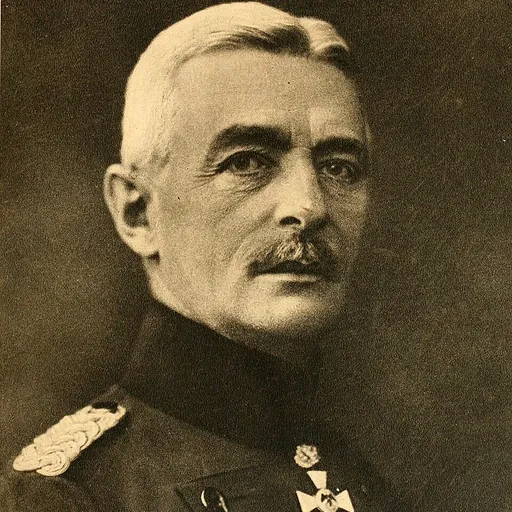
About Walther von Lüttwitz
Lived 1859 – 1942 (aged 83). Walther von Lüttwitz was a politician and military officer.
Walther Freiherr von Lüttwitz (2 February 1859 – 20 September 1942) was a German general who fought in World War I. Lüttwitz is best known for being the driving force behind the Kapp–Lüttwitz Putsch of 1920, which attempted to replace the democratic government of the Weimar Republic with a military dictatorship.
Early life
Lüttwitz was born on 2 February 1859 in the city of Bodland near Kreuzburg O.S. in Upper Silesia, then part of Prussia (now Bogacica, Poland). His father was Ernst von Lüttwitz (1823–1892), an Oberförster ("head forest warden"), Hauptmann (captain) and Deichhauptmann ("overseer of dikes"). His mother was Countess Cecile (1835–1910), the daughter of Count Heinrich Strachwitz von Groß-Zauche und Camminetz.
Military career
Lüttwitz received his military training in 1878–1887, finishing as an officer. He then attended the Kriegsakademie in 1887–1890. Between 1890 and 1912, he served in various army commands. In 1912, Lüttwitz was appointed Oberquartiermeister at the Großer Generalstab (German General Staff). With Emmich's death on 22 December 1915, Lüttwitz was formally named commanding general of the corps, which he led until 20 August 1916.
Kapp–Lüttwitz Putsch
Like many members of the Reichswehr, Lüttwitz was an outspoken opponent of the Treaty of Versailles that was signed in June 1919. He was concerned that the treaty's stipulations could cause the army to disintegrate during its period of re-organisation and he especially disliked the treaty articles that demanded the reduction of the army to 100,000 men, disbandment of the Freikorps, and the extradition of about 900 men whom the Allies accused of war crimes. He planned to defy these stipulations of the treaty. As early as July 1919, Lüttwitz was involved in plots to topple the Weimar Republic and replace the government of Friedrich Ebert with a military dictatorship. On 1 March, it staged a parade without inviting Noske. Their goal was to establish an authoritarian regime (though not a monarchy) with a return to the federal structure of the Empire. Lüttwitz asked them to be ready to take over the government on 13 March. Lüttwitz had not been dismissed, but only suspended from his post on 11 March.
On the morning of 13 March, the Marinebrigade reached the Brandenburger Tor, where it was met by Lüttwitz, Ludendorff, Kapp and their followers. Shortly thereafter, the putschists moved into the Reich Chancellery (Reichskanzlei). Supported by a battalion of the regular Reichswehr, they occupied the government quarter. Kapp declared himself Chancellor (Reichskanzler) and formed a provisional government. Lüttwitz served as commander of the armed forces and Minister of Defence.
Although the putsch received support from military commanders and other conservative and monarchistic groups around the Reich, the rank and file of the bureaucracy mostly refused to cooperate. A general strike, called by the legitimate government, the unions and the parties of the left, paralysed the country and made it impossible for Kapp to govern. After negotiations with those members of the legitimate government who had remained in Berlin, Kapp resigned on 17 March, but Lüttwitz tried to hold on for another day as head of a military dictatorship. When Lüttwitz offered his resignation on 18 March, Vice-Chancellor Eugen Schiffer accepted — granting him full pension rights. Schiffer also suggested Lüttwitz should leave the country until the National Assembly had decided on the question of an amnesty and even offered him a false passport and money.
Later life
After the collapse of the putsch, Lüttwitz first went to Saxony and only later left for Hungary. He used a passport provided by supporters in the Berlin police department. Lüttwitz returned to Germany after an amnesty in 1924. He went back to Silesia and supported the DNVP but was not politically active. In 1931, he called for the creation of the Harzburger Front and in 1933 congratulated Wilhelm Frick on the successful Machtergreifung (take-over) by the NSDAP. His book, Im Kampf gegen die November-Republik was published in 1934.
Personal life
Lüttwitz was married twice. In 1884 at Nimkau, he married Louise (1864–1918), daughter of the Austrian Hauptmann Viktor Graf von Wengersky and Eleonore Gräfin Haller von Hallerstein. In 1921 at Salzburg, he married Adelheid (1869–1956), daughter of Johann Freiherr Sardagna von Meanberg und Hohenstein and Irma von Dorner. With Louise, Lüttwitz had three daughters and a son. His son was Smilo Freiherr von Lüttwitz who served as a General in World War II and in the early Bundeswehr. His daughter Maria married Kurt von Hammerstein-Equord and was mother of Marie Luise von Hammerstein-Equord.
Death
Lüttwitz died on 20 September 1942 in Breslau.
Don’t just read it —
keep it.
Full-length biographies made to live with: read them, listen on the way to work, watch them tonight.
- E-book
- Audio
- Video
Instant download · yours to keep · every purchase keeps this site free
Important facts
People in Walther von Lüttwitz's life
Named in this biography and alive at the same time



Related people
Same field, nearest in time





Contemporaries
People whose lives overlapped Walther von Lüttwitz's


Frequently asked questions
Who was Walther von Lüttwitz?
German general (1859-1942)
When was Walther von Lüttwitz born?
Walther von Lüttwitz was born on 2 February 1859 in Kluczbork.
When did Walther von Lüttwitz die?
Walther von Lüttwitz died on 20 September 1942 in Wrocław.
What was Walther von Lüttwitz's occupation?
Walther von Lüttwitz was a politician and military officer.
What nationality was Walther von Lüttwitz?
Walther von Lüttwitz's recorded nationality: German Reich.
Sources & further reading
· Wikipedia: Walther von Lüttwitz
· DBpedia: Walther von Lüttwitz
Cite this page
APA: Biography.guide. (2026). Walther von Lüttwitz. https://biography.guide/walther-von-luttwitz/
MLA: "Walther von Lüttwitz." Biography.guide, https://biography.guide/walther-von-luttwitz/.
Chicago: "Walther von Lüttwitz." Biography.guide. https://biography.guide/walther-von-luttwitz/.
Data last updated: 2026-09-23 · Spot an error? Report a correction.
Portrait: Wikimedia Commons · author & licence
Page generated 2026-09-27 05:06 UTC