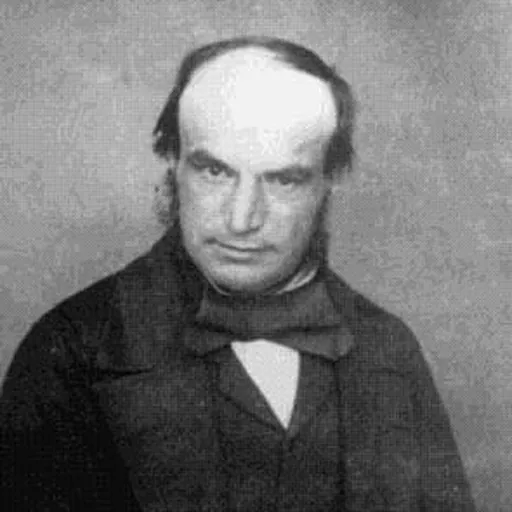
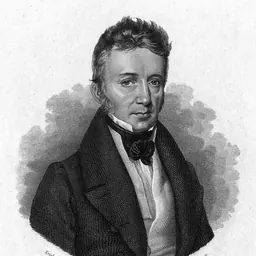
John Couch Adams
English mathematician and astronomer
About John Couch Adams
Lived 1819 – 1892 (aged 72). John Couch Adams was a British mathematician, astronomer and university teacher, known for Discovery of Neptune, Linear multistep method and Tidal acceleration.
Early life
Adams was born at Lidcot, a farm at Laneast, near Launceston, Cornwall, the eldest of seven children. His parents were Thomas Adams (1788–1859), a poor tenant farmer, and his wife, Tabitha Knill Grylls (1796–1866). The family were devout Wesleyans who enjoyed music and among John's brothers, Thomas became a missionary, George a farmer, and William Grylls Adams, professor of natural philosophy and astronomy at King's College London. Tabitha was a farmer's daughter but had received a rudimentary education from John Couch, her uncle, whose small library she had inherited. John was intrigued by the astronomy books from an early age.
John attended the Laneast village school where he acquired some Greek and algebra. From there, he went, at the age of twelve, to Devonport, where his mother's cousin, the Rev. John Couch Grylls, kept a private school.
Discovery of Neptune
In 1821, Alexis Bouvard had published astronomical tables of the orbit of Uranus, making predictions of future positions based on Newton's laws of motion and gravitation. Subsequent observations revealed substantial deviations from the tables, leading Bouvard to hypothesise some perturbing body. Adams learnt of the irregularities while still an undergraduate and became convinced of the "perturbation" theory. Adams believed, in the face of anything that had been attempted before, that he could use the observed data on Uranus, and utilising nothing more than Newton's law of gravitation, deduce the mass, position and orbit of the perturbing body. On 3 July 1841, he noted his intention to work on the problem. It appears that Adams did not regard the question as "trivial", as is often alleged, but he failed to complete a response. Various theories have been discussed as to Adams's failure to reply, such as his general nervousness, procrastination and disorganisation. The search was begun by a laborious method on 29 July.
Adams held no bitterness towards Challis or Airy
In 1852, he published new and accurate tables of the Moon's parallax, which superseded Johann Karl Burckhardt's, and supplied corrections to the theories of Marie-Charles Damoiseau, Giovanni Antonio Amedeo Plana, and Philippe Gustave Doulcet. Later, during the eighteenth century, Richard Dunthorne estimated the rate as +10" (arcseconds/century2) in terms of the resulting difference in lunar longitude, an effect that became known as the secular acceleration of the Moon. Pierre-Simon Laplace had given an explanation in 1787 in terms of changes in the eccentricity of the Earth's orbit. He considered only the radial gravitational force on the Moon from the Sun and Earth but obtained close agreement with the historical record of observations.
In 1820, at the insistence of the Académie des sciences, Damoiseau, Plana and Francesco Carlini revisited Laplace's work, investigating quadratic and higher-order perturbing terms, and obtained similar results, again addressing only a radial, and neglecting tangential, gravitational force on the Moon. Hansen obtained similar results in 1842 and 1847.
In 1853, Adams published a paper showing that, while tangential terms vanish in the first-order theory of Laplace, they become substantial when quadratic terms are admitted. Small terms integrated in time come to have large effects and Adams concluded that Plana had overestimated the secular acceleration by approximately 1.66" per century. In 1856, Plana admitted Adams's conclusions, claiming to have revised his own analysis and arrived at the same results. However, he soon recanted, publishing a third result different both from Adams's and Plana's own earlier work. Delaunay in 1859 calculated the fourth-order term and duplicated Adams's result leading Adams to publish his own calculations for the fifth, sixth and seventh-order terms. Adams now calculated that only 5.7" of the observed 11" was accounted for by gravitational effects. His "definitive orbit" for the Leonids coincided with that of the comet 55P/Tempel-Tuttle and thereby suggested the, later widely accepted, close relationship between comets and meteors.
The post of Astronomer Royal was offered him in 1881, but he preferred to pursue his teaching and research in Cambridge. He was British delegate to the International Meridian Conference at Washington in 1884, when he also attended the meetings of the British Association at Montreal and of the American Association at Philadelphia. 1848 Copley medal of the Royal Society; In 1863 he married Miss Eliza Bruce (1827–1919), of Dublin, who survived him and is buried with him.
Memorials Memorial in Westminster Abbey with a portrait medallion, by Albert Bruce-Joy; A bust, by Joy in the hall of St John's College, Cambridge;
By Adams Adams, J.C., ed. W.G. Adams & R. A. Sampson (1896–1900) The Scientific Papers of John Couch Adams, 2 vols, London: Cambridge University Press, with a memoir by J.W.L. Glaisher: Vol. 1 (1896) Previously published writings; Vol. 2 (1900) Manuscripts including the substance of his lectures on the Lunar Theory. Adams, J.C., ed. R.A. Sampson (1900) Lectures on the Lunar Theory, London: Cambridge University Press
Don’t just read it —
keep it.
Full-length biographies made to live with: read them, listen on the way to work, watch them tonight.
- E-book
- Audio
- Video
Instant download · yours to keep · every purchase keeps this site free
Important facts
People in John Couch Adams's life
Named in this biography and alive at the same time







Related people
Same field, nearest in time

Contemporaries
People whose lives overlapped John Couch Adams's


Frequently asked questions
Who was John Couch Adams?
English mathematician and astronomer (1819–1892)
When was John Couch Adams born?
John Couch Adams was born on 5 June 1819 in Laneast.
When did John Couch Adams die?
John Couch Adams died on 21 January 1892 in Cambridge.
What was John Couch Adams's occupation?
John Couch Adams was a mathematician, astronomer and university teacher.
What was John Couch Adams known for?
John Couch Adams was known for Discovery of Neptune, Linear multistep method and Tidal acceleration.
What nationality was John Couch Adams?
John Couch Adams was British.
Sources & further reading
Cite this page
APA: Biography.guide. (2026). John Couch Adams. https://biography.guide/john-couch-adams/
MLA: "John Couch Adams." Biography.guide, https://biography.guide/john-couch-adams/.
Chicago: "John Couch Adams." Biography.guide. https://biography.guide/john-couch-adams/.
Data last updated: 2026-09-22 · Spot an error? Report a correction.
Portrait: Wikimedia Commons · author & licence
Page generated 2026-09-27 05:04 UTC