
About Walter Rudin
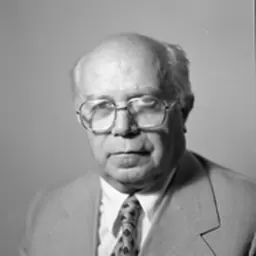
Lived 1921 – 2010 (aged 89). Walter Rudin was an American mathematician and university teacher, known for Complex analysis and Harmonic analysis.
Walter Rudin (May 2, 1921 – May 20, 2010 ) was an Austrian-American mathematician and professor of mathematics at the University of Wisconsin–Madison.
In addition to his contributions to complex and harmonic analysis, Rudin was known for his mathematical analysis textbooks: Principles of Mathematical Analysis, Real and Complex Analysis, and Functional Analysis. Rudin wrote Principles of Mathematical Analysis only two years after obtaining his Ph.D. from Duke University, while he was a C. L. E. Moore Instructor at MIT. Principles, acclaimed for its elegance and clarity,
Rudin's analysis textbooks have also been influential in mathematical education worldwide, having been translated into 13 languages, including Russian, Chinese, and Spanish.
Biography
Rudin was born into a Jewish family in Austria in 1921. He was enrolled for a period of time at a Swiss boarding school, the Institut auf dem Rosenberg, where he was part of a small program that prepared its students for entry to British universities. His family fled to France after the Anschluss in 1938.
When France surrendered to Germany in 1940, Rudin fled to England and served in the Royal Navy for the rest of World War II, after which he left for the United States. He obtained both his B.A. in 1947 and Ph.D. in 1949 from Duke University. After his Ph.D., he was a C. L. E. Moore instructor at MIT. He briefly taught at the University of Rochester before becoming a professor at the University of Wisconsin–Madison where he remained for 32 years. He was awarded the Leroy P. Steele Prize for Mathematical Exposition in 1993 for authorship of the now classic analysis texts, Principles of Mathematical Analysis and Real and Complex Analysis. He received an honorary degree from the University of Vienna in 2006.
In 1953, he married fellow mathematician Mary Ellen Estill, known for her work in set-theoretic topology. The two resided in Madison, Wisconsin, in the eponymous Walter Rudin House, a home designed by architect Frank Lloyd Wright. They had four children.
Selected research articles
"Totally real Klein bottles in
Books Textbooks: (1966; 3rd ed., 1987, 416 pp.)
(1973; 2nd ed., 1991, 424 pp.) Monographs: (1962) (1969) Function Theory in the Unit Ball of . (1980) Autobiography:
Major awards Steele Prize for Mathematical Exposition (1993)
Don’t just read it —
keep it.
Full-length biographies made to live with: read them, listen on the way to work, watch them tonight.
- E-book
- Audio
- Video
Instant download · yours to keep · every purchase keeps this site free
Important facts
People in Walter Rudin's life
Named in this biography and alive at the same time


Related people
Same field, nearest in time


Contemporaries
People whose lives overlapped Walter Rudin's




Frequently asked questions
Who was Walter Rudin?
American mathematician (1921-2010)
When was Walter Rudin born?
Walter Rudin was born on 2 May 1921 in Vienna.
When did Walter Rudin die?
Walter Rudin died on 20 May 2010 in Madison.
What was Walter Rudin's occupation?
Walter Rudin was a mathematician and university teacher.
What was Walter Rudin known for?
Walter Rudin was known for Complex analysis and Harmonic analysis.
What nationality was Walter Rudin?
Walter Rudin was American.
Sources & further reading
Cite this page
APA: Biography.guide. (2026). Walter Rudin. https://biography.guide/walter-rudin/
MLA: "Walter Rudin." Biography.guide, https://biography.guide/walter-rudin/.
Chicago: "Walter Rudin." Biography.guide. https://biography.guide/walter-rudin/.
Data last updated: 2026-09-20 · Spot an error? Report a correction.
Page generated 2026-09-27 05:13 UTC