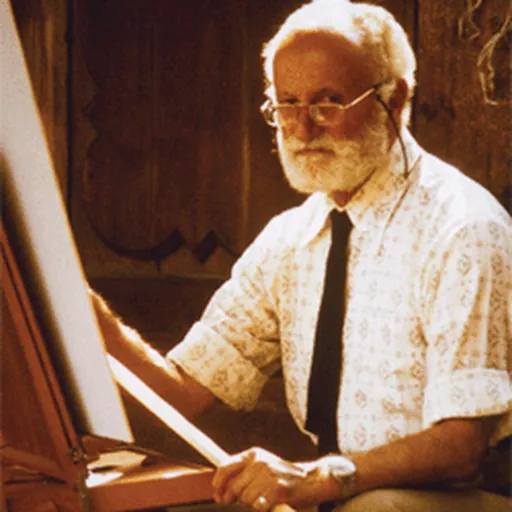
Wahbi al-Hariri
Syrian American artist, architect, archaeologist, and author
About Wahbi al-Hariri
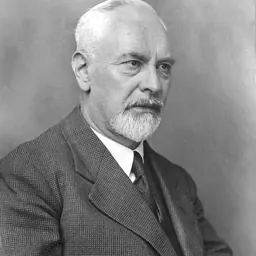
Lived 1914 – 1994 (aged 79–80). Wahbi al-Hariri was a Syrian architect, archaeologist, writer, anthropologist, architectural historian and artist.
Wahbi al-Hariri-Rifai (; 1914 – 16 August 1994) was a Syrian American artist. He was also an accomplished architect, archaeologist, and author. His artwork has garnered international recognition and praise both in his lifetime and posthumously.
He has also been recognized as a significant Middle Eastern cultural pioneer for his role in the "establishment of the foundations of the Plastic arts movement" in the Levant and for mentoring many important Arab artists.
Early life
Family Wahbi al-Hariri was born in 1914 in Aleppo, Syria. His documented family tree spans over fourteen centuries and lists several notable ancestors including Al-Hariri of Basra, the 11th-century poet, philosopher, and linguist known for authoring the Maqamat al-Hariri; Ali al-Hariri-Rifa'i, the 13th-century Sufi theologian known for founding the Syrian Rifai order; Mustapha al-Hariri-Rifai, the 18th-century composer and theologian; and Abdelrahman al-Hariri-Rifai the 19th-century calligrapher and astronomer.
Formative years in Rome Wahbi al-Hariri began drawing and sculpting as a child and had "inherent artistic talent and a consuming interest in the world around him". Recognizing his talent, his father supported his artistic development and encouraged him to travel to Italy in 1932 to formally study art. Al-Hariri was among the first contemporary students from the Middle East to train at the Reale Accademia di Belle Arti in Rome, one of the oldest and most important academies of fine arts in Italy.
In Rome, al-Hariri trained under Carlo Siviero, a prominent Academic artist. Carlo, who was president of the Accademia di San Luca and a member of the Consiglio Superiore di Belle Arti, became al-Hariri's mentor and a lifelong friend; they would remain in touch until Carlo's death in 1953. Al-Hariri also simultaneously studied archaeology and preservation at the Istituto Nazionale di Archeologia e Storia dell'Arte and from 1937 to 1939 participated in archaeological research and study in Greece. The Alta Cultura course that he attended on the island of Rhodes is that of Luigi Pernier fame.
According to notable art critic and author Helen Khal, the years that al-Hariri spent in Italy training were:
... intense and productive. It was academic training at its best, drawing from models, sometimes spending months on one charcoal study, copying the masters in museums, learning everything there was to know about the history and practice of art and archaeology. in Aleppo and also maintained a vibrant studio which also grew to be an intellectual hub. He taught periodic academy-style classes at his atelier, and organized and held gallery exhibitions with other Aleppine artists. There, he also hosted salons that attracted many contemporary philosophers and political thinkers. According to Fateh Moudarres, whose surrealist work has earned international recognition, Al-Hariri was an influential mentor who nurtured Moudarres's formal technique and artistic style as well as enriched Moudarre's worldview:
In addition to teaching and practicing art in Aleppo, al-Hariri also became actively engaged in archeology and was "appointed Inspector General of Historic Monuments and Sites."
According to Amer Moubayyed, an Aleppo historian, Wahbi al-Hariri:
Wahbi al-Hariri was an outspoken critic of the French occupation of Syria and "would often demonstrate against the French such that in March 1941 he was arrested by the French colonial forces and detained for forty days."
In 1954 Wahbi al-Hariri received his architectural DPLG with honors and was awarded the Prix du Meilleur Diplôme by the Société des Architectes Diplômés par le Gouvernement. The award, presented with a medal struck in bronze—which was designed for the société in by Louis Bottée—was bestowed annually upon the preeminent graduating student of architecture. Al-Hariri's Prix du Meilleur Diplôme medal.Other notable winners include British architect Nicholas Grimshaw who was a recipient in 1965.
Return to Syria Shortly after graduating from the Beaux-Arts he won the 1954 international competition for the design of the national broadcast headquarters in Damascus. Later that year he was named architecte en chef, chief architect, of the Directorate-General of Antiquities and Museums in Damascus. During this time, in addition to his art atelier, he maintained a successful architectural practice and organized archaeological and historic preservation initiatives. His architectural work in the 1950s is recognized as influential in contemporary Levant architecture. Alexander Prokhorov cites that " architects such as Wahbi Al-Hariri sought solutions that would reconcile modern industrial designs with national forms." He designed several large projects in the 1950s.
His watercolors and drawings from this period document his numerous trips around the country and "reflect his vision of a region on the verge of dramatic change." The 1964 Lawyers Association Credit Union, in Aleppo, was al-Hariri's last major project in Syria.
In al-Hariri won an important commission to renovate the historic Khalid ibn al-Walid Mosque, in Homs, and design its surrounding plaza. The 1960s in Syria, however, were marked by national unease and political instability and in a military coup caused the cancellation of a large exhibition of his artwork.
As frustrations with the political climate in Syria grew, King Faisal extended al-Hariri an invitation to Saudi Arabia in . The following year al-Hariri moved to the Kingdom and was appointed chief architect of the Ministry for Public Works.
Exploring Arabia
Al-Hariri's first major commission in Saudi Arabia was the design of an extensive master-plan for the new campus of the university in Medina which was executed under his supervision. His design made allowance for future growth and has informed the university's expansions over the years.
In his capacity as chief architect, al-Hariri designed and led projects all over the Kingdom. As he traveled throughout the country, al-Hariri grew increasingly interested in the history and culture of Arabia. After years of travel and research, "Al-Hariri produced a collection of superb drawings that has been hailed as one of the finest records of Saudi Arabia's architectural past", wrote Helen Khal; his "drawings are more than illustrations of old buildings and historical monuments. They reveal a devotional bond between artist and subject in a creative process." The drawings were the product of "intensive travel throughout the kingdom to draw on location. For months at a time, he would travel to remote towns and villages, carrying with him only his art supplies." Wahbi al-Hariri-Rifai and son, Mokhless, Washington, D.C., in 1982.
In , with the completion of his important collection of drawings, a full-size facsimile edition of this collection, titled Traditional Architecture in the Kingdom of Saudi Arabia, was published in Florence, Italy, by Fratelli Alinari Istituto di Edizioni Artistiche with the assistance of al-Hariri's son, Mokhless, a Washington, D.C. architect and also a graduate of the Beaux-Arts.
Al-Hariri, far left, at the Palazzo Strozzi, Florence, 1981, at a book launch presentation organized by his publisher, Fratelli Alinari.
In the massive book was first presented to King Khalid of Saudi Arabia.
Copies of the book can also be found in the collections of The Library of Congress, the Royal Library at Buckingham Palace, the library of Emperor Akihito of Japan, the Bibliothèque nationale de France, as well as several other libraries worldwide. The publication of this hand-printed art collector's folio brought about worldwide recognition of his artistic work. Select drawings were exhibited at several American venues, including the 1982 World's Fair and the Southern Arts Federation. The exhibition tour culminated with a 1984 solo exhibition of the collection at the Smithsonian Institution in Washington, D.C. With it, he became the first living artist to be honored with a solo show at the Smithsonian. The complete collection of drawings, which never before had all been publicly shown, were exhibited from 10 October to 7 November 1984 at the Smithsonian castle.
Esin Atıl explains that "inasmuch as some of the buildings depicted are no longer standing" the significance of the drawings is that they "provide a permanent record of the buildings' existence" and as such they "preserve a historical record of the architecture of Saudi Arabia."
Washington Post critic Benjamin Forgey, whose full-length feature of al-Hariri's exhibit ran on 22 October 1984, writes that:
This period in Saudi Arabia was integral and "he developed his unique style and excelled in the use of graphite." Atil explains that "By mastering this monochromatic medium, he absolved himself from conforming to coloristic expressions." she also remarks that "graphite was at once strong enough to reflect his artistic passion, yet gentle and lyrical enough to express his emotions and spirit."
Books on Saudi Arabia During his time in Saudi Arabia al-Hariri also published two other books that documented Saudi Arabia's culture and heritage, Asir: Heritage and Civilization, published in , and The Heritage of the Kingdom of Saudi Arabia, published in . Both featured "extensive" color photography and were co-authored with al-Hariri's son, Mokhless. and the Atlanta Journal-Constitution.
The Heritage of the Kingdom of Saudi Arabia by Wahbi and Mokhless al-Hariri-Rifai, 1990. The Washington Times review of the book describes that
In , in addition to other international citations and honors, France further recognized his artistic achievements by awarding him the highly regarded distinction of chevalier of the French Ordre des Arts et des Lettres.
Last years
Final work, from Spain to China
With the "active participation of his wife, Widad Marachi and the earnest encouragement H.R.H. Crown Prince Salman bin Abdulaziz, then governor of Riyadh, and numerous dignitaries " he was inspired to travel "from Washington, D.C. to Riyadh, and from Spain to China" to identify and document many significant historic mosques of the world.
"My last meeting with him was one month before his death" writer Lisa Kaaki recalled in an article she wrote for Arab News in 2002; she wrote that she "remembered the unique journey which took him from Spain to China, looking for the most significant mosques in the world." She expressed that she "was both relieved and deeply moved when [she] earned that the drawings of the mosques were part of an exhibition at the National Museum in Riyadh."
Arab Towns Organization The exhibition featured "fifty graphite, watercolor, and pastel drawings depicting the architectural heritage of Saudi Arabia and historic monuments of Washington, D.C."
Many luminaries and high-profile guests attended the exhibition opening. Among those present, Dr. Janet Breslin-Smith, wife of United States ambassador James B. Smith, "expressed her pleasure to participate in the celebration of the works of Arab-American Artist Wahbi Al-Hariri"; she also noted that it was "the first time that the exhibition is held outside the United States of America since its inception in 1984 at Smithsonian Institution in Washington."
Drawing by Wahbi al-Hariri titled Home of Jaber bin Hussein bin Naseeb, Najran, Saudi Arabia, 1981. Graphite on paper. . Princess Adelah bint Abdullah bin Abdulaziz Al Saud, who was active in the exhibition's planning in her capacity as president of the museum's Consultative Committee of the National Museum was also present to officiate the opening. In her remarks she said that "The purpose of having this exhibition at the National Museum is to focus on [Al-Hariri's] artwork which reflects the deep-rooted culture of the Kingdom". "Art also represents the bridge of knowledge that links past and present", she explains, in her preface to the exhibition book, and that al-Hariri, whom she considers "an illustrious name in history's memory", was an artist "who closely observed the world around him and recorded it through his passion for art."
Don’t just read it —
keep it.
Full-length biographies made to live with: read them, listen on the way to work, watch them tonight.
- E-book
- Audio
- Video
Instant download · yours to keep · every purchase keeps this site free
Important facts
People in Wahbi al-Hariri's life
Named in this biography and alive at the same time





Related people
Same field, nearest in time



Contemporaries
People whose lives overlapped Wahbi al-Hariri's


Frequently asked questions
Who was Wahbi al-Hariri?
Syrian American artist, architect, archaeologist, and author (1914–1994)
When was Wahbi al-Hariri born?
Wahbi al-Hariri was born in 1914 in Aleppo.
When did Wahbi al-Hariri die?
Wahbi al-Hariri died on 16 August 1994 in Aleppo.
What was Wahbi al-Hariri's occupation?
Wahbi al-Hariri was an architect, archaeologist, writer, anthropologist, architectural historian and artist.
What nationality was Wahbi al-Hariri?
Wahbi al-Hariri was Syrian.
Sources & further reading
Cite this page
APA: Biography.guide. (2026). Wahbi al-Hariri. https://biography.guide/wahbi-al-hariri/
MLA: "Wahbi al-Hariri." Biography.guide, https://biography.guide/wahbi-al-hariri/.
Chicago: "Wahbi al-Hariri." Biography.guide. https://biography.guide/wahbi-al-hariri/.
Data last updated: 2026-09-20 · Spot an error? Report a correction.
Page generated 2026-09-27 05:09 UTC