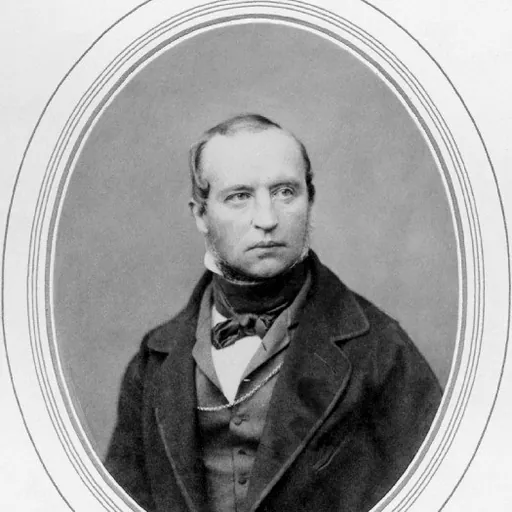
About Vladimir Odoevsky
Lived 1803 – 1869 (aged 65). Vladimir Odoevsky was a Russian writer, philosopher, musicologist, journalist, science fiction writer and music critic.
Prince Vladimir Fyodorovich Odoyevsky (, ; – ) was a Russian philosopher, writer, music critic, philanthropist, and pedagogue. He became known as the 'Russian Hoffmann' and even the 'Russian Faust' on account of his keen interest in phantasmagoric tales and musical criticism.
Biography The last member of the princely House of Odoyev, he was genealogically the most senior member of the House of Rurik. He was born to Prince Fyodor Sergeevich Odoyevsky (1771–1808), a state councillor (statsky sovietnik). His father began his career as an adjutant to Prince Grigory Potyomkin; in 1798 he entered civil service as the director of the Moscow Assignat Bank. According to one version, his mother, Ekaterina Alekseevna Filippova, was a serf; His widow, Avdotya Petrovna, owned a house on Prechistenka Street in Moscow, had several servants, and possessed a modest fortune inherited from her husband. His mother was a well‑educated young woman; she could speak French and play the piano. Odoyevsky finally returned to Moscow in 1861 but continued to serve as a senator until his death. He is buried in the necropolis of the Donskoy Monastery.
Short stories
Aspiring to imitate Ludwig Tieck and Novalis, Odoyevsky published a number of tales for children (e.g., 'The Snuff‑Box Town') and fantastical stories for adults (e.g., 'Cosmorama' and 'Salamandra'), imbued with the vague mysticism in the vein of Jakob Boehme and Louis Claude de Saint-Martin.
Following the success of Pushkin's The Queen of Spades, Odoyevsky wrote a number of similar stories on the dissipated life of the Russian aristocracy (e.g., Princess Mimi and Princess Zizi). On account of his many short stories from the 1820s and 1830s, Odoyevsky should be listed among the pioneers of the impressionistic short story in Europe.
His most mature book was the collection of essays and novellas entitled Russian Nights (1844). Loosely patterned after the Noctes Atticae, the book took two decades to complete. It contains some of Odoyevsky's best‑known fiction, including the dystopian novellas The Last Suicide and The Town with No Name. The stories are interlaced with philosophic conversations reminiscent of the French Encyclopedists.
Musical criticism As a music critic, Odoyevsky set out to propagate the national style of Mikhail Glinka and his followers, denigrating their forebears such as Dmitri Bortniansky. He also wrote a romanticised biography of the Russian violinist Ivan Khandoshkin, whose career he presented as having been thwarted by the malign influence of Italian musicians such as Giuseppe Sarti. Among his many articles on musical subjects, a treatise on old Russian church singing deserves particular attention, though he expressed a strong distaste for strochnoy (early Russian polyphonic) chant, stating: "No human ear could possibly bear the succession of seconds that are constantly to be encountered." Johann Sebastian Bach and Beethoven appear as characters in some of his novellas. Odoyevsky was active in the foundation of the Russian Musical Society, the Moscow Conservatory, and the St. Petersburg Conservatory.
Technology Odoyevsky took part in the development of electroplating technology, invented by Moritz von Jacobi in Russia. In 1844, Odoyevsky published a book, Galvanism Applied in Technology (Гальванизм в техническом применении). He conducted a number of experiments and developed a method for cobalt electroplating.
Works The Year 4338: Petersburg Letters (1835) The Living Corpse (1844)
English translations Russian Nights (translated by Olga Koshansky-Olienikov and Ralph E. Matlaw) (collection of philosophical essays and novellas), 1997. "Princess Mimi" (translated by David Lowe), "The Sylph" (translated by Joel Stern), and "The Live Corpse" (translated by Neil Cornwell) (stories), from Russian Romantic Prose: An Anthology, Translation Press, 1979. The Salamander and Other Stories (stories, translated by Neil Cornwell), Gerald Duckworth, 1992. Two Princesses (novel, translated by Neil Cornwell), Hesperus Press, 2010. Two Days in the Life of the Terrestrial Globe and Other Stories (stories, translated by Neil Cornwell), Ama Classics, 2012.
Don’t just read it —
keep it.
Full-length biographies made to live with: read them, listen on the way to work, watch them tonight.
- E-book
- Audio
- Video
Instant download · yours to keep · every purchase keeps this site free
Important facts
People in Vladimir Odoevsky's life
Named in this biography and alive at the same time



Related people
Same field, nearest in time


Contemporaries
People whose lives overlapped Vladimir Odoevsky's





Frequently asked questions
Who was Vladimir Odoevsky?
Russian writer and philosopher (1803–1869)
When was Vladimir Odoevsky born?
Vladimir Odoevsky was born on 25 August 1803 in Moscow.
When did Vladimir Odoevsky die?
Vladimir Odoevsky died on 27 February 1869 in Moscow.
What was Vladimir Odoevsky's occupation?
Vladimir Odoevsky was a writer, philosopher, musicologist, journalist, science fiction writer and music critic.
What nationality was Vladimir Odoevsky?
Vladimir Odoevsky was Russian.
Sources & further reading
· Wikipedia: Vladimir Odoevsky
Cite this page
APA: Biography.guide. (2026). Vladimir Odoevsky. https://biography.guide/vladimir-odoevsky/
MLA: "Vladimir Odoevsky." Biography.guide, https://biography.guide/vladimir-odoevsky/.
Chicago: "Vladimir Odoevsky." Biography.guide. https://biography.guide/vladimir-odoevsky/.
Data last updated: 2026-09-20 · Spot an error? Report a correction.
Portrait: Wikimedia Commons · author & licence
Page generated 2026-09-27 04:57 UTC