
About Moritz von Jacobi
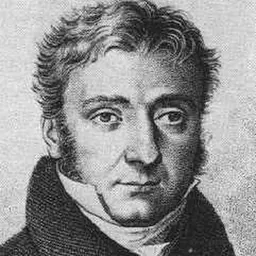
Lived 1801 – 1874 (aged 72). Moritz von Jacobi was a Russian and German physicist, inventor, university teacher and electrotechnician, known for Electric boat, Electric motor and Electrotyping.
Moritz Hermann von Jacobi (; 21 September 1801 – 10 March 1874), also known as Boris Semyonovich Yakobi , was a German-Russian electrical engineer and physicist.
Motors Jacobi began to study magnetic motors in 1834. In 1835 moved to Dorpat (now Tartu, Estonia) to lecture at Dorpat University. He moved to Saint Petersburg in 1837 to research the usage of electromagnetic forces for moving machines at the Russian Academy of Sciences. He investigated the power of an electromagnet in motors and generators. While studying the transfer of power from a battery to an electric motor, he deduced the maximum power theorem. Jacobi tested the output of motors by determining the amount of zinc consumed by the battery. With the financial assistance of Tsar Nicholas I, in 1839 Jacobi constructed a 28-foot electric motor boat powered by battery cells, which carried 14 passengers on the Neva river against the current at three miles per hour.
Jacobi's law
Circuit DiagramCircuit Diagram Power is being transferred from the source, with voltage V and resistance RS, to a load with resistance RL, resulting in a current I. I is simply the source voltage divided by the total circuit resistance
The law known as the maximum power theorem states:
The transfer of maximum power from a source with a fixed internal resistance to a load, the resistance of the load must be the same as that of the source. This law is of use when driving a load such as an electric motor from a battery.
Electrotyping and telegraphy
In 1838 he discovered galvanoplastics, or electrotyping, a method of making printing plates by electroplating. The way this works is analogous to a battery acting in reverse. The stereotype was an impression taken from a form of movable lead type and used for printing instead of the original type. This technique is used in relief printing.
He also worked on the development of the electric telegraph. In 1842-1845 he built a telegraph line between Saint Petersburg and Tsarskoe Selo using an underground cable. In 1867 he was a Russian delegate to the Commission on Measurement Units at the Paris World's Fair. He was a strong proponent of the metric system.
Naval mine In 1853 Jacobi developed the Jacobi naval mine.
The mine was tied to the sea bottom by an anchor, a cable connected it to a galvanic cell which powered it from the shore. The power of its explosive charge was equal to of black powder. Its production was approved by the Committee for Mines of the Ministry of War of the Russian Empire.
In 1854 60 Jacobi mines were laid in the vicinity of the Forts Pavel and Alexander (Kronstadt).
Family Von Jacobi's brother was the mathematician Carl Gustav Jacob Jacobi.
Jacobi was born into an Ashkenazi Jewish family.
Don’t just read it —
keep it.
Full-length biographies made to live with: read them, listen on the way to work, watch them tonight.
- E-book
- Audio
- Video
Instant download · yours to keep · every purchase keeps this site free
Important facts
People in Moritz von Jacobi's life
Named in this biography and alive at the same time

Related people
Same field, nearest in time


Contemporaries
People whose lives overlapped Moritz von Jacobi's





Frequently asked questions
Who was Moritz von Jacobi?
German engineer and physicist (1801–1874)
When was Moritz von Jacobi born?
Moritz von Jacobi was born on 9 September 1801 in Potsdam.
When did Moritz von Jacobi die?
Moritz von Jacobi died on 27 February 1874 in Saint Petersburg.
What was Moritz von Jacobi's occupation?
Moritz von Jacobi was a physicist, inventor, university teacher and electrotechnician.
What was Moritz von Jacobi known for?
Moritz von Jacobi was known for Electric boat, Electric motor, Electrotyping, Jacobi mine and Maximum power theorem.
What nationality was Moritz von Jacobi?
Moritz von Jacobi was Russian and German.
Sources & further reading
· Wikipedia: Moritz von Jacobi
Cite this page
APA: Biography.guide. (2026). Moritz von Jacobi. https://biography.guide/moritz-von-jacobi/
MLA: "Moritz von Jacobi." Biography.guide, https://biography.guide/moritz-von-jacobi/.
Chicago: "Moritz von Jacobi." Biography.guide. https://biography.guide/moritz-von-jacobi/.
Data last updated: 2026-09-20 · Spot an error? Report a correction.
Page generated 2026-09-27 05:28 UTC