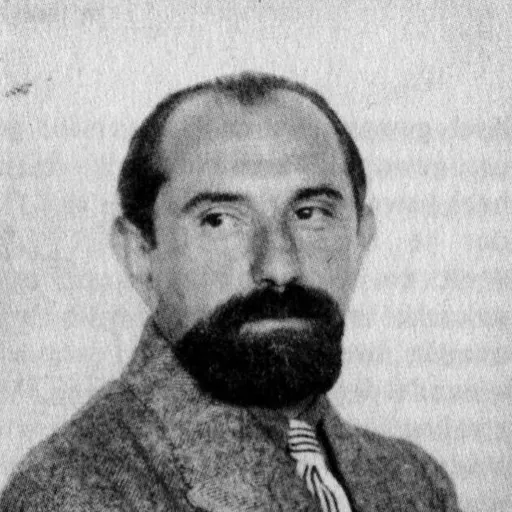
About Vilmos Huszár
Lived 1884 – 1960 (aged 76). Vilmos Huszár was a Dutch and Hungarian painter, resistance fighter, graphic designer, designer, typographer and exlibrist.
Vilmos Huszár (5 January 1884 – 8 September 1960) was a Hungarian painter and designer. He lived in The Netherlands, where he was one of the founding members of the art movement De Stijl.
Huszár was born in Budapest, Hungary. He emigrated to The Netherlands in 1905, settling at first in Voorburg. He was influenced by Cubism and Futurism. He met other influential artists including Piet Mondrian and Theo van Doesburg, both central figures in establishing the De Stijl movement with Huszár in 1917. Huszár also co-founded the De Stijl magazine and designed the cover for the first issue.
In 1918, he devised an interior colour scheme for the boys' bedroom, designed with , in house in Voorburg. From 1920 to 1921 he collaborated with Piet Zwart on furniture designs. He left the De Stijl group in 1923. He collaborated with Gerrit Rietveld on an exhibition interior for the Greater Berlin Art Exhibition. From 1925, Huszár concentrated on graphic design and painting.
In 1926 he created a complete visual identity for Miss Blanche Virginia cigarettes, which included packaging, advertising, and point of sale displays. The concept drew on the imagery associated with the emergent "New Women", or Flappers. The Flappers were perceived as young, single, urban, and employed, with independent ideas and a certain disdain for authority and social norms. The smoking of cigarettes was closely associated with their newfound independence.
Huszár's work was included in the 1939 exhibition and sale Onze Kunst van Heden (Our Art of Today) at the Rijksmuseum in Amsterdam.
The whereabouts of many of Huszár's works are unknown. Many of his paintings and sculptures are only known through photographs that appeared in De Stijl, or from photographs taken by the artist himself. Works that are lost include the Dancing mechanical doll, a device that could adopt several different postures and was used during Dada conferences in the early 1920s.
Huszár died in the Dutch town Harderwijk in 1960.
From 8 March to 19 May 1985 a large Huszár retrospective was held at the Gemeentemuseum in The Hague.
In 2021, a sculpture titled Dutch De Stijl Woman was discovered on eBay by a Hungarian collector who bought it for 95 euros. The finding sparked skepticism among experts on Huszár's body of work, as there were no prior records of sculptures of his. Based on new evidence, art historian Gergely Barki has suggested that the artwork might be a collaborative effort between Huszár and Chris Lanooy, a dutch ceramist. The art first have been displayed on a Parisian "Lost and Found" exhibition.
Don’t just read it —
keep it.
Full-length biographies made to live with: read them, listen on the way to work, watch them tonight.
- E-book
- Audio
- Video
Instant download · yours to keep · every purchase keeps this site free
Important facts
People in Vilmos Huszár's life
Named in this biography and alive at the same time


Related people
Same field, nearest in time



Contemporaries
People whose lives overlapped Vilmos Huszár's
Frequently asked questions
Who was Vilmos Huszár?
Hungarian painter and designer (1884–1960)
When was Vilmos Huszár born?
Vilmos Huszár was born on 5 January 1884 in Budapest.
When did Vilmos Huszár die?
Vilmos Huszár died on 8 September 1960 in Hierden, Harderwijk.
What was Vilmos Huszár's occupation?
Vilmos Huszár was a painter, resistance fighter, graphic designer, designer, typographer and exlibrist.
What nationality was Vilmos Huszár?
Vilmos Huszár was Dutch and Hungarian.
Sources & further reading
Cite this page
APA: Biography.guide. (2026). Vilmos Huszár. https://biography.guide/vilmos-huszar/
MLA: "Vilmos Huszár." Biography.guide, https://biography.guide/vilmos-huszar/.
Chicago: "Vilmos Huszár." Biography.guide. https://biography.guide/vilmos-huszar/.
Data last updated: 2026-09-22 · Spot an error? Report a correction.
Portrait: Wikimedia Commons · author & licence
Page generated 2026-09-27 05:03 UTC