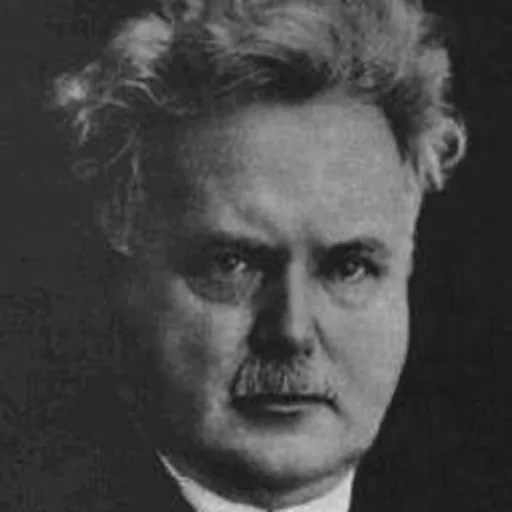
Viktor Dyk
Czech poet, prose writer, playwright, politician and political writer
About Viktor Dyk
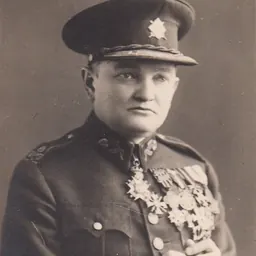
Lived 1877 – 1931 (aged 53). Viktor Dyk was an Austrian and Czech politician, poet, chess player, writer, playwright and journalist.
Viktor Dyk (; 31 December 1877 – 14 May 1931) was a nationalist Czech poet, prose writer, playwright, politician and political writer. He was sent to jail during the First World War for opposing the Austro-Hungarian empire. He was one of the signatories of the Manifesto of Czech writers. Dyk co-founded a political party and entered politics. He died at age 53, leaving his many poems, plays and writings.
Life
Dyk was born in Pšovka u Mělníka in the Kingdom of Bohemia in 1877. His family moved to Prague in 1888 where he began to write. His family settled in the Prague suburb of Vinohrady in 1904 and that year he published a novel titled The End of Hackenschmid which was anti-Austrian. Dyk had taken part in the Czech Chess Championship the year before and he was to remain interested in the game for at least the next twenty years. He was most active in 1913 and seven of his games between 1903 and 1927 are recorded but, of these, only one is a victory.
Viktor Dyk studied at a gymnasium in Prague (one of his teachers was Alois Jirásek). Dyk completed his education at Charles University in Prague where he achieved a law degree. Later, law and politics were to dominate his life.
In 1911, he became involved in politics and joined the Czech Constitutionalist Progressive Party (Státoprávně pokroková strana). He stood for office in the 1911 elections, but received just 205 votes in Vinohrady and placed fourth overall of five candidates.
Dyk together with Franz Kafka spoke of a "Great Wall" which, like the Great Wall of China or the Tower of Babel, became a metaphor for the cultural and linguistic division that they believed was required between Czech and Germanic culture. Dyk wrote in the magazine Lumír, where he was known to state that Bohemia had to become Czech or they should die in the attempt. On April 13, 1913, he composed a tirade in reply to an article published by Franz Werfel. Dyk stated that his group had not built the "Great Wall" as they were not opposed per se to German ideas, however they did see the dangers. Dyk saw no problem with communicating with Germans but he warned against "surrender" to ensure that they did not become "Czech speaking Germans".
During the First World War, he continued to write and he became involved in helping write a libretto for an opera by Leoš Janáček. Janáček's fifth opera, The Excursions of Mr. Brouček to the Moon and to the 15th Century went through a number of librettists and Dyk worked on Janáček's opera which was based on a story by Svatopluk Čech. In 1915 he started working with Vinohrady Theatre. In 1918, he co-founded the Czechoslovak National Democratic Party . In 1907 he became the editor of the magazine Lumír. He was to lead this magazine for the rest of his life. The magazine's followers were known by the same name as the magazine. The writers and artists involved started a new direction in Czech culture. Previously, the culture was seen as coming from Germans and sources in German. For instance, German poets like Heinrich Heine were translated poem by poem from German to Czech. With the emergence of the Lumír group writers like Vrchlický, Dyk himself and Julius Zeyer the focus turned away from German culture. This change of focus is said to have led other Czech intellectuals to also look in this new direction for scientific, economic and social ideas.
His political views were conservative and nationalist and in 1920 he was elected to parliament. In the times of the First Republic of Czechoslovakia, Viktor Dyk was one of the prominent intellectual opponents of President Tomáš Garrigue Masaryk.
Viktor Dyk died of heart failure on 14 May 1931 while swimming in the sea near the island of Lopud, near Dubrovnik in Croatia. He was replaced as senator by Jan Kapras.
There is also a monument to Dyk on the Island of Lopud created by Nikola Dobrović in 1936. The concrete monument is on hill where three paths meet and it was paid for by the former government of Czechoslovakia.
Dyk's book Krysař was the basis for a 2003 film of the same name by director F.A. Brabec. The film was shot in under 24 hours, leading to producers of the film claiming it to be a world record for the fastest-ever film shooting. The same book was also used by Jiří Barta in creating the base story for his 1986 animation The Pied Piper. Barta notes that it is Dyk's book which is the basis of the average Czech's understanding of the Pied Piper story.
Czech President Václav Klaus cited one of Dyk's poems in his 2011 New Year's address to the nation, urging Czech citizens not to emigrate. Klaus's speech was directed at the Czechs who were finding the fiscal restrictions of the economy difficult to bear. Klaus appealed to nationalists with Dyk's suggestion of what the nation would think: "I will survive if you leave me – but without me you will surely die."
Works
Poetry A porta inferi, 1897 Síla života, 1898 Marnosti, 1900 Satiry a sarkasmy, 1905 Milá sedmi loupežníků, 1906 Pohádky z naší vesnice, 1910 Giuseppe Moro, 1911 Zápas Jiřího Macků, 1916 Noci chiméry, 1917 Devátá vlna 1930 Lehké a těžké kroky 1915 Anebo 1917 Okno 1921 Poslední rok 1922
Prose Stud, 1900 Hučí jez a jiné prózy, 1903 Konec Hackenschmidův, (The End of Hackenschmid) 1904 Prosinec, 1906 Prsty Habakukovy, 1906 Píseň o vrbě, 1908 Příhody, 1911 Krysař, 1915, English edition The Pied Piper, Karolinum Press 2018. Tajemná dobrodružství Alexeje Iványče Kozulinova, 1923 Tichý dům, 1921 Zlý vítr, 1922 Prsty Habakukovy, 1925 Můj přítel Čehona, 1925 Dědivadelní hra, 1927 Holoubek Kuzma, 1928 Soykovy děti, 1929
Political literature Ad usum pana presidenta republiky (1929 – criticism of Edvard Beneš and Tomáš Garrigue Masaryk O národní stát (posthumously 1932–1938, 7 books of Dyk's political writing from 1917 to 1931)
Plays Epizoda, 1906 Posel, 1907 Zmoudření Dona Quijota, 1913 Veliký mág, 1914 Zvěrstva, 1919 Ondřej a drak, 1919 Revoluční trilogie, 1921 Napravený plukovník Švec, 1929 – support of Rudolf Medek
Memoirs Vzpomínky a komentáře, 1927
Opera libretto Partially wrote libretto of The Excursions of Mr. Brouček to the Moon and to the 15th Century
Don’t just read it —
keep it.
Full-length biographies made to live with: read them, listen on the way to work, watch them tonight.
- E-book
- Audio
- Video
Instant download · yours to keep · every purchase keeps this site free
Important facts
People in Viktor Dyk's life
Named in this biography and alive at the same time




Related people
Same field, nearest in time



Contemporaries
People whose lives overlapped Viktor Dyk's




Frequently asked questions
Who was Viktor Dyk?
Czech poet, prose writer, playwright, politician and political writer (1877-1931)
When was Viktor Dyk born?
Viktor Dyk was born on 31 December 1877 in Pšovka.
When did Viktor Dyk die?
Viktor Dyk died on 14 May 1931 in Lopud.
What was Viktor Dyk's occupation?
Viktor Dyk was a politician, poet, chess player, writer, playwright and journalist.
What nationality was Viktor Dyk?
Viktor Dyk was Austrian and Czech.
Sources & further reading
Cite this page
APA: Biography.guide. (2026). Viktor Dyk. https://biography.guide/viktor-dyk/
MLA: "Viktor Dyk." Biography.guide, https://biography.guide/viktor-dyk/.
Chicago: "Viktor Dyk." Biography.guide. https://biography.guide/viktor-dyk/.
Data last updated: 2026-09-23 · Spot an error? Report a correction.
Portrait: Wikimedia Commons · author & licence
Page generated 2026-09-27 05:05 UTC