
About Victor Soultanbeieff
Lived 1895 – 1972 (aged 76). Victor Soultanbeieff was a Russian and Belgian chess player.
Victor Ivanovich Soultanbéieff (; 11 November 1895 – 9 February 1972) was a Russian and Belgian chess master.
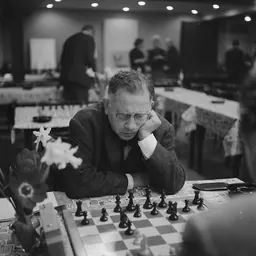
Life An illustration from Internationaal Schaaktournooi Zaanstreek 1946 by W.A.T. Schelfhout and C. Kottnauer (Amsterdam, 1946) Born in Yekaterinoslav, Russian Empire (now Ukraine), Soultanbéieff learned to play chess rather late, but he improved fast. In 1914 he won the city championship. In World War I, he fought in the Russian army. In 1918 he won the city championship again. After the Bolshevik Revolution, in 1920, he moved to Gallipoli with the army of Pyotr Nikolayevich Wrangel. At the end of 1921 he sought asylum in Belgium. After a short stay in Brussels he moved to Liège, where he would stay for the rest of his life.
In 1923 he participated for the first time in the Belgian Chess Championship, a championship which he would win 5 times; in 1932 (jointly with Boruch Israel Dyner), 1934, 1943, 1957, and 1961. In 1923 he finished 4th, but impressed with his play. He had to combine chess with his work, which resulted in a low number of international tournaments and sometimes bad playing conditions. Nevertheless, he participated in some important tournaments like Hastings International Chess Congress and the Hoogovens tournament.
Soultanbéieff was made a national master in 1931 and International Arbiter in 1964.
Chess
Playing style Soultanbéieff was known for his aggressive playing style, which sometimes resulted in short, brilliant games, but which sometimes led to unnecessary defeat. Some of his games are still famous like his games against Liubarski, 1928 or Borodin, 1943. Unlike many other players, Soultanbéieff stayed true to his attacking style when he grew old.
Tournament record Although he had won a few tournaments in Russia, his chess career only took off when he came to Belgium. He participated in a total of 22 Belgian championships between 1923 and 1969. He won it 5 times (1932 (shared with Boruch Israel Dyner), 1934, 1943, 1957*, 1961*), took 3 times 2nd place (1938 (Shared with Arthur Dunkelblum), 1945*, 1958*) and one time 3rd place (1962). (Tournaments marks with * were FBE-championships.)
Due to his professional activities, international tournaments were rare. Nevertheless, he achieved some remarkable results, which are contained in the following table:
Being one of the best Belgian players of his time, he represented Belgium on various occasions, notably on the 1933 Chess Olympiad in Folkestone. Playing on 1st board, he achieved 4/14, including a victory over Savielly Tartakower.
During his long career, Soultanbéieff played a few short matches. His most notable results in this category were a drawn match against Arthur Dunkelblum (1932; +1−1=2), a drawn match against Georges Koltanowski (1935; +1−1=2) and a lost match against Paul Devos (1946; +1−2=3).
Correspondence chess Soultanbéieff was a gifted correspondence player too, although again, his professional activities left not much time for this. He started playing correspondence chess tournaments when he was still in Russia. He became first a member, later an honorary member of the EB/BS. He played 1st board for Belgium I in the first correspondence chess Olympiad, scoring 3/6. Another notable result was a drawn match against Aleksandras Machtas, future champion of Lithuania.
Writing Like many chess players, Soultanbéieff also wrote about chess. He wrote a chess column for various local newspapers and collaborated with many outstanding chess periodicals like Shakmati Listock (later Shakhmaty v SSSR), l'Échiquier Belge and Échec et Mat. He wrote a book on the world championship match between José Raúl Capablanca and Alexander Alekhine, which appeared in 1929, published by l'Échiquier editions. He commented the games of the Ostend 1936 tournament for the tournament book and published a collection of his own games under the title Guide pratique du jeu des combinaisons, which was later reprinted as Le Maître de l'attaque.
Don’t just read it —
keep it.
Full-length biographies made to live with: read them, listen on the way to work, watch them tonight.
- E-book
- Audio
- Video
Instant download · yours to keep · every purchase keeps this site free
Important facts
People in Victor Soultanbeieff's life
Named in this biography and alive at the same time



Related people
Same field, nearest in time
Contemporaries
People whose lives overlapped Victor Soultanbeieff's


Frequently asked questions
Who was Victor Soultanbeieff?
chess master (1895–1972)
When was Victor Soultanbeieff born?
Victor Soultanbeieff was born on 11 November 1895 in Dnipro.
When did Victor Soultanbeieff die?
Victor Soultanbeieff died on 9 February 1972 in Liège.
What was Victor Soultanbeieff's occupation?
Victor Soultanbeieff was a chess player.
What nationality was Victor Soultanbeieff?
Victor Soultanbeieff was Russian and Belgian.
Sources & further reading
· Wikipedia: Victor Soultanbeieff
· DBpedia: Victor Soultanbeieff
Cite this page
APA: Biography.guide. (2026). Victor Soultanbeieff. https://biography.guide/victor-soultanbeieff/
MLA: "Victor Soultanbeieff." Biography.guide, https://biography.guide/victor-soultanbeieff/.
Chicago: "Victor Soultanbeieff." Biography.guide. https://biography.guide/victor-soultanbeieff/.
Data last updated: 2026-09-27 · Spot an error? Report a correction.
Page generated 2026-09-27 05:17 UTC