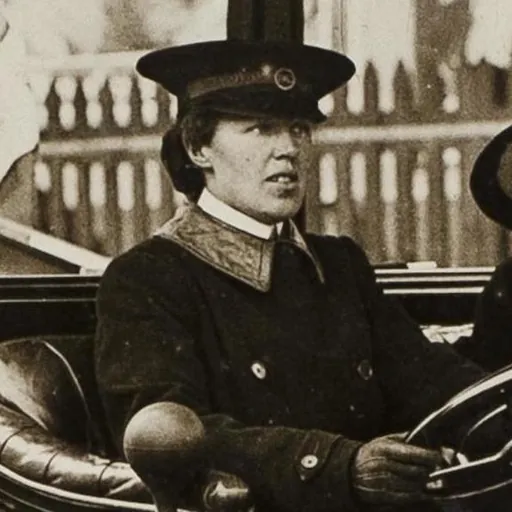
About Vera Holme
Lived 1881 – 1969 (aged 87). Vera Holme was a British stage actor, chauffeur, suffragette, opera singer and actor.
Vera Louise Holme, also known as Jack Holme (29 August 1881 – 1 January 1969), was a British actress and a suffragette. Born in Lancashire, she began working as a touring male impersonator when her parents could no longer support her. A talented violinist and singer, she also was a member of the chorus of the D'Oyly Carte Opera Company and later became a member of the Pioneer Players. After joining the Actresses' Franchise League, she became involved in the women's suffrage movement. She became the Pankhursts' chauffeur and the first professional woman driver in London.
With the outbreak of World War I Holme joined her partner Evelina Haverfield in the Women's Volunteer Reserve. In 1915 they went to Serbia with the Scottish Women's Hospitals for Foreign Service (SWH) as an ambulance driver and head of their transport services. When the Central Powers invaded Serbia, she and Haverfield refused evacuation to stay with their patients. They were arrested and held as prisoners of war for several months, but after they were released, they returned to work in SWH units in Romania and Russia. At the end of the war, she was honoured with medals by both Russia and Serbia, and returned to Serbia where she helped establish and run an orphanage from 1919 to 1922.
In 1923, Holme returned to Britain and began to perform again, moving to Scotland with two fellow veterans of the SWH. She and her ménage à trois partners, Margaret Greenlees and Margaret Ker, lived together in a home in Lochearnhead, until Ker moved out in 1939. Holme became a speaker and lecturer for the Women's Rural Institutes and also managed and produced plays in the region. She remained in a relationship with Greenlees until the latter died in 1952.
Holme died in Glasgow in 1969. Her archive is held by the Women's Library at the London School of Economics. Having continued correspondence for many years with her colleagues from the SWH, her papers give evidence of and insight into lesbian lives in the interwar period in both Britain and Serbia.
Early life Holme was born on 29 August 1881 in Birkdale, Lancashire, England. Her parents were Mary Louisa (née Crowe) and Richard Holme. Her father was a middle class timber merchant. Most of Holme's youth was spent in Lancashire, but she attended a convent school abroad, likely in France. Her parents separated when she was a teenager and her mother remarried. Her father periodically gave her an allowance, but because she had no regular income, Actresses in the Victorian Age had been strictly confined to roles reinforcing binary gender presentations to uphold moral norms. She toured with travelling theatrical companies for several years and had no permanent address. performing until 1915. After the war, she returned to theatre work,
Women's suffrage Holme, who Sylvia Pankhurst described as "a noisy, explosive young person, frequently rebuked by her elders for lack of dignity" became involved in the militant suffrage campaigning group the Women's Social and Political Union (WSPU). The WSPU staged controversial actions, preferring extremist challenges to create societal change. One such escapade involving Holme was when she hid in the large organ at Colston Hall, Bristol in May 1909. She waited there overnight with Elsie Howey with the objective of shouting "Votes for Women" at a political address by Liberal Party MP Augustine Birrell the next day. Their actions were commemorated in a poem, "An Organ Record", written by Holme and published in that month's issue of Votes for Women. By the end of the year, Pankhurst had changed her opinion of Holme, she became the official chauffeur of the leaders of the WSPU, Emmeline Pankhurst and Emmeline Pethick-Lawrence, sporting a uniform and a short hair style.
An accomplished horsewoman, Holme often rode astride when leading suffrage parades. In 1910, she led one such parade in London with Flora Drummond and Evelina Haverfield. In 1910, Holme and Haverfield, along with scientist Alice Laura Embleton, known as Alick, and her partner Celia Wray, set up the private Foosack League between themselves. The membership was restricted to women and suffragists; the internal evidence suggests the Foosack League was a lesbian secret society. Becoming close friends, Holme wrote letters to Embleton and Wray, particularly during World War I. When Britain entered the war, all of the women involved in striving for the vote, temporarily changed their focus to the war effort. They believed that their support and participation would prove their worth as citizens. They arrived in the Kingdom of Serbia in the spring of 1915, and made friendships with local military doctors and officers. When the Central Powers invaded Serbia at the end of the year, most of the SWH personnel were evacuated, but Holme and Haverfield refused to leave their wounded patients. where they met .
Holme joined Haverfield in Serbia in 1919, and before creating the new orphanage, they reorganised an existing orphan's facility in Užice. Once that was completed, they founded the orphanage at Bajina Basta. There they were joined by other veterans of the SWH, Onslow, Margaret Greenlees, and Margaret Ker. Holme, Onslow, Greenlees, and Ker took in and raised sixty orphans. They lived in a house they named (Sunny Burn), located on Glen Ogle. She performed at the Barn Theatre in Small Hythe, where memorial productions were given annually for Ellen Terry by Craig. The Barn Theatre also feted Holme on her birthday in 1935 and 1936. She and Craig maintained a lifelong friendship, and her threesome spent time with Craig and her ménage à trois partners Christabel Marshall and Clare Atwood. In 1941, Holme broadcast a memorial talk in honour of Elsie Inglis on the BBC Home Service. After Ker's departure, Holme and Greenlees were a couple until Greenlees died in 1952.
Death and legacy Holme died on 1 January 1969 in Glasgow from arteriosclerosis and kidney failure. Her archive is held at the Women's Library at the LSE, which contains both her papers and a large collection of photographs. Her correspondence with Rojc and the women of the SWH, which took place over decades, provides tangible proof of queer history in both Serbia and Britain and has offered scholars clues to historic terminology and codes used by lesbians in their relationships. Scholars Catherine Baker and Olga Dimitrijević said that analysing the letters also has the potential to change what is known about British lesbians and their circles in the interwar period. Johnstone painted Holme's likeness in two oil paintings and one black and white chalk image. One of the oils Lady in Black with Tulips (1919) is in a collection in Australia.
Don’t just read it —
keep it.
Full-length biographies made to live with: read them, listen on the way to work, watch them tonight.
- E-book
- Audio
- Video
Instant download · yours to keep · every purchase keeps this site free
Important facts
Family & relationships
People in Vera Holme's life
Named in this biography and alive at the same time


Related people
Same field, nearest in time
Contemporaries
People whose lives overlapped Vera Holme's



Frequently asked questions
Who was Vera Holme?
British stage actress (1881–1969)
When was Vera Holme born?
Vera Holme was born on 29 August 1881 in Birkdale.
When did Vera Holme die?
Vera Holme died on 1 January 1969 in Glasgow.
What was Vera Holme's occupation?
Vera Holme was a stage actor, chauffeur, suffragette, opera singer and actor.
What nationality was Vera Holme?
Vera Holme was British.
Sources & further reading
Cite this page
APA: Biography.guide. (2026). Vera Holme. https://biography.guide/vera-holme/
MLA: "Vera Holme." Biography.guide, https://biography.guide/vera-holme/.
Chicago: "Vera Holme." Biography.guide. https://biography.guide/vera-holme/.
Data last updated: 2026-09-22 · Spot an error? Report a correction.
Portrait: Wikimedia Commons · author & licence
Page generated 2026-09-27 05:02 UTC