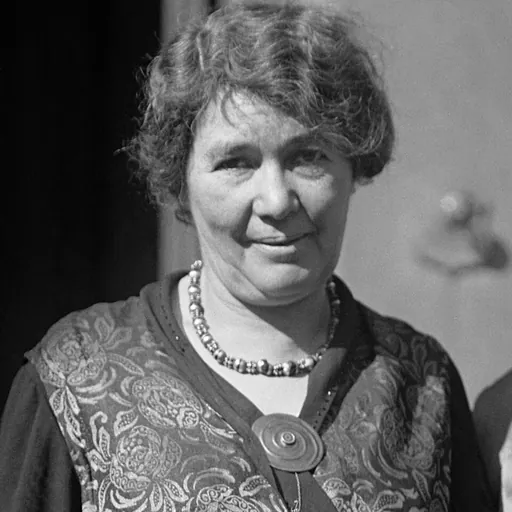
Emmeline Pethick-Lawrence
British women's rights activist, editor
About Emmeline Pethick-Lawrence
Lived 1867 – 1954 (aged 86). Emmeline Pethick-Lawrence was a British journalist, suffragette, women's rights activist, editor, pacifist and feminist, known for Votes for Women (newspaper) and Women's suffrage.
Emmeline Pethick-Lawrence, Baroness Pethick-Lawrence (née Pethick; 21 October 1867 – 11 March 1954 ) was a British women's rights activist, suffragist and pacifist. She was a leading member and treasurer of the Women's Social and Political Union (WSPU), organised WSPU's first Week of Self-Denial and founded and edited the publication Votes for Women. She was ousted from the WSPU for her opposition to more militant action and founded the United Suffragists. She was one of the first members of the Women's International League for Peace and Freedom (WILPF) and she led a campaign against the naval blockade on Germany during World War I.
Early life Pethick-Lawrence was born in 1867 in Clifton, Bristol as Emmeline Pethick. of Cornish farming stock, and her younger sister, Dorothy Pethick (the tenth child), was also a suffragist.
Pethick was sent away to the Greystone House boarding school in Devizes, Wiltshire, at the age of eight. She was then educated at private schools in England, France and Germany.
Early career From 1891 to 1895, Pethick worked as a "sister of the people" for the West London Methodist Mission at Cleveland Hall, near Fitzroy Square, having been inspired by Walter Besant's book The Children of Gibeon (1886).
In 1895, she and Neal left the mission to co-found the Espérance Club, with support from the evangelical Christian socialist Mark Guy Pearse. Pethick also started Maison Espérance, a dressmaking cooperative with a minimum wage, an eight-hour day and a holiday scheme,
Marriage
Pethick met wealthy barrister Frederick William Lawrence in 1899 They moved to Holmwood, near Dorking and also shared a London flat. On their first wedding anniversary, Frederick gave her the key to a private flat on the roof of Clement's Inn for her own private use. Back in Britain, Pethick-Lawrence became a member of the Suffrage Society and was introduced to Emmeline Pankhurst by politician Keir Hardie in 1906. Pethick-Lawrence became treasurer of the Women's Social and Political Union (WSPU), which Pankurst had founded in 1903, and raised £134,000 over six years. Her husband and Keir Hardie also donated funds to pay off the organisations debts and she insisted that her friend and chartered accountant Alfred Sayers be appointed to audit the WSPU finances. She also participated in the aborted visit to the Prime Minister in late June 1908, along with Jessie Stephenson, Florence Haig, Maud Joachim and Mary Phillips, after which there was some violent treatment of women protestors, and a number of arrests.
In 1908, together with Beatrice Sanders and Mrs Knight, Pethick-Lawrence organised WSPU's first Week of Self-Denial, where supporters of the suffragette movement were asked to go without certain necessities for a week, donating the money saved to the WSPU. She chose the suffragette campaigning colours of purple, white and green.
Pethick-Lawrence spoke at the Women's Sunday at Hyde Park on 21 June 1908, alongside Flora Drummond, Gladice Keevil, Edith New, Emmeline Pankhurst, Christabel Pankhurst, Adela Pankhurst, and other activists. and on 23 April 1909 she planted a tree at "Annie’s Arboretum." Emily Blathwayt wrote in her diary that "it was a beautiful day for tree planting." She was arrested again in November 1911. It was adopted as the official newspaper of the Women's Social and Political Union (WSPU), already the leading militant suffragette organisation in the country. thumb In April 1913, Frederick Pethick-Lawrence was made bankrupt after he refused to pay the £900 costs of the prosecutions of Emmeline Pethick-Lawrence, himself and Emmeline Pankhurst in the Old Bailey for conspiracy to commit property damage. The Irish Times noted that "this step does not mean that Mr Pethick-Lawrence is insolvent, because he is a wealthy man. The government sent bailiffs to the Pethick-Lawrence's homes and when their belongings were auctioned most of their possessions were bought back by friends and supporters. After being released from prison, the Pethick-Lawrences recuperated with Emmeline’s brother in Canada. Her sister Dorothy Pethick also left the WSPU in protest at their treatment, having previously taken part and been imprisoned for militant action. The Suffragette replaced Votes for Women as the paper of the WSPU.
Pacifism and election campaigns Pethick-Lawrence, left, with Women at the Hague in 1915, including Jane Addams and Annie E. Molloy The Pethick-Lawrences and the Pankhurts also had opposing views on war. Pethick-Lawrence described peace as "the highest effort of the human brain applied to the organisation of the life and being of the peoples of the world on the basis of cooperation." In 1914, she embarked on a speaking tour in America, speaking on the outbreak of World War I, the impact of war on women and feminist pacifism.
In April 1915, Aletta Jacobs, a suffragist in the Netherlands, invited suffrage members from around the world to an International Congress of Women in The Hague. Pethick-Lawrence was one of the three female British attendees. As a pacifist, Pethwick-Lawrence was amongst the women who encouraged Jane Addams to take leadership over the peace movement in America, along with Carrie Champan Catt and Rosika Schwimmer.
When back in England, she led a campaign against the naval blockade on Germany.
In 1919, when women were first permitted to stand in elections, Pethick-Lawrence stood as a Labour candidate for Rusholme in Manchester. She was not elected,
Later years
In 1938, Pethick-Lawrence published her memoirs, My Part in a Changing World, which discussed the radicalisation of the suffrage movement just before World War I and how the women's and peace movements were closely allied in England.
Pethick-Lawrence was involved in the setting up of the Suffragette Fellowship with Edith How-Martyn to document the women's suffrage movement. She was also involved with the Women's League of Unity, alongside Flora Drummond, which attempted to establish a women's newspaper in 1938-1939. She became the president of the Women's Freedom League (WFL) from 1926 to 1935, In 1945, she became Lady Pethick-Lawrence when her husband was made a Baron.
In 1950, she had a serious accident which ended her campaigning.
Suffrage interviews In 1976 the historian, Brian Harrison, conducted various interviews related to the Pethwick-Lawrence's as part of the Suffrage Interviews project, titled Oral evidence on the suffragette and suffragist movements: the Brian Harrison interviews''.
In 2018, the London School of Economics renamed three of its key campus buildings after central figures in the British suffrage movement, including Pethick-Lawrence. The newly named buildings were unveiled in a ceremony by HRH Sophie Windsor, then Countess of Wessex.
A blue plaque was unveiled in Pethick-Lawrence's honour by Weston-super-Mare Town Council and Weston Civic Society in March 2020. It was placed on a wall Lewisham House, Weston-super-Mare (known as 'Trewartha' when she lived there for fourteen years as a child).
Foundations, organisations and settlements Espérance Club Guild of the Poor Brave Things Independent Labour Party Kibbo Kift West London Methodist Mission Women's International League Women's Social and Political Union (WSPU) Women's International League for Peace and Freedom No More War Movement
Don’t just read it —
keep it.
Full-length biographies made to live with: read them, listen on the way to work, watch them tonight.
- E-book
- Audio
- Video
Instant download · yours to keep · every purchase keeps this site free
Important facts
Family & relationships
People in Emmeline Pethick-Lawrence's life
Named in this biography and alive at the same time







Related people
Same field, nearest in time
Contemporaries
People whose lives overlapped Emmeline Pethick-Lawrence's


Frequently asked questions
Who was Emmeline Pethick-Lawrence?
British women's rights activist, editor (1867-1954)
When was Emmeline Pethick-Lawrence born?
Emmeline Pethick-Lawrence was born on 21 October 1867 in Bristol, Clifton.
When did Emmeline Pethick-Lawrence die?
Emmeline Pethick-Lawrence died on 11 March 1954 in Gomshall.
What was Emmeline Pethick-Lawrence's occupation?
Emmeline Pethick-Lawrence was a journalist, suffragette, women's rights activist, editor, pacifist and feminist.
What was Emmeline Pethick-Lawrence known for?
Emmeline Pethick-Lawrence was known for Votes for Women (newspaper) and Women's suffrage.
What nationality was Emmeline Pethick-Lawrence?
Emmeline Pethick-Lawrence was British.
Sources & further reading
· Wikipedia: Emmeline Pethick-Lawrence
· DBpedia: Emmeline Pethick-Lawrence
Cite this page
APA: Biography.guide. (2026). Emmeline Pethick-Lawrence. https://biography.guide/emmeline-pethick-lawrence/
MLA: "Emmeline Pethick-Lawrence." Biography.guide, https://biography.guide/emmeline-pethick-lawrence/.
Chicago: "Emmeline Pethick-Lawrence." Biography.guide. https://biography.guide/emmeline-pethick-lawrence/.
Data last updated: 2026-09-20 · Spot an error? Report a correction.
Portrait: Wikimedia Commons · author & licence
Page generated 2026-09-27 04:57 UTC