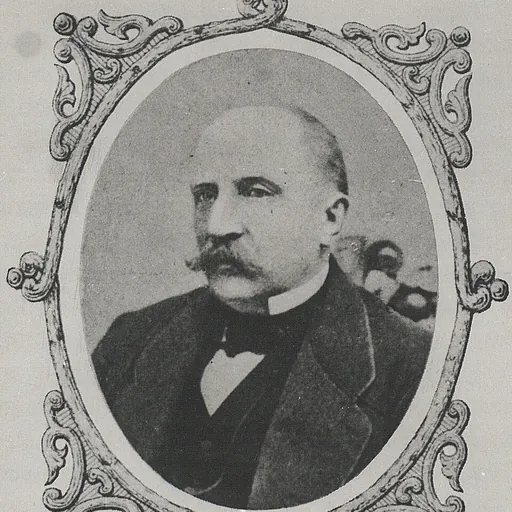
About Tytus Woyciechowski
Lived 1808 – 1879 (aged 70). Tytus Woyciechowski was an Austrian industrialist, large estate owner, jurist and composer.
Tytus Sylwester Woyciechowski (31 December 1808 – 23 March 1879) was a Polish political activist, agriculturalist, and patron of art. He was an early friend — and possible lover — of the Polish composer Frédéric Chopin.
The spelling of Woyciechowski's surname is an archaic version of the more common "Wojciechowski", with a "y" instead of a "j".
Life Woyciechowski was born in Lemberg, Austrian Empire (now Lviv, Ukraine).
Relationship with Chopin In his youth Woyciechowski was a fellow student of Chopin's at the Warsaw Lyceum, boarding with the Chopin family. He went on to study law at Warsaw University.
Chopin dedicated to him his Op. 2 Variations on "Là ci darem la mano". Woyciechowski wrote on the front page of the Variations "J'accepte avec plaisir" ("I accept with pleasure"). Prior to that, he had already dedicated to him the Variations in F major for piano four hands, which are now lost. In October 1829 Chopin sent him the Waltz Op. 70,3 together with a letter. In July 1830 Chopin visited Woyciechowski for a month at his estate in Poturzyn, which Woyciechowski had inherited from his mother. Chopin recalled this visit in a letter:
Although Chopin repeatedly and unequivocally referred to Woyciechowski as 'his lover', many biographers believe that he acted as a confidant for Chopin during an alleged infatuation with the singer Konstancja Gładkowska.
Woyciechowski is shown in Chopin's letters to him to be amongst the composer's favorite friends, or perhaps a lover:
As always, even now, I carry your letters with me. How blissful it will be for me, having gone beyond the city walls in May, thinking about my approaching journey, to pull out a letter of yours and assure myself sincerely that you love me, or at least to gaze at the hand and the writing of him, whom only I am able to love! — Frédéric Chopin to Tytus Woyciechowski (27.3.1830) While the two never met thereafter, they continued to correspond.
Later life In 1838, Woyciechowski married Countess Aloysia Poletylo, by whom he had four children – their second son being named Fryderyk, after Chopin.
Woyciechowski dedicated himself to agriculture, pioneered the introduction of crop rotation in Poland, and in 1847 founded one of the first sugar factories in the country. In 1857, he temporarily stood in for Julian Fontana in the process of publishing Chopin’s Songs, Op. 74. 1861–62 he was an active member of the White Party, which took part in the failed January 1863 Uprising. The family manor house at Poturzyn was destroyed during the Second World War.
Don’t just read it —
keep it.
Full-length biographies made to live with: read them, listen on the way to work, watch them tonight.
- E-book
- Audio
- Video
Instant download · yours to keep · every purchase keeps this site free
Important facts
People in Tytus Woyciechowski's life
Named in this biography and alive at the same time


Related people
Same field, nearest in time


Contemporaries
People whose lives overlapped Tytus Woyciechowski's






Frequently asked questions
Who was Tytus Woyciechowski?
Polish politician
When was Tytus Woyciechowski born?
Tytus Woyciechowski was born on 31 December 1808 in Lviv.
When did Tytus Woyciechowski die?
Tytus Woyciechowski died on 23 March 1879 in Poturzyn.
What was Tytus Woyciechowski's occupation?
Tytus Woyciechowski was an industrialist, large estate owner, jurist and composer.
What nationality was Tytus Woyciechowski?
Tytus Woyciechowski was Austrian.
Sources & further reading
· Wikipedia: Tytus Woyciechowski
· DBpedia: Tytus Woyciechowski
Cite this page
APA: Biography.guide. (2026). Tytus Woyciechowski. https://biography.guide/tytus-woyciechowski/
MLA: "Tytus Woyciechowski." Biography.guide, https://biography.guide/tytus-woyciechowski/.
Chicago: "Tytus Woyciechowski." Biography.guide. https://biography.guide/tytus-woyciechowski/.
Data last updated: 2026-09-21 · Spot an error? Report a correction.
Portrait: Wikimedia Commons · author & licence
Page generated 2026-09-27 04:59 UTC