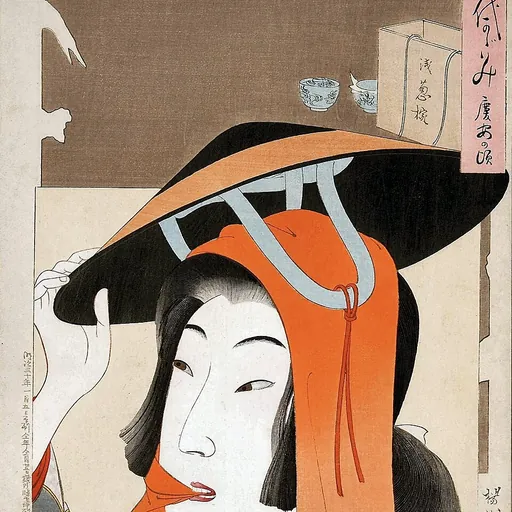
About Toyohara Chikanobu
Lived 1838 – 1912 (aged 73–74). Toyohara Chikanobu was a Japanese painter, ukiyo-e artist, xylographer, graphic artist, artist and illustrator.
, better known to his contemporaries as , was a Japanese painter and printmaker who was widely regarded as a prolific woodblock artist during the Meiji era.
Print depicting Yaegaki-hime carrying the helmet of the warrior Takeda Shingen as she dances amid magical foxfires in Honcho Nijushiko. Triptych by Chikanobu.
Names Chikanobu signed his artwork . This was his . The artist's was ; and it was published in his obituary.
Many of his earliest works were signed ; a small number of his early creations were simply signed . At least one triptych from 12 Meiji (1879) exists signed .
The portrait of the Emperor Meiji held by the British Museum is inscribed .
No works have surfaced that are signed either "Toyohara Chikanobu" or "Hashimoto Chikanobu".
Military career Chikanobu was a retainer of the Sakakibara clan of Takada Domain in Echigo Province. After the collapse of the Tokugawa Shogunate, he joined the Shōgitai and fought in the Battle of Ueno. In addition, he produced nishiki-e artworks. He also referred to himself as Yōshū.
Like many ukiyo-e artists, Chikanobu turned his attention towards a great variety of subjects. His work ranged from Japanese mythology to depictions of the battlefields of his lifetime to women's fashions. As well as a number of the other artists of this period, he too portrayed kabuki actors in character, and is well known for his impressions of the mie (mise en scène) of kabuki productions. Chikanobu was known as a master of bijinga are distinguished from those of the Keiō era, 1865–1867. His works capture the transition from the age of the samurai to Meiji modernity, the artistic chaos of the Meiji period exemplifying the concept of "furumekashii/imamekashii".
Chikanobu is a recognizable Meiji period artist, but his subjects were sometimes drawn from earlier historical eras. For example, one print illustrates an incident during the 1855 Ansei Edo earthquake. The early Meiji period was marked by clashes between disputing samurai forces with differing views about ending Japan's self-imposed isolation and about the changing relationship between the Imperial court and the Tokugawa shogunate. He created a range of impressions and scenes of the Satsuma Rebellion and Saigō Takamori. Some of these prints illustrated the period of domestic unrest and other subjects of topical interest, including prints like the 1882 image of the Imo Incident, also known as the at right.
The greatest number of Chikanobu's appeared in triptych format. These works documented the First Sino-Japanese War of 1894–1895. For example, the "Victory at Asan" was published with a contemporaneous account of the July 29, 1894 battle.
His series Chiyoda no Ōoku (1895), together with its companion Chiyoda no Omote (1897), documents court life and annual ceremonies within the women's quarters of Edo Castle before the Meiji Restoration. The women are depicted as elegant, dignified ideal figures showing little emotion, suggesting an atmosphere of quiet, harmonious order. format. There are quite a number of single panel series, as well as many other prints in this format which are not a part of any series.
He produced several series in the ōban yoko-e format, which were usually then folded cross-wise to produce an album.
Although he is, perhaps, best known for his triptychs, single topics and series, two diptych series are known as well. There are, at least, three polyptych prints known.
His signature may also be found in the line drawings and illustrations in a number of ehon (絵本), which were mostly of a historical nature. In addition, there are fan prints uchiwa-e (団扇絵), as well as number of sheets of sugoroku (すごろく) with his signature that still exist and at least three prints in the kakemono-e format were produced in his latter years.
Selected works In a statistical overview derived from writings by and about Hashimoto Toyohara, OCLC/WorldCat encompasses roughly 300+ works in 300+ publications in 2 languages and 700+ library holdings
(1878) (1878) (1879) (1880) (1880) (1880) (1880) (1880) (1880) (1880) (1880) (1880) (1881) (1881) (1882) (1888) (1888) by (1895)
Don’t just read it —
keep it.
Full-length biographies made to live with: read them, listen on the way to work, watch them tonight.
- E-book
- Audio
- Video
Instant download · yours to keep · every purchase keeps this site free
Important facts
People in Toyohara Chikanobu's life
Named in this biography and alive at the same time
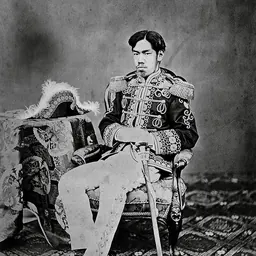

Related people
Same field, nearest in time

Contemporaries
People whose lives overlapped Toyohara Chikanobu's


Frequently asked questions
Who was Toyohara Chikanobu?
Japanese artist (1838-1912)
When was Toyohara Chikanobu born?
Toyohara Chikanobu was born in 1838 in Edo.
When did Toyohara Chikanobu die?
Toyohara Chikanobu died in 1912.
What was Toyohara Chikanobu's occupation?
Toyohara Chikanobu was a painter, ukiyo-e artist, xylographer, graphic artist, artist and illustrator.
What nationality was Toyohara Chikanobu?
Toyohara Chikanobu was Japanese.
Sources & further reading
· Wikipedia: Toyohara Chikanobu
Cite this page
APA: Biography.guide. (2026). Toyohara Chikanobu. https://biography.guide/toyohara-chikanobu/
MLA: "Toyohara Chikanobu." Biography.guide, https://biography.guide/toyohara-chikanobu/.
Chicago: "Toyohara Chikanobu." Biography.guide. https://biography.guide/toyohara-chikanobu/.
Data last updated: 2026-09-21 · Spot an error? Report a correction.
Portrait: Wikimedia Commons · author & licence
Page generated 2026-09-27 05:01 UTC