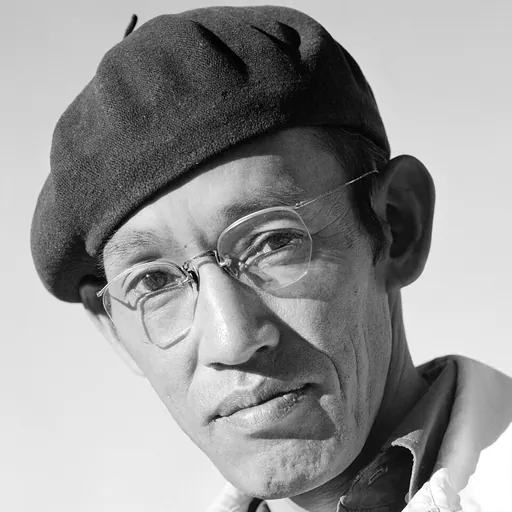
About Tōyō Miyatake
Lived 1895 – 1979 (aged 83–84). Tōyō Miyatake was an American photographer.
Tōyō Miyatake (宮武東洋, Miyatake Tōyō; 1895–1979) was a Japanese American photographer, best known for his photographs documenting the Japanese American people and the Japanese American internment at Manzanar during World War II.
Life
Miyatake was born in Kagawa, Shikoku, in Japan in 1895. — Miyatake began associating with the local arts community. In 1923 he bought his photo studio. Miyatake encouraged fellow photographer Edward Weston to exhibit his work and Miyatake is credited as giving Weston his first gallery showing.
At the time Miyatake met his future wife, his brother was courting her. He began spending time with Hiro under the guise that he was using her as a model. His brother was crushed; it is said that he "died of a broken heart" at an early age.
Before World War II, Miyatake's photography won awards including the 1926 London International Photography Exhibition part of the internment of Japanese Americans during the war. He smuggled a camera lens into the camp and had a camera body constructed from wood, Using this equipment he secretly took photographs of the camp, working primarily in the early morning before most people were about, or at mealtimes, to avoid being seen photographing by the military police. Although he initially started his photography in secret, he approached Manzanar project director Ralph Merritt to ask to serve as official camp photographer. This would allow him to take photos to commemorate weddings and other official purposes, and to photograph Japanese volunteers who wanted photos for their families before they left for military service. Merritt agreed to this, but since at the time inmates were not allowed cameras, the proviso was made that Miyatake could set up the camera and frame the photograph, but the actual shutter release must be done by a white person. and published the book Two Views of Manzanar featuring both his and Adams' photos of the camp.
Post-War After the war, the family returned to Los Angeles, where their home had been entrusted to some of their white friends during the incarceration. Unlike many families who lost their homes, the Miyatakes were able to resume their life and provide shelter to a few less fortunate incarcerees and their families. In post-war Little Tokyo, many residents were unable to afford Miyatake's services and some opted instead to barter goods to have him photograph weddings and portraits. With his wife Hiro running the front office, she once negotiated his services for a Steinway piano and another time, she negotiated for a litter of poodles.
After the death of his wife, Hiro, in 1971, Miyatake moved from his home on Third Street in East Los Angeles to live in neighboring Monterey Park with his daughter and her family.
He remained active in the studio throughout this period. In the early morning, Miyatake could be seen walking around Monterey Highlands Elementary School for exercise. The last image he captured on film was taken at this park. The film was discovered and processed after his death.
Before his death in 1979, Miyatake and Ansel Adams produced a book, Two Views of Manzanar, a compilation of their photographs during the incarceration.
Toyo Miyatake Studio
The Toyo Miyatake Studio moved in 1985 to San Gabriel, California, where it still operates today. The studio is now managed by grandson, Alan Miyatake.
In culture In the TV movie Farewell to Manzanar, Pat Morita portrays Zenahiro, a character based on Miyatake.
Legacy In 2001, Robert A. Nakamura directed the film, Toyo Miyatake: Infinite Shades of Gray, documenting the photographer's life and work. Kevin Thomas characterized this film in the Los Angeles Times as the "eloquent, deeply moving Toyo Miyatake: Infinite Shades of Gray".
In 2009, the film Toyo's Camera was released, documenting the internment of Japanese Americans during World War II through the perspective of the photographer's images. Narrated by George Takei, music by Kitaro.
His 1929 photograph of Michio Ito appeared on the cover of the Whitney Museum's Spring 2016 gallery guide.
Books by Miyatake
Shashinka Miyatake Tōyō no sekai: Renzu ga toraeta ningen no kiroku: 50-nen no nichibei-kōryū-shi (写真家宮武東洋の世界:レンズがとらえた人間の記録:50年の日米交流史). Tokyo: Bungeishunjū, 1980. Miyatake Tōyō no shashin: 1923–1979 (宮武東洋の写真:1923~1979). Tokyo: Bungeishunjū, 1984.
Don’t just read it —
keep it.
Full-length biographies made to live with: read them, listen on the way to work, watch them tonight.
- E-book
- Audio
- Video
Instant download · yours to keep · every purchase keeps this site free
Important facts
People in Tōyō Miyatake's life
Named in this biography and alive at the same time




Related people
Same field, nearest in time



Contemporaries
People whose lives overlapped Tōyō Miyatake's


Frequently asked questions
Who was Tōyō Miyatake?
American photographer (1895–1979)
When was Tōyō Miyatake born?
Tōyō Miyatake was born in 1895 in Kagawa Prefecture.
When did Tōyō Miyatake die?
Tōyō Miyatake died in 1979 in Los Angeles County.
What was Tōyō Miyatake's occupation?
Tōyō Miyatake was a photographer.
What nationality was Tōyō Miyatake?
Tōyō Miyatake was American.
Sources & further reading
Cite this page
APA: Biography.guide. (2026). Tōyō Miyatake. https://biography.guide/toyo-miyatake/
MLA: "Tōyō Miyatake." Biography.guide, https://biography.guide/toyo-miyatake/.
Chicago: "Tōyō Miyatake." Biography.guide. https://biography.guide/toyo-miyatake/.
Data last updated: 2026-09-23 · Spot an error? Report a correction.
Portrait: Wikimedia Commons · author & licence
Page generated 2026-09-27 05:04 UTC