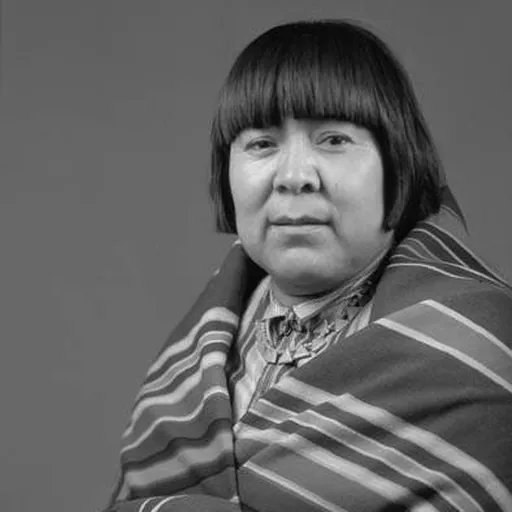
About Tonita Peña
Lived 1893 – 1949 (aged 56). Tonita Peña was an American painter, teacher and muralist.
Tonita Peña (May 10, 1893 – September 9, 1949) born as Quah Ah (meaning "white coral beads") and also known as Tonita Vigil Peña and María Antonia Tonita Peña, was a renowned Pueblo artist, specializing in pen and ink on paper embellished with watercolor. Peña attended St. Catherine Indian School in Santa Fe.
Career and later life Edgar Lee Hewett, an anthropologist involved in supervising the nearby Frijoles Canyon excavations (now Bandelier National Monument) was instrumental in developing the careers of several San Ildefonso "self taught" artists including Tonita Peña. Hewett purchased Peña's paintings for the Museum of New Mexico and supplied her with quality paint and paper. Peña began gaining more notoriety by the end of the 1910s selling an increasing amount to her work to collectors and the La Fonda Hotel. Much of this early work was done of Pueblo cultural subject matter, in a style inspired by historic Native American works, however her use of an artists easel and Western painting mediums gained her acceptance among her European-American contemporaries in the art world. At the age of 25, she exhibited her work at museums and galleries in the Santa Fe and Albuquerque area.
In the early 1920s Tonita did not know how much her painting sold for at the Museum of New Mexico, so she wrote letters to the administrators because a local farmer was worried that she got paid too little.
In the 1930s Peña was an instructor at the Santa Fe Indian School and at the Albuquerque Indian School As children, these artists attended San Ildefonso day school which was part of the institution of the Dawes Act of 1887, designed to indoctrinate and assimilate Native American children into mainstream American society. Works from this exhibition were shown at the 1932 Venice Biennial. That year is the only time Native American artists have shown in the official United States pavilion at that biennial, and Tonita Peña's paintings were part of that exhibition. Her painting Basket Dance, that had shown in the Venice Biennial was acquired by the Whitney Museum of American Art in New York for $225. This was the highest price paid up to this time for a Pueblo painting and most Native American paintings at this time were selling between $2 and $25.
Death and legacy Peña died on September 9, 1949. At Peña's death, all of her remaining paintings and personal effects were burned in compliance with Pueblo customs.
Peña's artwork is in the collections at the American Museum of Natural History in New York, the Cleveland Museum of Art in Ohio, the Cranbrook Institute of Science in Michigan, the Acequia Madre House in Santa Fe, NM the Heard Museum in Arizona, the Dartmouth College Collection in New Hampshire, the Haffenreffer Museum of Anthropology at Brown University, and the Peabody Museum at Harvard.
Affecting social change Peña did not accept the established roles of women in arts within the early 20th-century Native American art market. She focused primarily on two-dimensional works on paper rather than the more established accepted pottery medium of her contemporaries. Another way Peña rejected traditional roles of women was how she approached her role as a mother. Contrary to the traditions of her tribe and America at large, she chose to have others raise some of her children, so that she could focus on completing her education and also furthering her career. During her lifetime, the U.S. government pushed the idea of assimilating Native Americans within American culture. Peña's artwork emerged as a site of resistance towards those efforts, reaffirming the importance of ceremonial dances as crucial for Pueblo cultural survival.
Critics Critique of Peña can be found within the framework of studying "traditional" Native American art versus "White patronage"-supported Native American art. Artwork made by Native Americans and collected by White patrons served no traditional function in Native American communities. Peña's critics were not only the established art world, but also her own tribe. Many of Peña's paintings depicted sacred rituals and her fellow tribespeople believed these were inappropriate subject matters to portray and share outside the tribe. Epitacio Arquero, Governor of the Pueblo and Peña's husband at the time of the most heated protests, defended the subject matter, saying her paintings only depicted subject matter already visible to outsiders. Following the controversy, Peña's work changed to focus on Pueblo culture and traditions that were not sacred or private in nature.
In 1913 Peña had a second arranged marriage, this time to Felipe Herrera, who died in a mining accident in 1920.
Her final marriage was in 1922 to Epitacio Arquero, a politician who held important tribal offices at the Cochiti Pueblo, and together they had three children.
Don’t just read it —
keep it.
Full-length biographies made to live with: read them, listen on the way to work, watch them tonight.
- E-book
- Audio
- Video
Instant download · yours to keep · every purchase keeps this site free
Important facts
more
Tonita A. Pena, Tonita Chavez, Tonita. Peña, Tonita Pena, Tonita Vigil Pena, Tonita P. Arquero, Tonita HerreraFamily & relationships
People in Tonita Peña's life
Named in this biography and alive at the same time


Related people
Same field, nearest in time



Contemporaries
People whose lives overlapped Tonita Peña's


Frequently asked questions
Who was Tonita Peña?
Native American painter and muralist
When was Tonita Peña born?
Tonita Peña was born on 10 May 1893 in Real Sitio de San Ildefonso.
When did Tonita Peña die?
Tonita Peña died on 9 September 1949 in Kewa Pueblo.
What was Tonita Peña's occupation?
Tonita Peña was a painter, teacher and muralist.
What nationality was Tonita Peña?
Tonita Peña was American.
Sources & further reading
Cite this page
APA: Biography.guide. (2026). Tonita Peña. https://biography.guide/tonita-pena/
MLA: "Tonita Peña." Biography.guide, https://biography.guide/tonita-pena/.
Chicago: "Tonita Peña." Biography.guide. https://biography.guide/tonita-pena/.
Data last updated: 2026-09-20 · Spot an error? Report a correction.
Portrait: Wikimedia Commons · author & licence
Page generated 2026-09-27 04:57 UTC