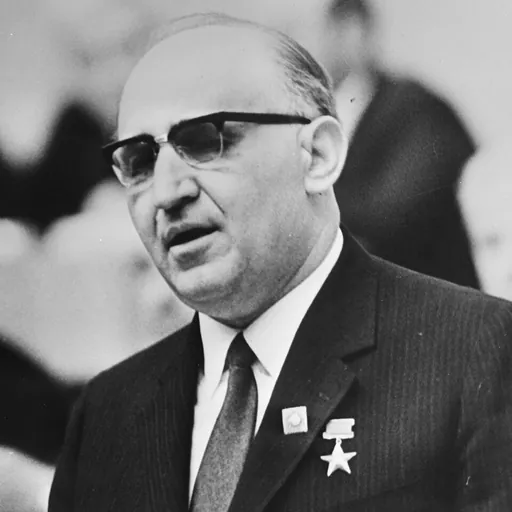
Todor Zhivkov
Former General Secretary of the Bulgarian Communist Party
About Todor Zhivkov
Lived 1911 – 1998 (aged 86). Todor Zhivkov was a Bulgarian politician, statesperson and resistance fighter.
Todor Hristov Zhivkov ( ; 7 September 1911 – 5 August 1998) was a Bulgarian communist politician who served as the de facto leader of the People's Republic of Bulgaria (PRB) from 1956 until 1989 as General Secretary of the Central Committee of the Bulgarian Communist Party. He was the longest-serving leader in the Eastern Bloc, the longest-serving leader within the Warsaw Pact and the longest-serving non-royal ruler in Bulgarian history.
During World War II, Zhivkov participated in Bulgaria's resistance movement in the People's Liberation Insurgent Army. In 1943, he was involved in organising the Chavdar Partisan Brigade in and around his place of birth, becoming deputy commander of the Sofia operations area in the summer of 1944. Under his rule, many fellow former combatants with Chavdar were to rise to positions of prominence in Bulgarian affairs. He is said to have coordinated partisan movements with those of pro-Soviet army units during the 9 September 1944 uprising.
He became First Secretary of the Bulgarian Communist Party (BCP) in 1954 (General Secretary from April 1981), served as Prime Minister from 1962 to 1971 and from 1971 onwards as Chairman of the State Council, concurrently with his post as First Secretary. He remained in these positions for 35 years, until 1989, thus becoming the longest-serving leader of any European Eastern Bloc nation after World War II, and one of the longest ruling non-royal leaders in modern history. His rule marked a period of unprecedented political and economic stability for Bulgaria, marked both by complete submission of Bulgaria to the Soviet Union and a desire to expand ties with the West. Bulgaria placed paramount importance on scientific and technological progress, as well as on the cultivation of trade skills suited to an industrial economy. In 1948, roughly 80 percent of the population depended on agriculture for their livelihood; by 1988, however, fewer than one in five workers remained in the agricultural sector, with the rest concentrated in industry and services.
Zhivkov's rule remained unchallenged until the deterioration of East–West relations in the 1980s, when a stagnating economic situation, a worsening international image and growing careerism and corruption in the BCP weakened his position. He resigned on 10 November 1989, under pressure by senior BCP members due to his refusal to recognise problems and deal with public protests. Within a month of Zhivkov's ousting, communist rule in Bulgaria had effectively ended, and within a year the People's Republic of Bulgaria had formally ceased to exist.
Early life Zhivkov was born in the Bulgarian village of Pravets into a peasant family, to Hristo Todorov Zhivkov and Maruza Gergova Zhivkova. The exact date of Zhivkov's birth was in dispute within Zhivkov's family, as his mother insisted that he had been born on 20 September 1911. However, Zhivkov would say in his memoirs that the Orthodox priest that was charged with keeping the records of new births at the time was found to be very drunk and forgot to write down the actual day of birth, instead writing in only the day of baptism. Expressing confidence in his knowledge of local custom, this allowed him to calculate that his actual day of birth had been 13 days earlier – on 7 September of that year. He had apparently been able to verify this as his real date of birth, though he continued to jokingly argue with his mother about the incident for years on end.
In 1928, he joined the Bulgarian Communist Youth Union (BCYU), an organisation closely linked with the Bulgarian Workers Party (BWP) – later the Bulgarian Communist Party (BCP). The following year he obtained a post at the Darzhavna pechatnitsa, the official government publisher in Sofia. In 1932, he joined the BWP proper, later serving as secretary of its Second Borough Committee and as a member of its Sofia County Committee. Although the BWP was banned along with all other political parties after the coup of 19 May 1934, it continued fielding a handful of non-party National Assembly Deputies and Zhivkov retained his posts at its Sofia structure.
During World War II, Zhivkov participated in Bulgaria's resistance movement in the People's Liberation Insurgent Army against the country's alignment with Nazi Germany and was sympathetic to the country's 50,000 Jews. In 1943, he was involved in organising the Chavdar Partisan Brigade in and around his place of birth, becoming deputy commander of the Sofia operations area in the summer of 1944. Under his rule, many fellow former combatants with Chavdar were to rise to positions of prominence in Bulgarian affairs. He is said to have coordinated partisan movements with those of pro-Soviet army units during the 9 September 1944 uprising.
Rise to power
After 9 September 1944, Zhivkov became head of the Sofia police force, restyled as the Narodna Militsiya (People's Militia). He was elected to the BCP Central Committee as a candidate member in 1945 and a full member in 1948. In the run-up to the 1949 treason trial against Traicho Kostov, Zhivkov criticised the Party and judicial authorities for what he claimed was their leniency with regard to Kostov. This placed him in the Stalinist hardline wing of the Party. In 1950, Zhivkov became a candidate member of the BCP Politburo, then led by Valko Chervenkov, leading to a full membership in 1951. In the years which followed, he was involved in countering countryside resistance to forced farm collectivisation in north-western Bulgaria.
The April Plenum and Zhivkov's ascendancy After Joseph Stalin's death, an emphasis on shared leadership emerged. When the hardline Stalinist Chervenkov gave up his post as General Secretary of the BCP in 1954, Zhivkov took his place, but Chervenkov retained most of his powers as prime minister. Bulgarian opinion at the time interpreted this as a self-preservation move by Chervenkov, since Zhivkov was a less well known figure in the party. After Nikita Khrushchev delivered his famous secret speech against Stalin at the Communist Party of the Soviet Union 20th Congress, a BCP Central Committee plenary meeting was convened in April 1956 to agree to adopt a new Krushchevite line. At that plenum, Zhivkov criticised Chervenkov as a disciple of Stalin, had him demoted from prime minister to a cabinet post, and promoted former Committee for State Security (CSS) head Anton Yugov to the post of prime minister. It was at this point that he became the de facto leader of Bulgaria. Subsequently, Zhivkov was associated with the "April Line", which had anti-Stalinist credentials. Chervenkov publicly accepted the criticism levied against him, admitted to allowing "mistakes" and "excesses" to take place in the country and resigned from political life.
The beginning of liberalisation Subsequently, Zhivkov carried out a policy of relative sociopolitical liberalisation and de-Stalinization in Bulgaria, similar to the Khrushchev Thaw in the Soviet Union. Zhivkov took action against what he saw as a cults of personality – whether in relation to Stalin, Chervenkov or to other figures. Monuments considered as being part of such cults were taken down and many public places renamed – the most prominent of which were the return of "Mount Stalin" back to its prewar name of Mount Musala and that of the city of "Stalin" back to Varna. Zhivkov resented the idea of himself being the subject of a cult and later, when the residents of his hometown of Pravets erected a monument bearing his likeness – he personally thanked them for their gesture, before ordering the statue be removed. It would only be restored in 2001 – after Zhivkov had died.
Zhivkov discontinued many "excesses", removed monopolies on art and culture and vastly restrained, though not fully abolished, the practice of penal labour. Zhivkov would also pardon and rehabilitate many of those he viewed as unfairly sentenced by the People's Courts (which were already abolished by this point), such as renowned Bulgarian author Dimitar Talev – who subsequently had his author's union membership restored, would publish his most famous works and would even be elected as member of parliament to Bulgaria's National Assembly in 1966.
The April Plenum of the BCP endorsed Zhivkov's liberalisation, which was seen by many as a sign of deeper reform. Consequently, groups began openly petitioning Zhivkov for further increases in the freedom of the press, cultural freedoms and subsequently, even some open protests formed, petitioning Zhivkov to take action against local party leaders that the protesters were unhappy with. Zhivkov reacted by sacking and punishing those local and regional leaders whose policies had led to local dissatisfaction and unrest, instead beginning a program of promoting younger and more ambitious cadres to fill their roles. The promotion of these new cadres, unaffiliated with cliques and untainted by corruption, served to create a loyal following of local leaders and administrators for Zhivkov, further increasing his control of the Communist party, whilst simultaneously increasing popular support for his government.
In the early 1970s, Zhivkov decided to update the country's Dimitrov Constitution, which led him to the creation of the so-called Zhivkov Constitution. The latter was intended to boost the country's image without risking any instability. The Zhivkov constitution separated party and state organs, empowering Bulgaria's National Assembly, giving the right of legislative initiative to labour unions and youth groups, as well as creating a collective head of state in the institution of the State Council, appointed by the National Assembly. The State Council took over some of the roles previously exercised by the country's communist party and had the ability to enact laws on behalf of the assembly when the latter was not in session. Zhivkov further wished to distance his country from the image of a one-party state, thus the Zhivkov constitution explicitly mentioned that political power in the country was to be shared "cooperatively" between the Communist Party and the Bulgarian Agrarian National Union, the communists' coalition partner.
The new constitution was approved by Bulgarian voters in the 1971 Bulgarian constitutional referendum. Subsequently, Zhivkov resigned from his post as prime minister and was instead made Chairman of the State Council, making him the titular head of the collective Bulgarian Presidency. In practice, though Bulgaria was now constitutionally at minimum a two-party state, the fact that the BANU was a minor coalition partner of Zhivkov's communist party allowed him to preside over a favourable national assembly, which could then approve of the State Council's decisions.
In 1959, the Communist Party borrowed from the Chinese Great Leap Forward to symbolise a sudden burst of economic activity to be injected into the Third Five-Year Plan (1958–1962), whose original scope was quite conservative. According to the revised plan, industrial production would double and agricultural production would triple by 1962; a new agricultural collectivisation and consolidation drive would achieve great economies of scale in that branch; investment in light industry would double, and foreign trade would expand. Following the Chinese model, all of Bulgarian society was to be propagandised and mobilised to meet the planning goals. Zhivkov, whose "theses" had defined the goals of the plan, purged Politburo members and party rivals Boris Taskov (in 1959) and Anton Yugov (in 1962), citing their criticism of his policy as economically obstructionist. Already by 1960, however, Zhivkov had been forced to redefine the impossible goals of his theses. The lack of skilled labour and materials made it impossible to complete projects at the prescribed pace. Harvests were disastrously poor in the early 1960s; peasant unrest forced the government to raise food prices; and the urban dissatisfaction that resulted from higher prices compounded a crisis that broke in the summer of 1962. Blame fell on Zhivkov's experiments with decentralised planning, which was totally abandoned by 1963.
Before the end of the 1960s, however, Bulgarian economic planning moved back toward the conventional CPE approach. Many Western analysts attributed the Bulgarian retreat from the reforms of the 1960s to tension caused by the Warsaw Pact invasion of Czechoslovakia in 1968. International events may well have played a role, but the timing of the retreat and the invasion suggest another component: dissatisfaction among the Party elite with the results and ideological implications of the reform. For example, in July 1968, one month before the invasion of Czechoslovakia, Bulgaria's unorthodox, three-tiered pricing system was eliminated. The party leadership had never accepted the concept of free and flexible pricing for some products, which was an important Bulgarian departure from centralised planning in the 1960s. Resistance to reform was further encouraged by a series of cases in which major enterprise directors used newly decentralised financial resources to line their own pockets. However, some of the recentralisation measures, such as the creation of an agricultural-industrial complex, also received domestic criticism.
After a relative stagnation in the 1970s, the New Economic Model (NEM), instituted in 1981 as the latest economic reform program, seemingly improved the supply of consumer goods and generally upgraded the economy. However, NEM was unable to drastically improve the quality or quantity of Bulgarian goods and produce. In 1983, Zhivkov harshly criticised all of Bulgarian industry and agriculture in a major speech, but the reforms generated by his speech did nothing to improve the situation. By 1984, Bulgaria was suffering a serious energy shortage because its Soviet-made nuclear power plant was unreliable and droughts reduced the productivity of hydroelectric plants.
In 1985, Soviet leader Mikhail Gorbachev visited Bulgaria and reportedly pressured Zhivkov to make the country more competitive economically. This led to a Bulgarian version of the Soviet perestroika program. After a round of failed experimental measures, in January 1989 the Party issued Decree Number 56. This decree established "firms" as the primary unit of economic management. In a fundamental departure from the socialist prohibition of private citizens hiring labour, as many as ten people could now be hired permanently, and an unlimited number could be hired on temporary contracts. This last round of reforms by the Zhivkov regime confused rather than improved economic performance. However, statistics on growth for 1986–88 still indicated a 5.5% annual rate, up from the 3.7% rate achieved during the previous five-year plan. Increases in real incomes in agriculture rose by 6.7 per cent per year during the 1960s. During this same period, industrial wages increased by 4.9 per cent annually. Availability of consumer durables significantly improved in the 1970s. According to official statistics, between 1965 and 1988 the number of televisions per 100 households increased from 8 to 100; radios increased from 59 to 95; refrigerators from 5 to 96; washing machines from 23 to 96; and automobiles from 2 to 40. Available automobiles were primarily Soviet Fiats, some of which were manufactured in Bulgaria. Housing remained one of the most serious shortcomings in the Bulgarian standard of living throughout Zhivkov's rule. Residential construction targets in the Five-Year Plans were regularly underfulfilled. Consequently, families often waited several years for apartments; in Sofia, where overcrowding was at its worst, the wait was as long as ten years. A system of distribution was implemented, which gave priority to 'Active Fighters against Fascism' (those who had been part of the partisan struggle or fought against Nazi Germany in World War II), as well as eminent artists, scientists and "Heroes of Socialist Labour" (mostly collective farmers and shop-floor workers).
The educational system, despite the addition of ideological subjects, remained relatively unchanged after the beginning of the Communist era. In 1979, Zhivkov introduced a sweeping educational reform, claiming that Marxist teachings on educating youth were still not being applied completely. Zhivkov therefore created Unified Secondary Polytechnical Schools (Edinni sredni politekhnicheski uchilishta, ESPU), in which all students would receive the same general education. The system united previously separate specialised middle schools in a single, twelve-grade program heavily emphasising technical subjects. In 1981, a national program introduced computers to most of the ESPUs.
Foreign
Although the Zhivkov regime often advocated closer relations and multilateral cooperation with Yugoslavia, Turkey, Greece, Albania, and Romania, a number of traditional issues barred significant improvement until the late 1980s. Without exception, Zhivkov imitated or supported Soviet twists and turns such as Khrushchev's denunciation of Stalin in 1956 and the invasion of Czechoslovakia in 1968. Substantial historical and economic ties supplemented the ideological foundation of the relationship. In the 1970s and 1980s, Bulgaria improved its diplomatic relations with nations outside the Soviet sphere. The 1970s were a period of closeness between Brezhnev's USSR and Zhivkov's Bulgaria. In 1977, Zhivkov was also awarded the Hero of the Soviet Union. Yet, though Bulgarian émigré dissident Georgi Markov wrote that "[Zhivkov] served the Soviet Union more ardently than the Soviet leaders themselves did", in many ways he can be said to have exploited the USSR for political purposes, with Bulgaria serving as a buffer between the USSR and NATO. Thus, he claims in his memoirs that the USSR had become "a raw material appendage to Bulgaria", something obliquely confirmed by Gorbachev when he wrote in his memoirs that "Bulgaria was a country which had lived beyond its means for a long time." An example of how the "raw material appendage" was exploited was the trade in Soviet crude oil. This would be shipped to Bulgaria's modern refinery in Burgas at subsidised prices, processed, and resold on world markets at a huge premium.
In 1963 and 1973, the Zhivkov regime made requests – it is unclear how far these were in earnest – that Bulgaria be incorporated into the USSR, both times because the Bulgarian government, having engaged in bitter polemics with Yugoslavia over the Macedonia naming dispute, feared a Soviet–Yugoslav reconciliation at its own expense. In 1963, following the decision of Patriarch Alexy I of Moscow to recognise the autonomy of the Macedonian Orthodox Church, the Bulgarian leaders openly declared that there was no "historic Macedonian nation". In the face of Moscow's post-1953 efforts to reach out to Belgrade and Athens, Zhivkov seems to have calculated that a policy of unswerving loyalty to the Kremlin would ensure that it remained more valuable for the USSR than non-aligned Yugoslavia or NATO-affiliated Greece. In 1967, he severed diplomatic ties with Israel.
Throughout the 1960s and 1970s, Bulgaria gave official military support to many national liberation causes, most notably in North Vietnam, Indonesia, Libya, Angola, Afghanistan, the Horn of Africa, and the Middle East. In 1984, the 9,000 Bulgarian advisers stationed in Libya for military and non-military aid put that country in first place among Bulgaria's Third World clients. Through its Kintex arms export enterprise, Bulgaria also engaged in covert military support activities, many of which were subsequently disclosed. In the 1970s, diplomatic crises with Sudan and Egypt were triggered by Bulgarian involvement in coup plots.
Under Zhivkov, Bulgaria's policy toward Western Europe and the United States was determined largely by the position of the Soviet Union. Events such as the invasions of Czechoslovakia and Afghanistan automatically distanced Bulgaria from the West; then, in the early 1980s, Soviet efforts to split NATO by cultivating Western Europe brought Bulgaria closer to France and West Germany – a position that continued through the 1980s. Even in the 1970s, Zhivkov actively pursued better relations with the West, overcoming conservative opposition and the tentative, tourism-based approach to the West taken as early as the 1960s. Emulating Soviet détente policy of the 1970s, Bulgaria gained Western technology, expanded cultural contacts, and attracted Western investments with the most liberal foreign investment policy in Eastern Europe. As in 1956 and 1968, however, Soviet actions altered Bulgaria's position. The Soviet invasion of Afghanistan in late 1979, which Bulgaria supported vigorously, renewed tension between Bulgaria and the West. Alleged Bulgarian implication in the attempted assassination of Pope John Paul II in 1981 exacerbated the problem and kept relations cool through the early 1980s. In 1986 the two countries signed a declaration of good-neighbourliness, friendship, and cooperation that was based on mutual enmity toward Turkey and toward Yugoslav demands for recognition of Macedonian minorities in Bulgaria and Greece. An important motivation for friendship with Greece was to exploit NATO's Greek-Turkish split, which was based on the claims of the two countries in Cyprus. In early 1989, Bulgaria signed a ten-year bilateral economic agreement with Greece.
Cultural Until the late 1980s, Zhivkov successfully prevented unrest in the Bulgarian intellectual community. Membership in the writers' union brought enormous privilege and social stature, and that drew many dissident writers such as Georgi Dzhagarov and Lyubomir Levchev into the circle of the officially approved intelligentsia. On the other hand, entry required intellectual compromise, and refusal to compromise led to dismissal from the union and loss of all privileges. Markov tells a story of how Zhivkov reproached a popular newspaper cartoonist for modifying his signature to resemble a pig's tail, yet did not persecute him. A handful of satirist dissidents such as Radoy Ralin enjoyed some prominence during Zhivkov's tenure, although Ralin was not favoured by the authorities due to his sharp satire.
Zhivkov also softened the organised opposition by restoring symbols of the Bulgarian cultural past that had been cast aside in the postwar campaign to consolidate Soviet-style party control. Beginning in 1967, he appealed loudly to the people to remember "our motherland Bulgaria". In the late 1970s, Zhivkov mended relations with the Bulgarian Orthodox Church.
Sports also prospered during Zhivkov's rule. From 1956 to 1988, Bulgaria won an unprecedented 153 Olympic medals and numerous European and world competitions in sports as diverse as volleyball, rhythmic gymnastics, and wrestling.
Controversy Despite the thaw period he initiated, dissidents could still be punished under Zhivkov's rule. The CSS was a feared tool of control, and overt opposition largely stayed underground until the late 1980s. Blaga Dimitrova was harshly denounced for her critical portrayal of party officials in her 1982 novel Litse. However, he showed his true colours when he expelled several members of a human-rights watch group from the Party. Soon afterward, when several intellectuals announced the formation of the "Club for the Support of Perestroika and Glasnost", he arrested the leaders and expelled them from the Party.
Character Throughout his tenure, Zhivkov's dialect and poor manners made him the butt of many acerbic jibes and jokes in Bulgaria's urbane circles. While the feared CSS secret police was commonly said to persecute those who told political jokes, Zhivkov himself was said to have found them amusing and collected an archive of them. His popular nickname was "bai Tosho" (approximately "Ol' Uncle Tosho") or occasionally (and later) "Tato" (a dialectal word for "Dad" or "Pop").
Fall
Zhivkov had long since benefited from restoring and promoting Bulgarian national symbols, such as those on the country's national emblem, thus creating a sort of patriotic national communism, which proved to increase Zhivkov's popularity. This, alongside the Turkish invasion of Cyprus, done ostensibly in order to protect the interests of Turkish Cypriots in 1974, alongside a fear of the militarist, anti-communist regime brought to power in Turkey by the 1980 Turkish coup d'état, caused both Zhivkov and the establishment to fear a similar scenario repeating in Bulgaria. To this end, Zhivkov attempted to counter this perceived threat by attempting to trigger a second Bulgarian National Revival through a series of policies collectively alluded to as the "Revival Process". The most controversial of these was a decision taken in December 1984 that aimed to assimilate the Bulgarian Turks through the "restoration" of "Turkish" to "Bulgarian" names. Though official statements attempted to portray this as a campaign of unity and the destruction of inter-ethnic barriers, it was met with strong resistance among several groups of Bulgarian Turks, who viewed it as an attack on their identity. The first demonstration against the "revival process" took place on 24 December, when 1200 people peacefully protested in the village of Mlechino without incident. However, the protests turned violent the day after, as the local chief of police alleged that the demonstrators had started throwing stones at both the police and local fire brigade, which led to an attempt by the authorities to disperse the protests via a water cannon. Several more incidents occurred between protesting crowds and the local police during the following few days. In total, 517 people were sent to prisons for their roles in the uprisings, riots, terrorist attacks, and other "revival process"-related events between 1984 and 1989. In May 1989, Zhivkov declared that all persons who felt not at home in Bulgaria would be free to leave the country to go live in Turkey. Zhivkov underestimated the opposition he had generated within the ranks of the Bulgarian Turks, and over 360,000 people left the country, some of whom reportedly felt as though they had few other options. The campaign was an abject failure and generally considered to be Zhivkov's biggest mistake.
As it turned out, this was the beginning of the end for the long-time leader. Bulgaria was the target of near-unanimous condemnation from the international community; even the Soviets protested. Gorbachev already did not think much of Zhivkov; he regarded Zhivkov as one of a group of inflexible hardliners that included East Germany's Erich Honecker, Czechoslovakia's Gustáv Husák and Romania's Nicolae Ceaușescu. However, after the Turkish episode, he was determined to see Zhivkov gone. The Turkish affair alarmed several high-ranking Bulgarian officials as well, including Prime Minister Georgi Atanasov, Foreign Minister Petar Mladenov and Finance Minister Andrey Lukanov. They began plotting to remove him, but had to move discreetly given the ubiquity of the CSS. The Central Committee fell into line two days later, calling for free elections in the spring and asking the National Assembly to delete the portions of the Constitution that enshrined the party's "leading role". On 15 January, the National Assembly struck out the portions of the constitution giving the Communist Party a monopoly of power. Thus, within only two months of Zhivkov losing power, the Communist system he had helped to create, and which he had dominated for 35 years, was no more.
Following his fall from power, the new regime brought Zhivkov to five separate trials – labelled trials No.1 through No. 5 of the Republic of Bulgaria, each with their own indictment. Indictment No. 1 regarded the 'Revival Process', Indictment 2 accused him of overstepping his authority in "funding the international communist movement", Indictment 3 accused him and 21 others of giving out high-risk loans to developing countries, Indictment 4 accused him of giving away apartments and cars worth a total of around $24 million (in 1990 dollars) to members of the security forces and indictment 5 accused him of involvement in labour camps. The first four were brought before the court immediately, while indictment 5 was brought before the court later.
Later life and death
Zhivkov was subsequently released, giving frequent interviews to foreign journalists and writing his memoirs in the final years of his life.
In his memoirs, which he dubbed "the longest confession of his life", he defined himself as an "ordinary village boy from Pravets" and told the story of his life, along with his analysis of his own government and legacy. He spoke of the socialist society in Bulgaria as being divided into two parts – the [societal] order, which he described as the basic societal organisation and ethos in country and the system, the practical structure of government, led by a Vanguard party. He spoke positively of the first, describing it as proper, justified and prosperous. He blamed the collapse of socialism, instead, on the latter. He stated that he had not changed his political views and remained a committed Marxist, but had come to realise that the system was overly bureaucratic, inflexible and ultimately failed, bringing the order down with it. He concluded that the ultimate collapse of his system was due to his own failures to reform and modernise said system in the 1970s and 80s. He opined that socialism would ultimately triumph regardless, but that this would be a new form of socialism and would be led by a new, younger generation, which he hoped would be "better in every way from ours" and would lead to a "more prosperous, more just and more democratic Bulgaria". He criticised the ruling right-wing UDF government at the time, but reserved his harshest criticism for the former members of his party that had taken part in embezzlement of state assets following his departure.
In early 1998, a shifting power balance within the Bulgarian Socialist Party led to Zhivkov re-joining it, leading to a round of ovation by party members during a rally.
Zhivkov died from complications of bronchial pneumonia as a free man on 5 August 1998, at the age of 86. With his death, all attempts of the prosecution to reintroduce the dismissed cases were dropped. shirts and various souvenirs featuring him or his likeness being easy to find in modern-day Bulgaria. A billboard posthumously celebrating his 100th birthday was erected in Nesebar in 2011, Obituaries were placed around the town of Smolyan 21 years after his death in 2019, comparing him to a star and Bulgarian national hero Hristo Botev.
In 2001, the communist-period monument of Zhivkov was re-erected in his hometown of Pravets in the presence of the leaders of the Bulgarian Socialist Party, alongside Zhivkov's 1990–1998 bodyguard, Boyko Borisov, future Bulgarian Prime Minister, who then was the Chief Secretary of the Bulgarian Ministry of Interior. His former home in the town was then turned into a museum in his honour in 2002. Subsequently, the annual celebrations of the anniversary of Zhivkov's birthday on 7 September, gradually developed into a state-wide affair. Beginning in 2012, the celebrations have been incongruously accompanied by the flag of Europe. A second monument of Zhivkov was erected in the village of Odurne in 2013 by the local mayor, who had promised its sculpting as part of his electoral program.
In modern times, Zhivkov is regarded as popular and his government widely viewed with nostalgia from many sectors of Bulgarian society. Sociological surveys have found that the average approval of Todor Zhivkov in the 2010s ranged from 41% to 55%, while disapproval ranged from 18% to 25%. A study published by RC Trend pegged Zhivkov as one of the top 5 most approved of Bulgarian politicians of all time, alongside former prime ministers Petko Karavelov, Stefan Stambolov and Aleksandar Stamboliyski, while another by Gallup International Association found that 74% of Bulgarians believe the country to have been "ruined" by the politicians that took power after his resignation, most prominently blaming UDF leader Ivan Kostov (49% of respondents). Half of all respondents which gave an answer in the RC Trend study also expressed a desire to go back in time, so that they would live during 'Zhivkov's time', rather than continue living in the modern day republic.
In 2019, the history textbooks of five major academic publishers in Bulgaria had described Zhivkov as a 'moderate ruler, whose policies were aimed at improving the welfare of the ordinary people' – drawing condemnation from a faculty member at the American University in Bulgaria and an investigative journalist. The growing academic nostalgia for Zhivkov's rule was not appreciated by Bulgaria's ruling centre-right GERB party and in particular the education minister Krasimir Valchev – who ordered the textbooks changed to condemn what he dubbed "bloody communism". Valchev's order was opposed by the Bulgarian Socialist Party, which accused him of historical revisionism, political interference in education and an undemocratic enforcement of a particular worldview.
Political and social Zhivkov ultimately survived the Sino-Soviet split, Khrushchev's fall in October 1964, an attempted Stalinist-Maoist coup d'état in 1965, his daughter Lyudmila Zhivkova's death in 1981, Brezhnev's death in 1982, and Mikhail Gorbachev's post-1985 reforms.
However, shortly after falling from power, Zhivkov was expelled from the communist party and subsequently arrested by his former comrades. The Soviet Bloc in the face of the Council for Mutual Economic Assistance (SEV, Comecon), the Warsaw Pact Organization and the USSR itself collapsed. The communist party rebranded itself as the Bulgarian Socialist Party and won the 1990 Bulgarian Constitutional Assembly election, defeating both the right-wing opposition Union of Democratic Forces (UDF) and the Movement for Rights and Freedoms, a party representing ethnic Turks. Analyst Gerald Creed opined that this marked a significant victory for supporters of socialism in Bulgaria, noting that Bulgaria had become the first Eastern European country to re-elect an openly socialist party in a free election following the collapse of socialism in the bloc. The Socialist-led government, however, failed at addressing the problems facing the country and providing a cohesive vision for the future. It suffered a split as the left wing of the party broke off in order to form the New Bulgarian Communist Party, while the right-wing opposition remained united and aggressively opposed the government, hampering any attempts at finding an exit to the political crisis that had gripped the country. The Socialists' government, which had by then rejected Marxism–Leninism in favour of social democracy under its new leader Andrey Lukanov, subsequently collapsed under its inability to deal with the crisis, narrowly losing the opposition in the 1991 Bulgarian parliamentary election.
Zhivkov's attempts to integrate and assimilate Bulgarian Turks ultimately did not yield their intended results, instead leading to the creation of the Movement for Rights and Freedoms, a party largely based on ethnic Turkish affiliation. Despite the fact that Bulgaria's post-1991 constitution retained the restrictions against the formation of racial, ethnic or religious-based parties, the MRF was ruled a legal party by Bulgaria's supreme court in 1992.
The country's political ideology and foreign policies of Zhivkov's era have thus been reversed.
Economic After very significant reverses and difficulties in the 1940s and 1950s, the Bulgarian economy developed apace from the mid-1960s until the late 1970s. Most of today's large industrial facilities such as the Kremikovtsi steelworks and the Chervena Mogila engineering works were built under Zhivkov. Bulgaria's nuclear power station, AEC Kozloduy, was built in the 1970s, all six large reactors commissioned in under five years. This, and Bulgaria's many coal-fired and hydroelectric power stations, made the country a major electric power exporter. By the 1970s, the focus switched to high technologies such as electronics and even space exploration: on 10 April 1979 Bulgaria launched the first of two kosmonavti (cosmonauts), Georgi Ivanov, aboard Soviet Soyuz spaceships and later launched its own space satellites. Having been among the first nations to market electronic calculators (the ELKA brand, since 1973) and digital watches (Elektronika, since 1975), in 1982 the country launched its Pravets personal computer (a near-"Apple II clone") for business and domestic use. In the mid-1960s an economic reform package was introduced, which allowed for farmers to freely sell their over-planned production. Shortly after that Bulgaria became the first and only Eastern Bloc country which locally produced Coca-Cola. Mass tourism developed under Zhivkov's direction from the early 1960s onwards.
However, this Bulgarian economy was exceptionally susceptible to Soviet largesse and Soviet-bloc markets. After the Soviet crude oil price shock of 1979, it entered a very severe recession from which it hardly recovered in the 1980s. After the early-1990s loss of Soviet and Comecon markets, this economy (unused to competing in a free market environment) entered prolonged and significant contraction. Zhivkov-era industrial facilities were largely unattractive to investors, many being left to decay. Great numbers of specialist personnel retired and died without being replaced, or else emigrated or left their state jobs for more lucrative private employment. As agriculture declined, tourism has emerged as almost the sole Zhivkov-era industrial survivor. However, it is widely thought that incompetent and corrupt administration after 1989 had a much greater effect on the decline of the economy, as even successful industries declined. Following the end of Zhivkov's rule state properties were widely embezzled and stripped of assets, the revenues of which were funnelled through tax havens, creating a new class of nouveau riche oligarchs at the cost of the destruction of Bulgaria's industry. This was done both by ex-functionaries from Zhivkov's former party turned 'businessmen', as well as by members of the right-wing opposition, the Union of Democratic Forces, which came into power a year later.
Family and personal life Zhivkov married Mara Maleeva (1911–1971) in 1938. They had two children, a daughter named Lyudmila Zhivkova and a son called Vladimir Zhivkov. Maleeva was diagnosed with stomach cancer in 1969, leading to a two year long and ultimately futile fight with the disease. Maleeva reportedly did not wish to undergo surgery, but Zhivkov insistently convinced her to go. The operation was successful, but the cancer was already late-stage. In August 1971, her condition worsened sharply. She was described as undergoing unbearable pain and became bedridden. In his memoirs, Zhivkov mentioned that the last time he had seen her, he noticed that she had played a recording of one of his speeches on repeat, so that she could keep listening to his voice. She died of the disease on 23 October 1971. Her death deeply affected Zhivkov and he was described as becoming unpredictable and lacking self control in the few weeks after her death.
Lyudmila would become a very notable, albeit controversial, cultural icon – promoting unorthodox and divergent artistic ideas, as well as practising Eastern religions and mysticism to the ire of both the supporters of state atheism and the Bulgarian Orthodox Church. Her mother sharply opposed the idea of Lyudmilla having any part in Bulgaria's politics and even went as far as to 'forbid' her husband Zhivkov from considering her or any other family members for political posts of any kind. Zhivkov respected his wife's wishes during her life, but reconsidered his position following her death and was later convinced to appoint Lyudmilla, who was popular among artists and the intelligentsia, as the vice-chairperson on the consultative committee for friendship and cultural diplomacy. In this position, she actively promoted cultural liberalisation with the aid of several of Bulgaria's top intellectuals, while at the same time her avant-garde tastes were left unappreciated by the general masses. She juggled Bulgarian National Revival themes with postmodernism, puzzling many observers. Zhivkov nevertheless allowed her to advise him on cultural matters and agreed on an idea she had presented alongside several artists, for the creation of a grand monument in commemoration of the 1300th Anniversary of the Bulgarian State. She had proposed the granting to an avant-garde sculptor, Valentin Starchev, full creative freedom in designing the monument. The result was a controversial monument that was both incredibly unique, and commonly understood as very ugly. Todor Zhivkov himself was said to have altered his daily commute in order to avoid having to look at it, though he never scolded the sculptor for it. Lyudmilla lived in poor health, ostensibly due to her unusual lifestyle, failed relationships and stress, dying abruptly at the age of 38 in 1981.
Zhivkov's son-in-law Ivan Slavkov became the chairman of Bulgaria's state television company and later became president of the Bulgarian Olympic Committee, a position he would continue to hold until 2005.
Zhivkov reserved a special attention for his birthplace of Pravets. In the 1960s this small village was declared "an Urban Community", becoming a town a decade later. In 1982 Bulgaria's first Apple clone personal computer was named the Pravets. The citizens of Pravets responded by erecting a heroic statue to Zhivkov which he duly had taken down, ostensibly to prevent a personality cult growing around him. It was re-erected after his death.
Don’t just read it —
keep it.
Full-length biographies made to live with: read them, listen on the way to work, watch them tonight.
- E-book
- Audio
- Video
Instant download · yours to keep · every purchase keeps this site free
Important facts
Family & relationships
People in Todor Zhivkov's life
Named in this biography and alive at the same time





Related people
Same field, nearest in time




Contemporaries
People whose lives overlapped Todor Zhivkov's





Frequently asked questions
Who was Todor Zhivkov?
former General Secretary of the Bulgarian Communist Party
When was Todor Zhivkov born?
Todor Zhivkov was born on 7 September 1911 in Pravets.
When did Todor Zhivkov die?
Todor Zhivkov died on 5 August 1998 in Sofia.
What was Todor Zhivkov's occupation?
Todor Zhivkov was a politician, statesperson and resistance fighter.
What nationality was Todor Zhivkov?
Todor Zhivkov was Bulgarian.
Sources & further reading
Cite this page
APA: Biography.guide. (2026). Todor Zhivkov. https://biography.guide/todor-zhivkov/
MLA: "Todor Zhivkov." Biography.guide, https://biography.guide/todor-zhivkov/.
Chicago: "Todor Zhivkov." Biography.guide. https://biography.guide/todor-zhivkov/.
Data last updated: 2026-09-22 · Spot an error? Report a correction.
Portrait: Wikimedia Commons · author & licence
Page generated 2026-09-27 05:04 UTC