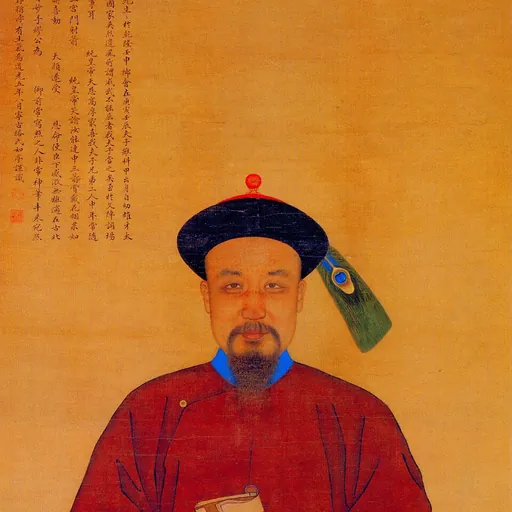
About Tiyeboo
Lived 1752 – 1824 (aged 71–72). Tiyeboo was a Chinese politician, calligrapher and poet.
Tiyeboo (1752-1824), courtesy name Yeting (冶亭), art name Mei'an (梅庵), was a Qing official, calligrapher, and scholar of the Donggo clan from the Manchu Plain Yellow Banner. He obtained the Jinshi degree in 1772 and served in a number of senior official positions.
Biography Tiyeboo's ancestor Joto was a clansman of the founding minister Hohori, whose original surname was Gioro and joined Nurhaci during his raising. According to Tiyeboo's own research, he believed that his further ancestor was Zhao Si (趙偲), Prince of Yue of the Northern Song dynasty, who was captured by the Jurchens. Although born into a family of military officers, he pursued a civil career. After earning the Jinshi degree, he entered the Ministry of Personnel and was promoted steadily through the court system with the support of Grand Secretary Agui, eventually serving as Deputy Minister of Rites (禮部侍郎), Academician of the Imperial Cabinet (內閣學士), and host for the metropolitan and provincial examinations.
During the reign of the Jiaqing Emperor, Tiyeboo served as Viceroy of Grain Transport (漕運總督), Governors of Guangdong (廣東巡撫), Shandong (山東巡撫), and Viceroy of Liangjiang. As Viceroy of Grain Transport, he introduced administrative reforms, and later compiled practical guidelines for his successors based on his experience. He also directed relief efforts following the Yellow River flood of 1803. In 1809, however, he was held accountable for negligence as a leader in subordinate's case of corruption and murder of imperial inspector and was dismissed and exiled to Xinjiang. After returning to Beijing, he served as Ministers of Rites and Personnel, but was again dismissed and exiled to Jilin after the Eight Trigrams Uprising. He returned to the capital in 1818 and retired due to illness in the early Daoguang reign, dying in 1824.
As a reputable calligrapher and scholar in his era, Tiyeboo also served as chief editor of Comprehensive Statutes of the Eight Banners (欽定八旗通志), Anthology of Odes and Eulogies of the Prosperous Dynasty (熙朝雅頌集, a poem collection of Bannermen), and author of his own poem collections.
Citation
Don’t just read it —
keep it.
Full-length biographies made to live with: read them, listen on the way to work, watch them tonight.
- E-book
- Audio
- Video
Instant download · yours to keep · every purchase keeps this site free
Important facts
more
Chabanxiangchuzhitang, An, Meiweng, Haidaoren, Laotie, Weiqingzhai, Yeting, Tie-bao, Donge Tiebao, Tieboo, Dong'e TiebaoPeople in Tiyeboo's life
Named in this biography and alive at the same time
Related people
Same field, nearest in time



Contemporaries
People whose lives overlapped Tiyeboo's





Frequently asked questions
Who was Tiyeboo?
Qing dynasty politician
When was Tiyeboo born?
Tiyeboo was born in 1752.
When did Tiyeboo die?
Tiyeboo died in 1824.
What was Tiyeboo's occupation?
Tiyeboo was a politician, calligrapher and poet.
What nationality was Tiyeboo?
Tiyeboo was Chinese.
Sources & further reading
Cite this page
APA: Biography.guide. (2026). Tiyeboo. https://biography.guide/tiyeboo/
MLA: "Tiyeboo." Biography.guide, https://biography.guide/tiyeboo/.
Chicago: "Tiyeboo." Biography.guide. https://biography.guide/tiyeboo/.
Data last updated: 2026-09-22 · Spot an error? Report a correction.
Portrait: Wikimedia Commons · author & licence
Page generated 2026-09-27 05:04 UTC