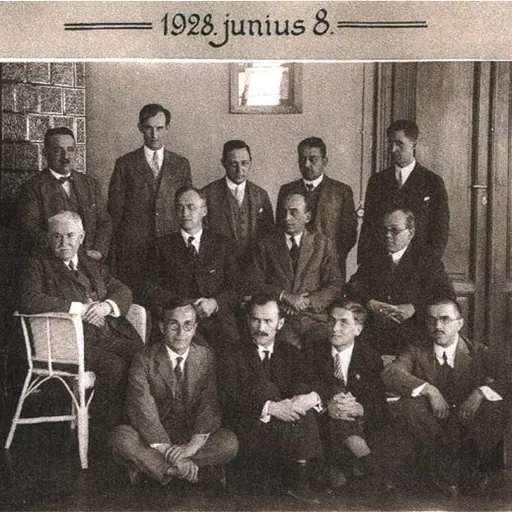
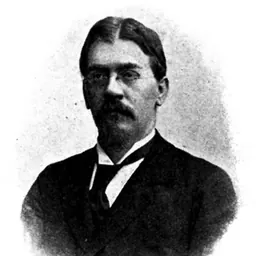
Tibor Radó
Hungarian mathematician
About Tibor Radó
Lived 1895 – 1965 (aged 70). Tibor Radó was a Hungarian and American mathematician, university teacher and czechoslovak legionary, known for Busy beaver, Covering problem of Rado and Radó's theorem (Riemann surfaces).
Tibor Radó ( ; June 2, 1895 – December 29, 1965) was a Hungarian mathematician who moved to the United States after World War I.
Biography Radó was born in Budapest in 1895. He later went on to attend the Polytechnic Institute, studying civil engineering. In World War I, he became a First Lieutenant in the Hungarian Army and was captured on the Russian Front. He escaped from a Siberian prisoner camp and, traveling thousands of miles across Arctic wasteland, managed to return to Hungary.
He received a doctorate from the Franz Joseph University in 1923. He taught briefly at the university and then became a research fellow in Germany for the Rockefeller Foundation. In 1929, he moved to the United States and lectured at Harvard University and the Rice Institute before obtaining a faculty position in the Department of Mathematics at Ohio State University in 1930. In 1935 he was granted American citizenship. In World War II he was a science consultant to the United States government, interrupting his academic career. He became Chairman of the Department of Mathematics at Ohio State University in 1948.
In the 1920s, he proved that surfaces have an essentially unique triangulation. In 1933, Radó published "On the Problem of Plateau" in which he gave a solution to Plateau's problem, and in 1935, "Subharmonic Functions". His work focused on computer science in the last decade of his life and in May 1962 he published one of his most famous results in the Bell System Technical Journal: the busy beaver function and its non-computability ("On Non-Computable Functions").
He died in New Smyrna Beach, Florida.
Works Über den Begriff der Riemannschen Fläche, Acta Scientarum Mathematicarum Universitatis Szegediensis, 1925 The problem of least area and the problem of Plateau, Mathematische Zeitschrift Vol. 32, 1930, p.763 On the problem of Plateau, Springer-Verlag, Berlin, Ergebnisse der Mathematik und ihrer Grenzgebiete, 1933, 1951, 1971 Subharmonic Functions, Springer, Ergebnisse der Mathematik und ihrer Grenzgebiete, 1937 Length and Area, AMS Colloquium Lectures, 1948 with Paul V. Reichelderfer Continuous transformations in analysis - with an introduction to algebraic topology, Springer 1955 On Non-Computable Functions, Bell System Technical Journal 41/1962 scan Computer studies of Turing machine problems, Journal of the ACM 12/1965
Don’t just read it —
keep it.
Full-length biographies made to live with: read them, listen on the way to work, watch them tonight.
- E-book
- Audio
- Video
Instant download · yours to keep · every purchase keeps this site free
Important facts
People in Tibor Radó's life
Named in this biography and alive at the same time

Related people
Same field, nearest in time

Contemporaries
People whose lives overlapped Tibor Radó's

Frequently asked questions
Who was Tibor Radó?
Hungarian mathematician (1895–1965)
When was Tibor Radó born?
Tibor Radó was born on 2 June 1895 in Budapest.
When did Tibor Radó die?
Tibor Radó died on 29 December 1965 in New Smyrna Beach.
What was Tibor Radó's occupation?
Tibor Radó was a mathematician, university teacher and czechoslovak legionary.
What was Tibor Radó known for?
Tibor Radó was known for Busy beaver, Covering problem of Rado, Radó's theorem (Riemann surfaces), Radó's theorem (harmonic functions) and Radó–Kneser–Choquet theorem.
What nationality was Tibor Radó?
Tibor Radó was Hungarian and American.
Sources & further reading
Cite this page
APA: Biography.guide. (2026). Tibor Radó. https://biography.guide/tibor-rado/
MLA: "Tibor Radó." Biography.guide, https://biography.guide/tibor-rado/.
Chicago: "Tibor Radó." Biography.guide. https://biography.guide/tibor-rado/.
Data last updated: 2026-09-23 · Spot an error? Report a correction.
Portrait: Wikimedia Commons · author & licence
Page generated 2026-09-27 05:07 UTC