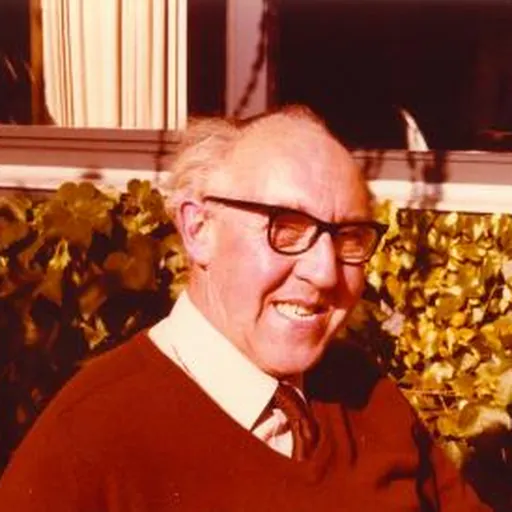
About Thomas Willmore
Lived 1919 – 2005 (aged 85). Thomas Willmore was a British mathematician and university teacher, known for Willmore conjecture, Willmore energy and Willmore flow.
Thomas James Willmore (16 April 1919 – 20 February 2005) was an English geometer. He is best known for his work on Riemannian 3-space and harmonic spaces.
Willmore studied at King's College London. After his graduation in 1939, he was appointed as a lecturer, but the onset of World War II led him to working as a scientific officer at RAF Cardington, working mainly on barrage balloon defences. During the war, he found the time to write his Ph.D. on relativistic cosmology, and gained his Ph.D. on Clock regraduations and general relativity as an external student of the University of London in 1943.
In 1946, he was given a lectureship at the University of Durham. He wrote an influential book with Arthur Geoffrey Walker and HS Ruse entitled Harmonic Spaces in 1953. He left Durham in 1954 for the University of Liverpool to join Walker, after a supposed dispute between Willmore and a Durham colleague who refused to order German textbooks after being wounded in World War I.
In 1965, Willmore returned to Durham, where he was appointed Professor of Pure Mathematics. He was elected vice president of the London Mathematical Society in 1977, a post he held for two years. During that time, he was elected a member of The Royal Academies for Science and the Arts of Belgium.
Willmore retired from the University of Durham in 1984 after holding the position of Head of the Department of Mathematical Sciences on three occasions, covering most of his Professorship there. He was given an honorary degree from the Open University in 1994.
A sculpture by Peter Sales was unveiled at the university on 13 March 2012. It is entitled "Willmore Surface" and depicts a 4-lobed Willmore torus.
Books
Don’t just read it —
keep it.
Full-length biographies made to live with: read them, listen on the way to work, watch them tonight.
- E-book
- Audio
- Video
Instant download · yours to keep · every purchase keeps this site free
Important facts
People in Thomas Willmore's life
Named in this biography and alive at the same time


Related people
Same field, nearest in time


Contemporaries
People whose lives overlapped Thomas Willmore's



Frequently asked questions
Who was Thomas Willmore?
English mathematician (1919–2005)
When was Thomas Willmore born?
Thomas Willmore was born on 16 April 1919 in Gillingham.
When did Thomas Willmore die?
Thomas Willmore died on 20 February 2005 in Durham.
What was Thomas Willmore's occupation?
Thomas Willmore was a mathematician and university teacher.
What was Thomas Willmore known for?
Thomas Willmore was known for Willmore conjecture, Willmore energy and Willmore flow.
What nationality was Thomas Willmore?
Thomas Willmore was British.
Sources & further reading
Cite this page
APA: Biography.guide. (2026). Thomas Willmore. https://biography.guide/thomas-willmore/
MLA: "Thomas Willmore." Biography.guide, https://biography.guide/thomas-willmore/.
Chicago: "Thomas Willmore." Biography.guide. https://biography.guide/thomas-willmore/.
Data last updated: 2026-09-20 · Spot an error? Report a correction.
Portrait: Wikimedia Commons · author & licence
Page generated 2026-09-27 04:58 UTC