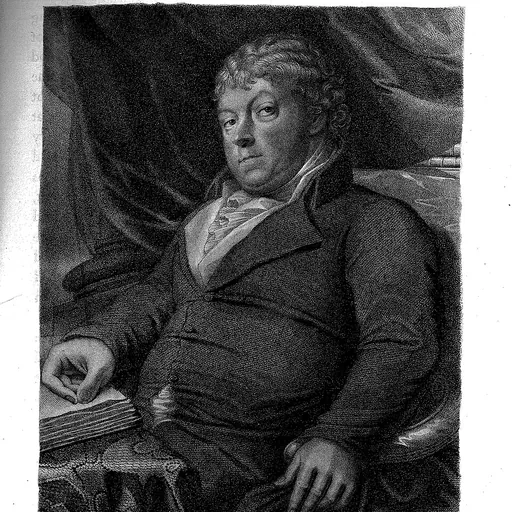
About Thomas Johnes
Lived 1748 – 1816 (aged 67). Thomas Johnes was a British politician, publisher, translator and landscape architect.
Thomas Johnes FRS (1 September 1748 – 23 April 1816) was a Member of Parliament, landscape architect, farmer, printer, writer and social benefactor. He is best known for his development of the Hafod Estate in Wales.
Johnes was born in Ludlow, Shropshire, England. Upon moving from his family home at Croft Castle to an isolated area near Cwmystwyth, in Ceredigion, Wales, Johnes began his life works by building a church for the local tenants, a school, and magnificent gardens, walks and bridges.
He undertook experiments in sheep and cattle breeding together with the growing of new crops and a thriving dairy was established. Trees were planted in great quantities on land considered unsuitable for crops; Johnes obtained the Royal Society of Arts medal five times for planting trees. He encouraged his tenants to improve their farming practices when in 1800 he published A Cardiganshire Landlord's Advice to his Tenants, with a Welsh translation and offered prizes for good crops. He was also one of the chief supporters of the Cardiganshire Agricultural Society, founded in 1784. Johnes devoted his entire life fortune to improving Hafod Estate.
Johnes was the eldest son of Thomas Johnes (–1780) of Llanfair Clydogau and his mother was Elizabeth Knight, daughter of Richard Knight of Croft Castle, Herefordshire. He was born on 1 September 1748 and baptised at Saint Laurence's Church in Ludlow. He was taught to read English at a local preparatory seminary in his native town, and then attended Shrewsbury School at the age of seven and remained for four years. In 1760, he was enrolled in Eton where he remained for seven years; during this time he studied the Latin classics and the Greek language under the direction of William Windham. In 1767, he attended a course of lectures on Logic and Moral Philosophy at the University of Edinburgh. Johnes left Edinburgh towards the end of 1768, and immediately began a Grand Tour on the continent accompanied by Robert Listen. Under his guidance, Johnes travelled through France, Spain, and Italy. They next went to Switzerland, followed the Rhine as far as Strasburgh and crossed through Alsace-Lorraine to Paris, where they lived for several months.
Returning from the trip in the year 1771, Johnes remained nearly three years in Herefordshire society, and in the rural pursuits suited to his age. In the year 1774, however, tired of a life of pleasure, he was determined to devote himself to more worthy and more important causes; he ran as candidate for the borough of Cardigan and was opposed by Sir Robert Smith. Johnes eventually won by petition.
After completing studies at the University of Edinburgh, Johnes matriculated at Jesus College, Oxford, where he obtained the degree of M.A. on 8 July 1783. His first acquaintance with Lord Thurlow first occurred while he was at Oxford.
His marriage to his wife Jane, a beautiful and highly intelligent woman, brought great happiness to Thomas. They enjoyed a close relationship, sharing an interest in improving Ceredigion and a love of Hafod.
Their first child Mariamné was born 30 June 1784. Johnes was completely besotted with her and was closely involved with her upbringing. No expense was spared in her education; tutors from all over the world were hired. He shared an especially close emotional bond with Mariamné. He was heartbroken when she predeceased him on 4 July 1811.
His son Evan was born in 1786, during the time his wife Jane had laid the cornerstone of their home. The boy died in infancy. near Dawlish on 23 April 1816 aged 68 years. He was buried at Saint Michael's Hafod Church, Eglwys Newydd Parish.
Political career After returning from his tour of Europe in 1774 he was elected Member of Parliament (MP) for the borough of Cardigan in the following year. He went on to be elected MP for Radnorshire in 1780, 1784, 1790, 1795 and for Cardiganshire in 1796, 1802, 1806, 1807, and 1812. He served as Lord Lieutenant of Cardiganshire from 1800 until his death in 1816, was promoted as a militia officer to Brevet Colonel in the army, and was elected a Fellow of the Royal Society in 1800.
In 1780, the year he lost his father, in respect for him, he vacated his seat for the borough of Cardigan, and offered himself a candidate for the county of Radnor. This step involved him in a second electioneering contest. He was opposed by Walter Williams, Esq. of Maesclough, but after a heated battle was returned as Knight of the Shire.
The parliamentary politics of Mr. Johnes were at this time decidedly ministerial. To Prime Minister North, who was then prime minister, he was attached by the ties of personal friendship, as well as by their agreement in political views. Like the celebrated Gibbon, he gave many a silent, but sincere vote in favour of the American war. His devotion was his reward. In the year 1781, he was appointed His Majesty's Auditor for the Principality of Wales. This office, which was in fact a well paid sinecure[sic], was a few years afterwards proscribed by a bill- of reform: but by a kind consideration, usual in such cases, and in this instance enforced by the powerful interference of Mr. Johnes's intimate friend Lord Chancellor Thurlow, its abolition was deferred till the demise of the existing incumbent. While Chancellor, secured for his friend Mr. Johnes, a life interest in the office of Auditor of the Landed Revenues of South Wales, in direct opposition to the report of a Committee of the Commons; the other, as a member of that House, is said, in return, to have contributed by his vote and influence to the reversionary Tellership granted by act of parliament to his noble friend, in express opposition to the wishes of Mr. Fox, with whom he had lately become connected in politics.
Mansion
A new mansion at Hafod was built in 1785 by Johnes, after the demolition of the Herbert structure, from the designs of Thomas Baldwin of Bath in the Gothic style. Johnes collected many rare and noble books on natural history and manuscripts in Welsh, French and Latin, which also included many by Edward Lhuyd and many manuscripts and printed editions of the French chronicles of the later Middle Ages.
On 13 March 1807, a fire broke out that completely destroyed the mansion including the contents of the library. Johnes was in London attending Parliament when he heard the news and that his wife and daughter had escaped. 1800 – The Gold Medal, being the Premium offered for planting Larch – Trees was this Session adjudged to Thomas Johnes MP of Hafod. 1801 – The Gold Medal, being the Premium offered for sowing, planting, and inclosing Timber-trees, was this Session adjudged to Thomas Johnes MP of Hafod. 1802 – The Gold Medal, being the Premium offered for sowing, planting, and enclosing Timber-trees was this session adjudged to Thomas Johnes MP of Hafod 1805 – The Gold Medal of the Society was this Session adjudged to Thomas Johnes MP of Hafod, in Cardiganshire, for his plantations of Oaks. 1810 – The Gold Medal of the Society was this Session adjudged to Thomas Johnes, Esq. MP of Hafod in Cardiganshire, for his Plantations of Larch and other trees.
Approximately three million trees were planted on the estate during the tenancy of Colonel Johnes.
Without doubt, Thomas Johnes was the pioneer of upland afforestation in Wales. However, the achievement was not his alone. Throughout his years at Hafod, Thomas Johnes employed some outstanding foresters and gardeners.
Between 1790 and 1810 two Scottish men played key roles: John Greenshields, Estate Bailiff and James Todd, Head Gardener who had previously been a gardener at the Royal Botanic Garden Edinburgh. These two men were in charge of the extensive plantations and forest-nursery activity.
Over the following years, many more Scots foresters were to play key roles in the development of silviculture on estates throughout Wales. Of course it was the men and boys who did the actual planting thereby, playing a key role in making Hafod an outstanding experiment in land management. At Hafod planting rates were in the order of 1000 per team of one man and a boy per day.
The cruciform structure, constructed at the sole expense of Johnes, was designed in Gothic architecture, has a square tower at the west end. In the centre of the cross is a richly ornamented font of artificial stone, supported on an octagonal shaft; one side of the basin bears a shield charged with the arms of the family of Johnes, and the faces of the shaft are embellished with figures representing the cardinal virtues. A painting, by Fuseli, of Christ and the two disciples of Emmaus is installed in the northern transept. The southern window was composed of an ancient stained and painted Renaissance Flemish glass had been installed in Cardigan Priory church; Johnes removed the window from that church for his own project at Hafod.
Farm and dairy New Farm , an experimental farm including an extensive dairy was established at Hafod. It was thought that the lands of Hafod and surrounding Cardiganshire were of a type of soil that could not support dairy farming, however in 1800 approximately four tons of cheese and of butter were produced. Johnes experimented with varieties of cattle to determine which would produce the most milk. To accomplish these studies, he imported 40 cows from the Netherlands which Johnes referred to has his "Dutch ladies". He was subsequently able to produce Parmesan, Stilton, Cheshire and Gloucestershire cheese at will from his own dairy. He also built a school for the poor of the community to attend at no charge. A fund was established to assist families hit by casualties. A physician was brought on staff and medicine was supplied. Each year he and Mrs. Johnes opened up their home at Christmas hosting a large event for everyone at Hafod including staff and tenants.
The Hafod Trust and the Forestry Commission, the current owners, endeavour to preserve and enhance the landscape of Thomas Johnes.
Don’t just read it —
keep it.
Full-length biographies made to live with: read them, listen on the way to work, watch them tonight.
- E-book
- Audio
- Video
Instant download · yours to keep · every purchase keeps this site free
Important facts
Family & relationships
People in Thomas Johnes's life
Named in this biography and alive at the same time




Related people
Same field, nearest in time



Contemporaries
People whose lives overlapped Thomas Johnes's




Frequently asked questions
Who was Thomas Johnes?
British politician, died 1816
When was Thomas Johnes born?
Thomas Johnes was born on 1 September 1748 in Ludlow.
When did Thomas Johnes die?
Thomas Johnes died on 23 April 1816 in Devon.
What was Thomas Johnes's occupation?
Thomas Johnes was a politician, publisher, translator and landscape architect.
What nationality was Thomas Johnes?
Thomas Johnes was British.
Sources & further reading
Cite this page
APA: Biography.guide. (2026). Thomas Johnes. https://biography.guide/thomas-johnes-politician-1748/
MLA: "Thomas Johnes." Biography.guide, https://biography.guide/thomas-johnes-politician-1748/.
Chicago: "Thomas Johnes." Biography.guide. https://biography.guide/thomas-johnes-politician-1748/.
Data last updated: 2026-09-22 · Spot an error? Report a correction.
Portrait: Wikimedia Commons · author & licence
Page generated 2026-09-27 04:59 UTC