
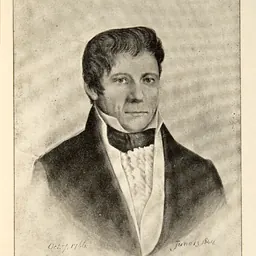
Thomas Humphrey Metcalfe
American maritime fur trader
About Thomas Humphrey Metcalfe
Lived 1761 – 1790 (aged 28–29). Thomas Humphrey Metcalfe was an American fur trader and maritime fur trade.
Thomas Humphrey Metcalfe (also spelled Metcalf) ( – March 16, 1790) was an American maritime fur trader who worked with his father, Simon Metcalfe. After being separated from his father in a storm, Thomas sailed a small schooner with a crew of four from the vicinity of China to Nootka Sound on Vancouver Island where he was arrested by the Spanish. After being released he sailed to Hawaii, hoping to find his father. Instead, he was attacked and killed by Native Hawaiians in revenge for misdeeds committed by his father just days before.
Early family life Little is known about Thomas Metcalfe's life apart from the events of about 1787–1790. Thomas's father, Simon was born in London, England, in the mid-18th century. In 1763 he married Catherine Humphrey. They immigrated to the Province of New York about 1765.
The intention was to take a cargo of tea from China to New York City. But while in Guangzhou (Canton) or Macau, China, the Metcalfes heard about the possibility of making large profits trading sea otter furs in China. Simon Metcalfe decided to sail to the Pacific Northwest Coast to acquire sea otter furs before returning to China to buy tea. An English captain recommended taking a second, smaller ship to serve as tender and to more easily navigate narrow fjords.
To this end, Simon Metcalfe purchased a 26-ton schooner in Macau. This vessel was given the name Fair American and put under the command of Thomas Metcalfe. The little schooner was long and wide and had a crew of four, plus Thomas. The schooner was undecked but copper-bottomed.
Separation and voyage to Nootka Sound The Eleanora, under Simon Metcalfe, and the Fair American, under Thomas Metcalfe, left Macau in May 1789, intending to sail together to Nootka Sound on Vancouver Island, present-day British Columbia, Canada, but they were separated during a storm in the South China Sea.
Thomas sailed north along the Japanese archipelago, the Kuriles, and the Aleutian Islands. After 42 days at sea he stopped at a Russian fur-trade post on Unalaska Island, where the Russian commander Potak Zaikov provided flour and dried fish. Thomas continued down the Pacific Northwest Coast, acquiring some furs through trade with some Tlingit and Haida villages, before arriving at Nootka Sound.
According to Esteban José Martínez, the Spanish commander at Nootka Sound, Thomas Metcalfe's Fair American arrived with "her mast sprung and her sails split", and that the schooner had no provisions left but only "some casks of water and some 65 otter skins". In addition, Martínez noted that Thomas Metcalfe had "no written passport or instructions and no papers except his diary", and that his sole compass was broken.
The Spanish naval officer Esteban José Martínez was in command and had orders to detain all foreign vessels. He seized the British merchant ships Argonaut, under James Colnett, , under Thomas Hudson, and North West America, under Robert Funter. Martínez did not detain the U.S. ships Columbia Rediviva and Lady Washington, under John Kendrick and Robert Gray.
On 20 October 1789, the Fair American under Thomas Metcalfe reached Nootka Sound. Esteban José Martínez seized the schooner and arrested the crew. A few days later Simon Metcalfe approached Nootka Sound and the Eleanora was almost captured as well, but he managed to escape. Martínez took the Fair American and her crew to the Spanish naval base at San Blas, Mexico, arriving on 6 December 1789.
The Eleanora under Simon Metcalfe arrived in the islands first, in the winter of 1789–90. In Kohala on the island of Hawaiʻi, Simon Metcalfe was greeted by local chief Kameʻeiamoku and trading ensued. There was some altercation between Simon and Kameʻeiamoku. The details are lost except that Simon had the chief flogged. He then sailed to the neighboring island of Maui to trade along the coast. Due to Simon's treatment of him, Kameʻeiamoku vowed revenge on whatever ship next came his way.
On the coast of Maui a boat and sailor from the Eleanora went missing. It was discovered that the boat had been stolen. Simon Metcalfe's reaction became known as the Olowalu Massacre. He sailed to the village of the suspected thieves, Olowalu. Feigning peaceful intent, he invited the villagers to the Eleanora for trade while he had his cannon loaded with ball and shot. When many canoes had gathered at the ship Simon ordered a broadside fired at point-blank range, which blasted the canoes to pieces. About 100 Native Hawaiian men, women, and children were killed and a great many more wounded.
That next ship was the Fair American, captained by Thomas Metcalfe, the son of the very person who had so offended the chief, although nobody was aware of that fact at the time. The schooner was manned by only four sailors plus its relatively inexperienced captain. On 16 March 1790, Kameʻeiamoku's men easily captured the schooner. Thomas Metcalfe and his crew were killed. The only survivor was Isaac Davis, who was badly injured but for some reason spared. Kameʻeiamoku appropriated the ship, its guns, ammunition, and other valuable goods, as well as Isaac Davis himself. At the time no one was aware of the family relation between the captain of the Fair American and Simon Metcalfe, whose Eleanora was anchored at Kealakekua Bay, about away.
These events mark a turning point in Hawaiian history. John Young and Isaac Davis were instrumental in Kamehameha's military ventures and his eventual conquest and unification of the Hawaiian Islands. Their skill in gunnery, as well as the cannon from the Fair American, helped Kamehameha win many battles, including the Battle of Kepaniwai, later in 1790, where the forces of Maui were defeated. Young and Davis married members of the royal family, raised families and received valuable lands. Simon Metcalfe and his entire crew, except one, were killed.
Don’t just read it —
keep it.
Full-length biographies made to live with: read them, listen on the way to work, watch them tonight.
- E-book
- Audio
- Video
Instant download · yours to keep · every purchase keeps this site free
Important facts
People in Thomas Humphrey Metcalfe's life
Named in this biography and alive at the same time



Related people
Same field, nearest in time



Contemporaries
People whose lives overlapped Thomas Humphrey Metcalfe's




Frequently asked questions
Who was Thomas Humphrey Metcalfe?
American maritime fur trader
When was Thomas Humphrey Metcalfe born?
Thomas Humphrey Metcalfe was born in 1761.
When did Thomas Humphrey Metcalfe die?
Thomas Humphrey Metcalfe died on 16 March 1790 in Hawaii.
What was Thomas Humphrey Metcalfe's occupation?
Thomas Humphrey Metcalfe was a fur trader and maritime fur trade.
What nationality was Thomas Humphrey Metcalfe?
Thomas Humphrey Metcalfe was American.
Sources & further reading
· Wikipedia: Thomas Humphrey Metcalfe
· DBpedia: Thomas Humphrey Metcalfe
Cite this page
APA: Biography.guide. (2026). Thomas Humphrey Metcalfe. https://biography.guide/thomas-humphrey-metcalfe/
MLA: "Thomas Humphrey Metcalfe." Biography.guide, https://biography.guide/thomas-humphrey-metcalfe/.
Chicago: "Thomas Humphrey Metcalfe." Biography.guide. https://biography.guide/thomas-humphrey-metcalfe/.
Data last updated: 2026-09-22 · Spot an error? Report a correction.
Page generated 2026-09-27 05:24 UTC