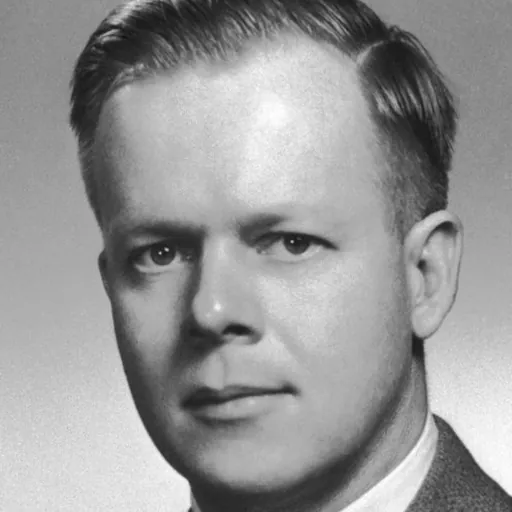
About Thomas Huckle Weller
Lived 1915 – 2008 (aged 93). Thomas Huckle Weller was an American biologist, virologist and physician, known for Polio.
Thomas Huckle Weller (June 15, 1915 – August 23, 2008) was an American virologist. He, John Franklin Enders and Frederick Chapman Robbins were awarded a Nobel Prize in Physiology or Medicine in 1954 for showing how to cultivate poliomyelitis viruses in a test tube, using a combination of human embryonic skin and muscle tissue.
Biography Weller was born and grew up in Ann Arbor, Michigan, where he graduated from Ann Arbor High School. He then went to the University of Michigan, where his father Carl Vernon Weller was a professor in the Department of Pathology. At Michigan, he studied medical zoology and received a B.S. and an M.S., with his masters thesis on fish parasites.
In 1936, Weller entered Harvard Medical School, and in 1939 began working under John Franklin Enders, with whom he would later (along with Frederick Chapman Robbins) share the Nobel Prize. It was Enders who got Weller involved in researching viruses and tissue-culture techniques for determining infectious disease causes. Weller received his MD in 1940, and went to work at Children's Hospital in Boston.
In 1942, during World War II, he entered the Army Medical Corps and was stationed at the Antilles Medical Laboratory in Puerto Rico, earning the rank of Major and heading the facility's Departments of Bacteriology, Virology and Parasitology. After the War, he returned to Children's Hospital in Boston, and it was there in 1947, that he rejoined Enders in the newly created Research Division of Infectious Diseases. After several leading positions, in July 1954, he was appointed head of the Tropical Public Health Department at the Harvard School of Public Health. Weller also served from 1953 to 1959 as director of the Commission on Parasitic Diseases of the American Armed Forces Epidemiological Board.
In addition to his work on polio, Weller also contributed to treating schistosomiasis, and Coxsackie viruses. He was also the first to isolate the virus responsible for chickenpox.
Awards In 1954, Weller was awarded the George Ledlie prize in recognition of his research on rubella, polio and cytomegalovirus(CMV) viruses.
He was awarded the Nobel Prize in Physiology or Medicine in 1954 for his research on polio.
In 1996 he was awarded the Walter Reed Medal from the American Society of Tropical Medicine and Hygiene.
Personal life In 1945, Weller married Kathleen Fahey, who died in 2011 aged 95. They had two sons and two daughters.
Don’t just read it —
keep it.
Full-length biographies made to live with: read them, listen on the way to work, watch them tonight.
- E-book
- Audio
- Video
Instant download · yours to keep · every purchase keeps this site free
Important facts
People in Thomas Huckle Weller's life
Named in this biography and alive at the same time





Related people
Same field, nearest in time


Contemporaries
People whose lives overlapped Thomas Huckle Weller's




Frequently asked questions
Who was Thomas Huckle Weller?
American virologist (1915-2008)
When was Thomas Huckle Weller born?
Thomas Huckle Weller was born on 15 June 1915 in Ann Arbor.
When did Thomas Huckle Weller die?
Thomas Huckle Weller died on 23 August 2008 in Needham.
What was Thomas Huckle Weller's occupation?
Thomas Huckle Weller was a biologist, virologist and physician.
What was Thomas Huckle Weller known for?
Thomas Huckle Weller was known for Polio.
What nationality was Thomas Huckle Weller?
Thomas Huckle Weller was American.
Sources & further reading
· Wikipedia: Thomas Huckle Weller
· DBpedia: Thomas Huckle Weller
Cite this page
APA: Biography.guide. (2026). Thomas Huckle Weller. https://biography.guide/thomas-huckle-weller/
MLA: "Thomas Huckle Weller." Biography.guide, https://biography.guide/thomas-huckle-weller/.
Chicago: "Thomas Huckle Weller." Biography.guide. https://biography.guide/thomas-huckle-weller/.
Data last updated: 2026-09-20 · Spot an error? Report a correction.
Portrait: Wikimedia Commons · author & licence
Page generated 2026-09-27 04:58 UTC