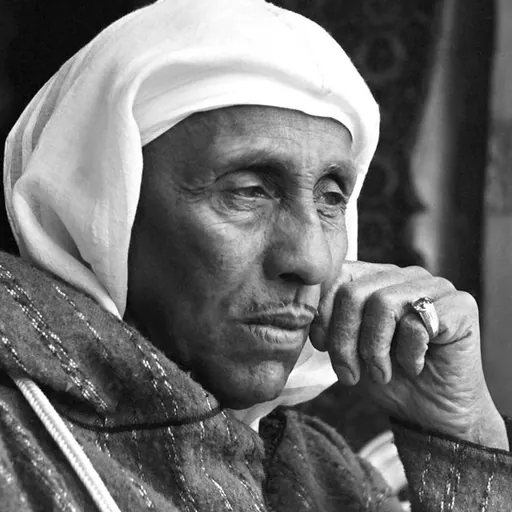
About Thami El Glaoui
Lived 1879 – 1956 (aged 76–77). Thami El Glaoui was a Moroccan politician and statesperson.
Thami El Glaoui (; 1879–23 January 1956) was the Pasha of Marrakesh from 1912 to 1956. His family name was el Mezouari, from a title given an ancestor by Ismail Ibn Sharif in 1700, while El Glaoui refers to his chieftainship of the Glaoua (Glawa) tribe of the Berbers of southern Morocco, based at the Kasbah of Telouet in the High Atlas and at Marrakesh. El Glaoui became head of the Glaoua upon the death of his elder brother, Si el-Madani, and as an ally of the French protectorate in Morocco, conspired with them in the overthrow of Sultan Mohammed V.
On October 25 of 1955, El-Glaoui announced his acceptance of Mohammed V's restoration as well as Morocco's independence.
Early life and career
Thami was born in 1879 in the Imezouaren family, in the Ait Telouet tribe, a clan of the Southern Glaoua. His family was originally in a place called Tigemmi n'Imezouaren in the Fatwaka tribe, near the Tassaout river. His father was the qaid of Telouet, Mohammed ben Hammou, known as Tibibit, and his mother was Zouhra Oum El Khaïr, a black slave. When Si Mohammed died on 4 August 1886, his eldest son Si Mhamed took over his father's position and then died the same year. After the death of Si M'hammed, his brother Si Madani took power and put his brother T'hami as his khalifat (assistant).
In the autumn of 1893, Sultan Moulay Hassan and his army were crossing the High Atlas mountains after a tax-gathering expedition when they were caught in a blizzard. They were rescued by Si Madani, and the grateful Sultan bestowed on Si Madani from Tafilalt to the Sous. In addition, he presented the Glaoua arsenal with a working 77-mm Krupp cannon, the only such weapon in Morocco outside the imperial army. The Glaoua army used this weapon to subdue rival warlords.
In 1902, Madani, T'hami and the Glaoua force joined the imperial army of Moulay Abdelaziz as it marched against the pretender Bou Hamara. The Sultan's forces were routed by the pretender. Madani became a scapegoat, and spent months of humiliation at court before being allowed to return home. He thereupon began to actively work to depose Moulay Abdelaziz. This was achieved in 1907 with the enthronement of Abdelhafid of Morocco, who rewarded the Glaoua by appointing Si Madani as his Grand Vizier, and T'hami as Pasha of Marrakesh.
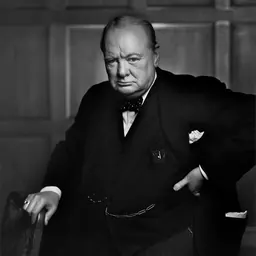
Thami el-Glawi (center) at his reception at the Élysée Palace in Paris in 1921, photographed with Abdelqader Bin Ghabrit (right).The Pasha attended the coronation of Queen Elizabeth II as a private guest of Winston Churchill, the two had met during the latter's trips to Marrakech, often to paint. The Pasha's lavish gifts of a jeweled crown and an ornate dagger were refused as it was not customary for gifts to be received from individuals not representing a government. T'hami regarded the Sultan's order as a personal insult that must be wiped out at all costs. On 17 August 1953, Kittani and the Glaoui unilaterally declared Ben Arafa to be the country's imām. On 25 August 1953, the French Resident had the Sultan and his family forcibly seized and deported to exile, and Ben Arafa was proclaimed the new sultan.
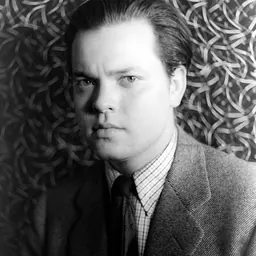
Personal life In the spring of 1933, Orson Welles, was the guest of El Glaoui.
Death El Glaoui died during his night prayers on 23 January 1956, not long after the return of the Sultan. His properties and wealth were later seized by the state.
Descendants
Hassan El Glaoui, one of T'hami's sons, is among Morocco's best-known figurative painters, with works selling for hundreds of thousands pounds at Sotheby's. Abdessadeq El Glaoui, another one of T'hami's sons, is a former Moroccan ambassador to the USA, has written a book about his father and his relations with the French and the monarchy. Mehdi El Glaoui, a grandson of Thami El Glaoui and son of Brahim El Glaoui is famous for his role as Sébastien in the French television series Belle et Sébastien Brice Bexter, a great-grandson of Thami El Glaoui an grandson of Hassan El Glaoui, is a rising Moroccan and international actor.
Honours Grand Cross of the Légion d'honneur (1925) Grand Officer of the Légion d'honneur (1919) Commandeur of the Légion d'honneur (1913) Officier of the Légion d'honneur (1912) Chevalier of the Légion d'honneur (1912) Croix de Guerre 1914–1918 with two palms (1916 at Sektana and 1917 at Tiznit)
Don’t just read it —
keep it.
Full-length biographies made to live with: read them, listen on the way to work, watch them tonight.
- E-book
- Audio
- Video
Instant download · yours to keep · every purchase keeps this site free
Important facts
People in Thami El Glaoui's life
Named in this biography and alive at the same time

Related people
Same field, nearest in time





Contemporaries
People whose lives overlapped Thami El Glaoui's


Frequently asked questions
Who was Thami El Glaoui?
Moroccan politician (1870-1956)
When was Thami El Glaoui born?
Thami El Glaoui was born in 1879 in Telouet.
When did Thami El Glaoui die?
Thami El Glaoui died on 12 January 1956 in Marrakech.
What was Thami El Glaoui's occupation?
Thami El Glaoui was a politician and statesperson.
What nationality was Thami El Glaoui?
Thami El Glaoui was Moroccan.
Sources & further reading
Cite this page
APA: Biography.guide. (2026). Thami El Glaoui. https://biography.guide/thami-el-glaoui/
MLA: "Thami El Glaoui." Biography.guide, https://biography.guide/thami-el-glaoui/.
Chicago: "Thami El Glaoui." Biography.guide. https://biography.guide/thami-el-glaoui/.
Data last updated: 2026-09-22 · Spot an error? Report a correction.
Portrait: Wikimedia Commons · author & licence
Page generated 2026-09-27 05:04 UTC