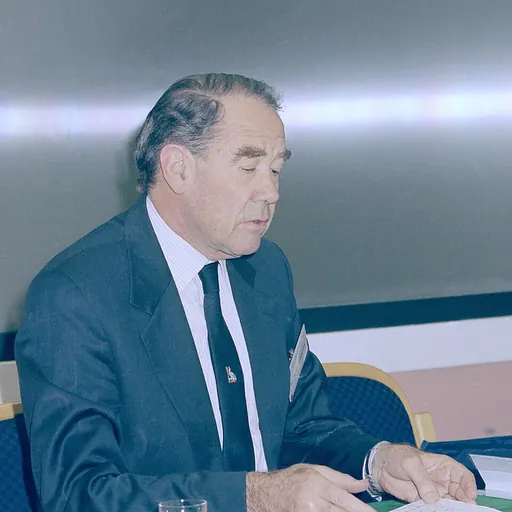
About Terence English
Lived 1932 – 2025 (aged 93). Terence English was a South African and British surgeon.
Sir Terence Alexander Hawthorne English (3 October 1932 – 23 November 2025) was a South African-born British cardiac surgeon. He was consultant cardiothoracic surgeon at Papworth Hospital and Addenbrooke's Hospital, Cambridge, 1973–1995. After starting a career in mining engineering, English switched to medicine and went on to lead the team that performed Britain's first successful heart transplant in August 1979 at Papworth, and soon established it as one of Europe's leading heart–lung transplant programmes. Professor John Wallwork subsequently developed the heart lung transplantation programme at Papworth.
English was born into a family of mixed Irish, Afrikaans, Yorkshire and Scottish descent. His father died at age 49, leaving his mother to bring up two children in South Africa. After completing a degree in Mining Engineering in Johannesburg, he was inspired by a maternal uncle, who was a surgeon, to study medicine, and with the financial aid of an unexpected legacy travelled to London. After completing his medical training at Guy's Hospital Medical School, he was stimulated by the pioneering open heart surgery taking place in the 1960s and he embarked on a career in cardiac surgery and then specialised in cardiac transplantation. He was knighted a KBE in the 1991 New Years Honours List.
Early life and education Terence English was born on 3 October 1932 in Pietermaritzburg, South Africa, to Mavis and Arthur English. He had an older sister called Elizabeth. Arthur English died from silicosis when Sir Terence was two years old.
Engineering and university, mining to medicine
After leaving school at the age of seventeen, English worked for a year in what was then Southern Rhodesia (now Zimbabwe), as a diamond driller with the Cementation Company (Africa) Ltd on a dam near Salisbury (now Harare). This skill was useful in providing opportunities for summer jobs while he was studying for a BSc in mining engineering at Witwatersrand University in Johannesburg, which he completed in 1954.
In 1961, English captained the Guy's 1st XV team when they won the Rugby Inter-Hospitals Cup.
Surgical career After completing medical school and internship,
Subsequently, English embarked on his own research at Huntingdon Research Centre directed towards defining the best way of preserving myocardial function during the period of anoxia between the heart's removal from the donor and its transplantation into the recipient. This comprised a combination of hypothermic, and pharmacological inhibition of metabolism and allowed safe periods of storage of the donor heart for up to 6 hours. By the end of 1977 English felt ready to embark on a clinical programme and submitted his plans to the Transplant Advisory Panel (TAP) of the Department of Health. He was received politely when the TAP met in January 1978 but was later informed that there was no funding for a heart transplant programme and they did not want to see any one-off operations. English carried on with developing the heart transplant programme and became Director of the British Heart Foundation Transplant Research Unit at Papworth (1980–1998).
Factors in the transplant programme development The criteria for establishing brainstem death published by the UK Medical Royal Colleges and their Faculties in October 1976, allowed removal of a heart from a brain-dead donor. Political opposition versus philanthropy. After failing to get funding from the Transplant Advisory Panel, English obtained support for the first two from the Area health Authority and then funding from the Cambridge millionaire David Robinson. Other sources followed until 1985 when the DoH provided secure funding for both transplant units at Papworth and Harefield Hospital. A Jarvic 7 heart was used as a bridge to transplantation until a human donor heart could be found and the patient subsequently survived nearly two years.
Other roles
Member General Medical Council, GMC, (1983–1989) Representing the Royal College of Surgeons, English served initially on the Preliminary Proceedings Committee of the GMC. Later, he became a member of the Education Committee the GMC and was involved in the debate on specialist certification. Being responsible for presidents of the surgical specialist associations becoming invited members of the RCS Council. Implementing the "English Clause" during the 1991 New Deal for Junior Doctors Hours. This allowed surgical trainees to work beyond the stipulated 72 hours providing this was voluntary and they were not under pressure to do this. It worked well until abolished by the DoH 6 years later. Insisted on including the BMA in the Clinical Services Advisory Group (CSAG). Proposals to radically reform the NHS by the Conservative government in 1990 had planned to exclude the BMA. English played a key role by refusing to co-operate with the CSAG unless the Joint Consultants Committee chairman, Tony Grabham was a member.
President of the British Medical Association (1995–1996) English publicly supported the extended role of nurses.
Master of St Catharine's College Cambridge (1993–2000)
Elected master of St Catharine's College, where English spent seven years. In his farewell speech he expressed admiration for the wide educational and social background of the students and their hard work and range of extra-curricular activities. He also regretted the increasing bureaucracy of performance assessment exercises that the academic staff were being subjected to.
Trustee of the Hunterian Museum (1994–) English was an elected trustee of the Hunterian Museum in London beginning in 1994. English also became a Member of the Audit Commission 1993–1998, assisting with medical projects and treatment of Gaza's wounded; supporting the legalization of physician-assisted dying; as patron for Dignity in Dying; and 4x4 adventure driving across the world.
Honours and awards 1951 – Transvaal Chamber of Mines Scholarship. 1979 – Travelling Scholarship, Society for Cardiothoracic Surgery in Great Britain and Ireland. 2009 – Lifetime Achievement Award (Society for Cardiothoracic Surgery in Great Britain and Ireland) for outstanding contributions to cardiothoracic surgery. 2014 – Lifetime Achievement Award from the International Society for Heart and Lung Transplantation in Recognition of Outstanding Achievements and Tireless Dedication in the Field of Heart and Lung Transplantation. 2014 – The Ray C Fish Award for Scientific Achievement in Cardiovascular Disease from the Texas Heart Institute. Books and publications "Follow Your Star" From Mining to Heart Transplants – A Surgeon's Story (AuthorHouse 2011). Principles of Cardiac Diagnosis and Treatment – A Surgeon's Guide, edited by Donald Ross, Terence English and Roxane McKay Springer-Verlag (Second Edition, London, 1992). 23 chapters contributed to books. 118 peer reviewed articles.
Don’t just read it —
keep it.
Full-length biographies made to live with: read them, listen on the way to work, watch them tonight.
- E-book
- Audio
- Video
Instant download · yours to keep · every purchase keeps this site free
Important facts
People in Terence English's life
Named in this biography and alive at the same time





Related people
Same field, nearest in time



Contemporaries
People whose lives overlapped Terence English's

Frequently asked questions
Who was Terence English?
South African-born British cardiac surgeon
When was Terence English born?
Terence English was born on 3 October 1932 in South Africa, Pietermaritzburg.
When did Terence English die?
Terence English died on 23 November 2025 in Iffley.
What was Terence English's occupation?
Terence English was a surgeon.
What nationality was Terence English?
Terence English was South African and British.
Sources & further reading
Cite this page
APA: Biography.guide. (2026). Terence English. https://biography.guide/terence-english/
MLA: "Terence English." Biography.guide, https://biography.guide/terence-english/.
Chicago: "Terence English." Biography.guide. https://biography.guide/terence-english/.
Data last updated: 2026-09-22 · Spot an error? Report a correction.
Portrait: Wikimedia Commons · author & licence
Page generated 2026-09-27 05:02 UTC