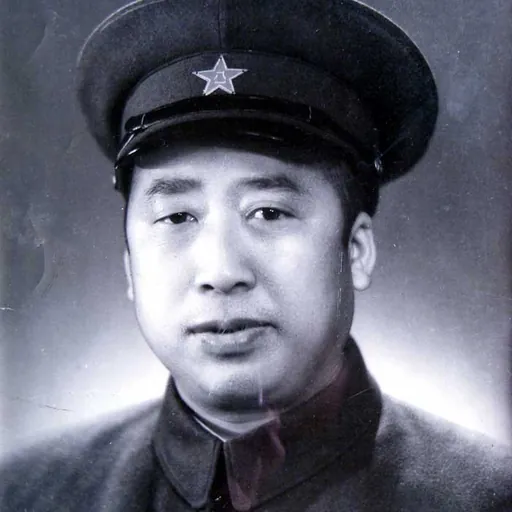
About Teng Daiyuan
Lived 1904 – 1974 (aged 70). Teng Daiyuan was a Chinese politician.
Teng Daiyuan (; November 2, 1904 – December 1, 1974) was a military leader of the People's Liberation Army, a senior leader of the Chinese Communist Party, and a politician of the People's Republic of China. After formation of the People's Republic of China, Teng served as the first Minister of Railways.
Early life Teng was born on 2 November 1904 in Mayang, Hunan, to a family of Miao ethnicity. In 1923, he was admitted to the Hunan Public Second Normal School in Changde, where he organized the Mayang New People Society and founded the publication Jinjiang Tide.
Revolutionary career In October 1924, he joined the Communist Youth League of China, and in the spring of 1925, he joined the Kuomintang. Later that same year, in October, he transferred to the Chinese Communist Party, where he led student movements. After 1926, he served as the Secretary of the Communist Youth League in Pingjiang County, Hunan. He was then transferred to the outskirts of Changsha, where he held positions as the Chairman of the Hunan Provincial Farmers' Association and the Secretary of the Suburban District Committee, actively promoting the peasant movement.
Chinese Civil War Photo taken in Yan'an of the political commissar and former commanders of the Third Red Army, which had been based in Hunan before the Long March. From left: Li Fuchun, Peng Dehuai, Yang Shangkun and Teng Daiyuan. Following the Changsha coup in 1927, Teng went underground. In August, he was appointed as a member of the Hunan Provincial Committee and Chairman of the Provincial Farmers' Association. Shortly afterward, he took on the role of Secretary of the Xiangdong Special Committee in Jiangxi, while concurrently serving as Secretary of the Liling County Committee. In June 1928, Teng became the Secretary of the Hunan–Hubei–Jiangxi Soviet Border Special Committee, where he focused on youth movements, the peasant movement, and military organization efforts.
On January 1, 1929, the Nationalist forces launched their third encirclement campaign against Jinggangshan. On January 4, Communist leaders in Jinggangshan held a four-day meeting in Bailu Village, Ninggang County, Jiangxi, where they decided that Mao Zedong and Zhu De would lead the main force of the Fourth Red Army in an offensive while leaving Peng Dehuai and Teng Daiyuan to defend Jinggangshan. Teng and Peng subsequently commanded the Fifth Red Army and Wang Zuo’s forces to repel Nationalist attacks on Jinggangshan. However, facing overwhelming enemy strength, Jinggangshan eventually fell, and Peng led a breakout with heavy losses, leaving only 283 survivors from the Red Army units.
In 1932, Teng participated in the battles in the border region of Guangdong and Jiangxi. In July 1933, he became the Political Commissar of the Eastern Army, leading forces in combat in Fujian. However, by the end of 1933, Teng faced marginalization due to the influence of Wang Ming and Bo Gu and was forced to leave his position in the Third Red Army Corps, being reassigned as Director of the Armament Mobilization Department under the Central Military Commission. In July 1934, Teng traveled to the Soviet Union to attend the 7th World Congress of the Comintern and studied at the Red Army Military Academy and the International Lenin School. In the spring of 1937, he returned to Xinjiang, where he and Chen Yun organized the reception of remnants of the Western Route Army in Dihua, Xinjiang, establishing the Eighth Route Army office in Xinjiang.
In 1940, Teng was transferred to serve as vice president and Deputy Political Commissar of the Anti-Japanese Military and Political University, while also becoming a standing committee member of the CCP Northern Bureau. He dedicated his efforts to training anti-Japanese military and political cadres in the Taihang anti-Japanese base area. In August 1942, after the death of Zuo Quan, Teng became the Chief of Staff of the Eighth Route Army's forward command and also took on the role of Director of the Intelligence Department. During this period, communist bases faced dual blockades from both Japanese and Nationalist forces.
In 1944, Teng and Yang Lisan proposed the "Teng-Yang Scheme" to conserve resources and maintain logistics within Chinese communist military units. In August 1945, as Japan prepared to surrender, Teng led his troops in counteroffensive operations against the Japanese forces, successfully reclaiming vast amounts of lost territory.
Second part of Chinese Civil War The leaders of the Shanxi-Hebei-Shandong-Henan Military Region. From left to right: Xu Xiangqian, Wang Shiying, Zhou Shidi and Teng Daiyuan (1947) After the Second Sino-Japanese War, Teng Daiyuan was appointed Deputy Commander of the Jin-Ji-Lu-Yu (Shanxi-Hebei-Shandong-Henan) Military Region. In 1946, Teng went to Beiping as a military advisor to Ye Jianying, a representative of the CCP at the Military Mediation Executive Department. While wearing the rank of lieutenant general in the National Revolutionary Army, he assisted Ye in mediating military conflicts, overseeing the implementation of army reorganization plans, restoring transportation, disarming enemy forces, and repatriating Japanese prisoners of war.
In July 1946, to ensure that Liu Bocheng and Deng Xiaoping could lead the main forces to carry out key combat missions, Teng and Bo Yibo took charge of leadership responsibilities in the military region. By July 1947, after the Jin-Ji-Lu-Yu Field Army advanced into the Dabie Mountains, Teng and Bo began organizing the North China Field Army under the People's Liberation Army (PLA) to support Xu Xiangqian's decisive battles against Yan Xishan's forces in Shanxi.
In April 1948, Teng was appointed Deputy Commander of the North China Military Region and became a member of the Standing Committee of the CCP North China Bureau. In November 1948, he was appointed Minister of Railways for the Central Military Commission and later also served as Commander of the Railway Corps.
Political career Teng (left) awards honorary certificate to Konstantin S. Silin, the team leader of Soviet engineers who took part in the construction of Wuhan Yangtze River Bridge (1957) After the establishment of the People's Republic of China, Teng Daiyuan served as the Minister of Railways in the Central People's Government and the People's Republic of China. He was a pioneer in the development of China's railway system and the founder of the Railway Corps. Under his leadership, several major projects were completed in the first decade after the country's founding, including the construction of the Chengdu–Chongqing railway, the Tianshui-Lanzhou Railway, the Fengsha Railway, the Baotou–Lanzhou railway, the Liuzhou-Zhanjiang Railway, the Baoji–Chengdu railway, the Yingtan–Xiamen railway, and the Wuhan Yangtze River Bridge. By the end of 1958, the total length of China's railway network had reached 53,000 kilometers.
In 1958, he took a leave of absence due to illness, and Lü Zhengcao assumed responsibility for the Ministry of Railways, eventually taking over the position in 1965.
Family life In 1938, Teng married Lin Yi, who served as an intelligence officer in the Eighth Route Army. The couple had five sons. Their youngest son, Teng Jiuxin, served as the deputy manager of the Railway Travel Agency and director of the China Railway Museum.
Don’t just read it —
keep it.
Full-length biographies made to live with: read them, listen on the way to work, watch them tonight.
- E-book
- Audio
- Video
Instant download · yours to keep · every purchase keeps this site free
Important facts
People in Teng Daiyuan's life
Named in this biography and alive at the same time


Related people
Same field, nearest in time





Contemporaries
People whose lives overlapped Teng Daiyuan's

Frequently asked questions
Who was Teng Daiyuan?
Chinese politician (1904–1974)
When was Teng Daiyuan born?
Teng Daiyuan was born on 2 November 1904.
When did Teng Daiyuan die?
Teng Daiyuan died on 1 December 1974.
What was Teng Daiyuan's occupation?
Teng Daiyuan was a politician.
What nationality was Teng Daiyuan?
Teng Daiyuan was Chinese.
Sources & further reading
Cite this page
APA: Biography.guide. (2026). Teng Daiyuan. https://biography.guide/teng-daiyuan/
MLA: "Teng Daiyuan." Biography.guide, https://biography.guide/teng-daiyuan/.
Chicago: "Teng Daiyuan." Biography.guide. https://biography.guide/teng-daiyuan/.
Data last updated: 2026-09-21 · Spot an error? Report a correction.
Portrait: Wikimedia Commons · author & licence
Page generated 2026-09-27 04:58 UTC