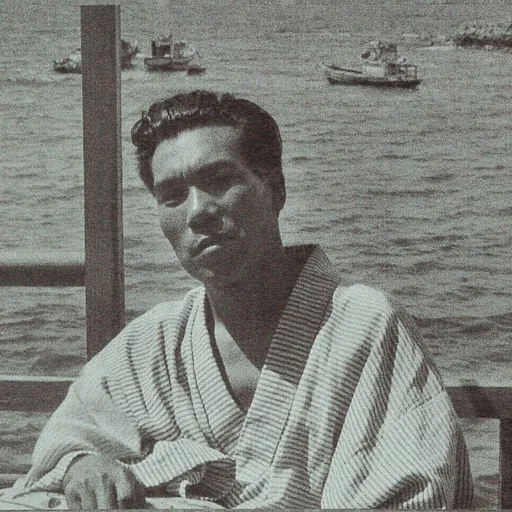
About Teikō Shiotani
Lived 1899 – 1988 (aged 89). Teikō Shiotani was a Japanese photographer.
alt=Teikō Shiotani, when 35 years old. He is wearing a yukata and faces the camera across a table. The sea is visible behind him. was a Japanese photographer whose work in the late 1920s and early 1930s in and near Tottori, where he lived, made him a major figure in Japanese pictorialism.
Despite living far from any metropolis, Shiotani was famous among photographers nationwide. He portrayed landscapes, seascapes, priests at a local temple, his family, and other quotidian matters and scenes; his images at times unmediated, at others exploiting lens aberration or using darkroom effects. Among the photographers directly influenced by him was Shōji Ueda, who lived nearby.
As ideals and fashions in photography changed, Shiotani's work was largely forgotten in postwar Japan until interest was reawakened by a 1975 book devoted to his work; he later became known outside Japan thanks to an exhibition of Japanese photography that toured Europe from 1979 to 1982. Many prints made by Shiotani survive in museum collections, and since 2016 four photobooks largely or exclusively dedicated to his work have been published in Japan.
Life and career
Early life Magazine advertisement (January 1913) for the Vest Pocket Kodak, describing it as "the latest ideal handheld camera"
Sadayoshi Shiotani (, Shiotani Sadayoshi) was born on 24 October 1899 in Akasaki (since 2004 part of Kotoura), Tottori, to a family who owned a shipping agency. He was the eldest son; his paternal grandfather had held various important civic posts and been interested in photography. camera. When Shiotani was 13, he participated in a photography event at Karo harbour in Tottori.
From 1912, Shiotani attended Kurayoshi Agricultural High School (now ). Powerfully built, he did well at judo. Like other users of the Vest Pocket Kodak, the teenage Shiotani was embarrassed when serious amateur photographers saw him using it; he soon supplemented it with a large format (90×130 mm) camera with a Carl Zeiss Tessar lens, Hokutō Saigō , the key figure in Kōei, greatly encouraged Shiotani. The aim was geijutsu shashin, which, depending on context, could be translated as "artistic", "art", "salon" or "pictorialist" photography. The meniscus lens of the Vest Pocket Kodak did not permit detail, and photographers using it – notably Masataka Takayama, , , Mitsugi Arima and Kōyō Yasumoto – would often remove an aperture limiter from around its lens (fūdo hazushi), Shiotani was attracted by the misty results and their resemblance to the works of a painter from Tottori whom he respected highly. ), realized that Shiotani was unusually talented.
Despite these hardships, a number of photographs Shiotani took on the trip soon appeared in magazines. His Bird's-Eye View of a Village (Mura no chōkan) was published in the March 1926 issue of Geijutsu Shashin Kenkyū. It was influenced by Picasso and Braque's paintings from L'Estaque (which Shiotani knew of via the writings of Nakajima), and also Maeta's paintings of Paris.
From 1925 to 1927, Shiotani was also one of the key members of a group of photographers that in 1928 formally became the Japan Photography Association (Nihon Kōga Kyōkai, ). A successor to the Japan Photographic Art Association (Nihon Kōga Geijutsu Kyōkai, ), this published a magazine (Gashū, ) and an annual, and held meetings and exhibitions. It was open to expressive distortions made with the camera, in the darkroom, or to the print: in addition to removing the aperture limiter from around the lens of a Vest Pocket Kodak, this might include deforming the printing paper under the enlarger, wiping prints with darker oil, and selectively removing this or adding powder to lighten areas. The work of Shiotani and the three other key members – Yamamoto, Takayama and Watanabe – was highly regarded by Nakajima, whose publications made their work well known (and who in 1933 published a how-to guide for the Vest Pocket Kodak ).
From the mid-1920s, and often under one pseudonym or another, Shiotani's photographs frequently appeared in four Japanese photography magazines: Asahi Camera, Geijutsu Shashin Kenkyū, Camera and . All four were new, championing the new trends in art photography whose major proponents were Tetsusuke Akiyama of the and Kōrō Kometani of the Naniwa Photo Club, both with "a style reminiscent of academic painting"; Shinzō Fukuhara of the Japan Photographic Society, with "light and its harmony" (influenced by Impressionism); and Hakuyō Fuchikami of the Japan Photographic Art Association), with avant-garde techniques drawn from painting – four photographers who were also among the judges of the magazines' contests. it was influential; in 1927 it had the fifth largest number of members of photography organizations, behind only Tokyo, Osaka, Hyōgo (including Kobe) and Kyoto. as the point at which Shiotani matured as a photographer. This was published as a contest winner in the September 1929 issue of Geijutsu Shashin Kenkyū, where Kenkichi Nakajima praised it for its lack of gimmickry and for its calm. Both Kometani and the younger photographer Eiichi Sakurai also praised it. The photograph shows the then 15-year-old priest Kōsen Daigaku, who had been at the Sōtō temple Kaizō-ji , near Shiotani's house, for less than a year; he was very lonely there but his dignity led Shiotani to make many portraits of him. Shiotani also photographed the other child priests and the chief priest at the temple, of which Shiotani was the chief parishioner. as a powerful seascape. Takeuji points out that it is very different from the "nostalgic landscape photography" popular at the time, but that its depiction of the wrecked ship and its horrified spectators also avoids expressing emotion and instead shows natural forces at work. On various occasions he wrote of both the importance to him of nature photography, and the childishness of evaluating the landscapes that one sees. Also, that merely showing the exterior of "a piece of grass or a tree" was insufficient, and that the photographer "should attempt to capture the inner life hidden in its nature and to express it". is View with Weather Forecast (Tenki yohō no aru fūkei, ) of 1931. According to Shiotani's own account, he took the original photograph from his window, using his Vest Pocket Kodak. He trimmed it, and held the photographic paper curved during exposure under the enlarger, "rendering the feeling of that day of hard winds and stressing my first impression by [adjusting] the deformation of the curve".
alt=Photograph of a path in the hills, and, parallel to this, a railway line going into a tunnel. See also the adjacent text.
View with Weather Forecast is not unusual in Shiotani's oeuvre in its altered proportions. View with a Tunnel (Tonneru no aru fūkei) of 1930 is known both with horizontal compression (as shown here) and without. Although it has a "pastoral atmosphere" without the compression, one has "a sense of unease" when viewing the compressed version. and Takeuji surmises from this and from Shiotani's occasional photography of cemeteries and human bones that he may have been an early exponent of Surrealism in Japanese photography, although Surrealism in the visual arts was little known in Japan until later (1937) and the degree of Shiotani's awareness of Surrealist trends overseas is unknown. Moreover, it had become an area of photographic excellence and experimentation. Younger photographers from the area followed in Shiotani's footsteps: most notably Yasuo Iwasa , and a little later Shōji Ueda, who went on to enjoy great success. Among the legends about Shiotani was that he was such a perfectionist that retouching just two square centimetres of a print could occupy him for a whole day.
Withdrawal
Shiotani gradually reduced his participation in photography at the national level during the 1930s. The last appearances of his photographs in Asahi Camera and The Photo-Times were in the October 1932 and June 1934 issues respectively. A series of twelve articles by him on techniques for The Photo-Times ended in September 1935. Takeuji surmises that this gradual withdrawal was because his geijutsu photography was becoming eclipsed by the newer trend of more expressly modernist . In the mid 30s, Shiotani returned to photographs he had taken from 1923 to 1925, printing them with less detail than previously, for an abstract and dreamlike effect.
In 1938, the Vest Club was renamed Shakenkai , and Shiotani continued to participate in it. (Its meetings are known to have continued until September 1942, and in October 1949 it was revived in Shiotani's house. However, a 1968 exhibition of the first hundred years of Japanese photography "effectuated a great turning point in how photography was understood [in Japan] and established a comprehensive canon of photographers, thereby rewriting the history of Japanese photography":
Shiotani was hospitalized from December 1974 to March 1975. The following month he had a one-man exhibition, Album 1923–1973, in the Asahi Pentax Gallery in Tokyo. of pre-1945 photography to be profiled in Ryūichi Kaneko and Ivan Vartanian's survey Japanese Photobooks of the 1960s and '70s. Susumu Shiotani accepted a crystal obelisk at Photokina on his grandfather's behalf.
From 1973 to 1983, Shiotani often contributed to 's quarterly magazine Kōdai .
The Vest Pocket Kodak and large-format camera were not the only cameras Shiotani used – in 1975, he wrote that he was still using the former but also a Piccolette and a Rolleicord – but in his eighties he continued to use the lens of the Vest Pocket Kodak, attached to a Pentax Spotmatic 35 mm camera.
Shiotani said to his fellow photographers:
You have to look for beauty close to hand. It is important that you find beauty in ordinary, daily life; there is no need to travel long distances to photograph. Subjects exist all around you. You must sharpen your sensitivity and discover the beauty in your local environment.
Legacy
Teiko Shiotani Memorial Photo Gallery In 2014, hundreds of prints from the Shiotani family's collection, and many other related materials, were donated to the Shimane Art Museum. According to the chief curator of the museum, "His work [had] been meticulously preserved for eighty years, this miraculous collection remaining in perfect condition." Constructed in 1874, this two-storey building was registered as a Tangible Cultural Property of Japan in November 2017.
Awards Photokina Prize of Honor, 1982.
Exhibitions Solo exhibitions Shiotani Teikō sakuhin-ten (; Exhibition of works of Teikō Shiotani). Akasaki Agricultural Management Center (Akasaki Nōgyō Kanri Sentā, ), Akasaki, September 1971. 200 works. Shiotani Teikō kaiko-ten (; Teikō Shiotani retrospective exhibition). Yonago Art Gallery U, Yonago, Tottori. October 1971. 50 works. (The gallery belonged to Shōji Ueda.) organized by the Center for Contemporary Arts of Santa Fe, Bijutsukan wo kangaeru 365-hi: Tottori kenritsu hakubutsukan shozō bijutsuhin-ten: Yonago-ten: Shashinka Shiotani Teikō no sekai 1 (; Thinking about art galleries 365 days: Exhibition of the artworks in Tottori prefectural museum collections: Yonago exhibition: The world of the photographer Teikō Shiotani, 1). Yonago City Museum of Art, July–August 2000. Shiotani Teikō sakuhin-ten (; Exhibition of the works of Teikō Shiotani). Manabi Town Tōhaku exhibition hall, Kotoura, Tottori, November 2012. Shiotani Teikō sakuhin-ten "Furusato to shizen wo shitau: Part II" (; Exhibition of the works of Teikō Shiotani: Longing for where I come from, and nature). Teiko Shiotani Memorial Photo Gallery, October 2014 – March 2015. Shirarezaru Nihon geijutsu shashin paionia Shiotani Teikō shashin = Teiko Shiotani: Pioneer of Artistic Photography in Japan. Photo History Museum, Fujifilm Square, Tokyo, May–July 2015. Shiotani Teikō no shijō (; The poetic sentiment of Teikō Shiotani). Teiko Shiotani Memorial Photo Gallery, April–September 2015. Geijutsu toshite no shashin = Pictorialism. Teiko Shiotani Memorial Photo Gallery, October 2015 – March 2016. Accompanied by a catalogue. Kurashikku foto no tanoshimi (; The enjoyment of classic photos). Teiko Shiotani Memorial Photo Gallery, April–September 2016. Shashin no bikan (; The beauty of photographs). Teiko Shiotani Memorial Photo Gallery, October 2016 – March 2017. Accompanied by a catalogue. Shizen no kokoro, watakushi no kokoro (; Nature's mind, my mind ). Teiko Shiotani Memorial Photo Gallery, April–September 2017. Geijutsu shashin no ajiwai (; The taste of art photography). Teiko Shiotani Memorial Photo Gallery, October 2017 – March 2018. Shashin no omomuki (; The grace of photographs ). Teiko Shiotani Memorial Photo Gallery, October 2018 – March 2019. Geijutsu shashin no 100-nen (II) (; 100 years of art photography (II)). Teiko Shiotani Memorial Photo Gallery, October 2019 – March 2020. Seitan 120-nen kinen: Shiotani Teikō (; 120th anniversary of birth: Teikō Shiotani). Shimane Art Museum, August–November 2019. Accompanied by publication of a book. Seitan 120-nen: Geijutsu-shashin no kamisama Shiotani Teikō to sono jidai = The Legend in Art Photography: Teikoh Shiotani and His Contemporaries. Tottori Prefectural Museum, Tottori City, November–December 2019. Accompanied by a catalogue. Furusato to shashin (; The old village and photographs). Teiko Shiotani Memorial Photo Gallery, April–September 2020. Dō to sei no bi (; The beauty of movement and stillness). Teiko Shiotani Memorial Photo Gallery, October 2020 – March 2021. Oto o kanaderu shashin (; Photographs playing sounds). Teiko Shiotani Memorial Photo Gallery, April–September 2021. Monokuro ni miru shikisai (; Colours seen in monochrome). Teiko Shiotani Memorial Photo Gallery, October 2021 – March 2022. Kaze no yuragi (; Swaying in the wind). Teiko Shiotani Memorial Photo Gallery, April–September 2022. Joint exhibitions The list is selective, and omits mention of any of the exhibitions between 1926 and 1940. The chronologies provided in the 21st-century books about Shiotani give more information. Dai-ikkai besutan-ha Kōdai ten (; First new besu-tan group Kōdai exhibition). Pentax Gallery, Tokyo, 1973. Accompanied by a book in Italian and one in English. Fotografie 1922–82 = Photography 1922–82. Photokina, Josef-Haubrich-Kunsthalle, Cologne, September–October 1982. Ueda Shōji to sono jidai: Seitan 100-nen (; Shōji Ueda and his time: 100th anniversary of his birth). Shimane Art Museum, April–July 2013. Japan Modern: Photography from the Gloria Katz and Willard Huyck Collection, curated by Carol Huh. Freer Gallery of Art and Arthur M. Sackler Gallery, Smithsonian Institution, Washington, D.C. September 2018 – January 2019.
Collections Tokyo Photographic Art Museum. Ten prints. Yonago City Museum of Art. Shimane Art Museum (Matsue, Shimane). Tottori Prefectural Museum (Tottori City). Mitaka City Gallery of Art (Mitaka, Tokyo). Yokohama Museum of Art. Ten prints. Fujifilm Photo Collection (Tokyo). One print. Museum of Fine Arts, Houston. Five prints. J. Paul Getty Museum (Brentwood, Los Angeles). Seven prints. Freer Gallery of Art and Arthur M. Sackler Gallery, Smithsonian Institution (Washington, DC). One print.
Publication of Shiotani's works Books largely devoted to Shiotani
Shiotani Teikō meisakushū: 1923–1973 = Album 1923–1973: Teikoh Siotani. Yonago, Tottori: Nihon Shashin Shuppan, 1975. Edited by Shōji Ueda; with texts by Shiotani, Ueda, , and Eiichi Sakurai.. Despite the alternative title in English, captions and texts are in Japanese only. Publication was accompanied by an exhibition. Uminari no fūkei: Shiotani Teikō shashinshū = Teikoh Shiotani Portfolio 1923–1973. Nikon Salon Books 10. Tokyo: Nikkor Club, 1984.. Despite the alternative title in English, text and captions are in Japanese only. With 95 plates (each on its own page), essays, an interview and other material; edited by Jun Miki. Publication (distribution to members of the Nikkor Club) was accompanied by an exhibition. Geijutsu shashin no jidai: Shiotani-Teikō-ten katarogu = The Age of Art Photography: Shiotani Teiko Exhibition Catalogue. Mitaka, Tokyo: Mitaka City Gallery of Art and Mitaka City Sports and Culture Foundation, 2016. The catalogue of an exhibition. One hundred plates; all texts in both Japanese and English. Edited by Yūichirō Asakura and Yuki Ōtake ; translated by Yukari Nakayama and Tim Groves. . . Itoshiki mono e: Shiotani Teikō: 1899–1988 = To things beloved: Shiotani Teikō 1899–1988. Over three hundred plates; most texts in both Japanese and English but some in Japanese only. Edited by Noriko Tsutatani ; translated by Gavin Frew. Matsue, Shimane: Shimane Art Museum, 2017. . . The catalogue of an exhibition. Yume no kageri: Shiotani Teikō no shashin 1899–1988 = Teiko Shiotani. Edited by Noriko Tsutatani. Tokyo: Kyūryūdō, 2019. . With 136 plates by Shiotani. For each plate, the caption and the name of the collection from which the print comes are provided in both Japanese and English; all other text is in Japanese only. Not a catalogue, but its publication accompanied an exhibition. Other appearances A selective list, in chronological order: "Shiotani Teikō sakuhin-sen (; Selected works of Teikō Shiotani). Pp. 35–42 within Nippon Camera, June 1976. Eight photographs by Shiotani (with a brief note by Shōji Ueda on pp. 130–131). Attilio Colombo, Isabella Doniselli, Lorenzo Merlo, et al. Fotografia Giapponese dal 1848 ad Oggi. Bologna: Grafis, 1979. . Italian-language book accompanying a travelling exhibition. Pages 96–103 are devoted to "Sadayoshi Shiotani", and show seven of his photographs. Attilio Colombo, Isabella Doniselli, Lorenzo Merlo, et al. Japanese Photography Today and Its Origin. Bologna: Grafis, 1979. . Book accompanying a travelling exhibition; introductory texts in English and French, other texts in English only. Pages 96–103 are devoted to "Sadayoshi Shiotani", and show seven of his photographs. , ed. Fotografie 1922–82 = Photography 1922–82. Cologne: KölnMesse, 1982. . In German and English; catalogue of an exhibition. Pages 223–235 are devoted to Shiotani, showing 31 of his works (24 of which appear on just two pages). "Fotokina shashinten kara Shiotani Teikō no sekai" = "World of Sadayoshi Shiotani: From Photokina picture exhibitions 'Photography 1922–1982'." Pp. 23–30 within Nippon Camera, December 1982. Eight photographs by Shiotani (with a brief note by Takao Kajiwara on p. 121). Geijutsu shashin no nenpu ( = The Heritage of Art Photography in Japan. Nihon shashin zenshū = The Complete History of Japanese Photography 2. Tokyo: Shogakukan, 1986. . Despite its alternative English title, virtually all of the book is in Japanese only. Plates 115–120 (pp. 116–120) are by Shiotani. Photo Metro, March 1988. Contains 13 pages devoted to Shiotani. Norihiko Matsumoto, ed. A Collection of Japanese Photographs 1912–1940. Tokyo: Shashinkosha, 1990.. Despite its English title, the book is in Japanese only. Plates 11, 16, 38 and 40 are by Shiotani. Geijutsu shashin no jidai: Yonago Shayūkai kaikoten: Taishō makki – Shōwa shoki (; The age of art photography: Retrospective exhibition of the Yonago Photography Circle: From the end of Taishō to early Shōwa). Yonago City Museum of Art, Yonago, Tottori, 1990. Catalogue of an exhibition. Five plates, on pp. 22, 68–69. Shigeichi Nagano, Kōtarō Iizawa and Naoyuki Kinoshita, eds. Takayama Masataka to Taishō pikutoriarizumu = Takayama Masataka and the Pictorialists of the Taisho Era. Nihon no shashinka 5. Tokyo: Iwanami Shoten, 1998. . Despite its alternative English title, the book is in Japanese only. Plates 24–31 are by Shiotani. Deborah Klochko, ed. Modern Photography in Japan 1915–1940. San Francisco: The Friends of Photography, 2001. . Catalogue of an exhibition. The plates are not numbered but are alphabetically ordered by photographer; there are four by Shiotani. . Une saison au Japon. Paris: La Martinière. 2009. . With five photographs by Shiotani. Japan: Season by Season. New York: Abrams, 2009. . English-language edition, with five photographs by Shiotani (on pp. 351, 356, 359, 364, 365). "Hikari no tezawari 1929–40-nen: Nihon no kindai shashin (Noguchi Rika sen)" (; The touch of light 1929–40: Modern photography of Japan (selected by Rika Noguchi)), pp. 80–113 within Photographica, vol. 21, Spring 2011 (special issue on Rika Noguchi). . Contains seven photographs by Shiotani.
Don’t just read it —
keep it.
Full-length biographies made to live with: read them, listen on the way to work, watch them tonight.
- E-book
- Audio
- Video
Instant download · yours to keep · every purchase keeps this site free
Important facts
People in Teikō Shiotani's life
Named in this biography and alive at the same time





Related people
Same field, nearest in time



Contemporaries
People whose lives overlapped Teikō Shiotani's



Frequently asked questions
Who was Teikō Shiotani?
Japanese photographer (1899–1988)
When was Teikō Shiotani born?
Teikō Shiotani was born on 22 October 1899 in Akasaki.
When did Teikō Shiotani die?
Teikō Shiotani died on 28 October 1988.
What was Teikō Shiotani's occupation?
Teikō Shiotani was a photographer.
What nationality was Teikō Shiotani?
Teikō Shiotani was Japanese.
Sources & further reading
Cite this page
APA: Biography.guide. (2026). Teikō Shiotani. https://biography.guide/teiko-shiotani/
MLA: "Teikō Shiotani." Biography.guide, https://biography.guide/teiko-shiotani/.
Chicago: "Teikō Shiotani." Biography.guide. https://biography.guide/teiko-shiotani/.
Data last updated: 2026-09-20 · Spot an error? Report a correction.
Portrait: Wikimedia Commons · author & licence
Page generated 2026-09-27 04:58 UTC