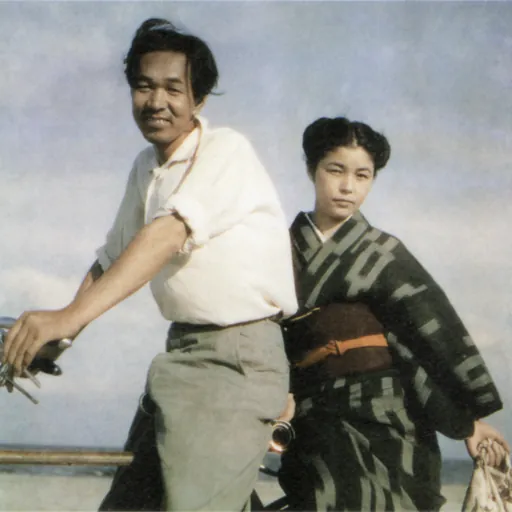
About Shōji Ueda
Lived 1913 – 2000 (aged 86–87). Shōji Ueda was a Japanese photographer and teacher.
was a Japanese photographer from Tottori, best known for his distinctive, dreamlike black-and-white images with staged figures, taken on the Tottori sand dunes. The term Ueda-chō (Ueda-tone) has been used to refer to his cool and mysterious atmospheric style.
Ueda began using posed figures and objects in his photographs in 1939, but would be forced to cease his production due to Japan's participation in World War II. His surreal Sand Dune series, of which the first images were published 1949, was overshadowed by the predominance of social realism, a major trend in Japanese post-war photography.
His oeuvre was reconsidered by critics in 1971 after the publication of the widely-appreciated photobook Warabe Goyomi (Children the Year Round), containing images of children which masterfully balanced social realism and the playfulness of Ueda's posed pictures. Since the 1970s, his work has won him international renown, and in 1995 the Ueda Shōji Museum of Photography was inaugurated.
Throughout the entirety of his life, Ueda remained deeply attached to his native San'in region, and in particular his hometown of Sakaiminato.
Biography
Early life and career beginnings Ueda Shōji was born to a merchant family in the port town of Sakaiminato, Tottori prefecture, on the western coast of the Sea of Japan. As a teenager, he showed interest in being a painter, but he started taking photographs instead after his father gave him his first camera when he was fifteen.
He joined a local photography club, the Yonoga Photography Circle, in 1931. Here, he learned about "art photography", which promoted a pictorialist style, popular amongst amateurs of photography in Japan at that time. He was particularly influenced by the pictorialist photographer Shiotani Teikō, his mentor. Ueda oversaw an important publication of Shiotani's work in 1975. He notably retained the photographers' spirit of experimentation, which inspired him to create photograms, play with perspectives and toy with the framing of his images as he began to develop his own style. Ueda thus never participated in the war, and he would make no reference to it in his photographic works for the rest of his career.
Post-war career and Sand Dune series During the tumultuous period following Japan's defeat, Ueda jumped on new opportunities to create again. He joined Ginryūsha, a Tokyo-based association of Japanese photographers active before the war, and came to know Kuwabara Kineo, editor of the influential photography magazine Camera. Kuwabara proposed that Ueda shoot a series of images of fellow photographer Domon Ken in the Tottori sand dunes, which were published in Camera in September 1949. Reflecting back later on this period, Ueda wrote: "The war had just ended. The wave of Social Realism was at its peak. The prestige of the absolute snapshot was overwhelming and critics heaped scorn on anything posed. In those stormy times, people like me saw no value in taking photographs; we turned on ourselves and sometimes lost hope." Contrary to this statement, Ueda did not give up taking photography. In 1956, his works were included in the First International Subjective Photography Exhibition. Held in the same year that the newly founded Japan Subjective Photography League was established, the exhibition brought together prewar avant-garde figures such as Kansuke Yamamoto alongside emerging postwar photographers including Kiyoji Ōtsuji, Ikkō Narahara, and Yasuhiro Ishimoto. He increasingly his attention on his beloved San'in region, in particular the Izumo area. His photos appeared in numerous photo essay books throughout the 1960s and 1970s. Curator Kaneko Ryuichi posits that these endeavors, which remain overlooked even today, confirmed Ueda's self-identification as a "lifelong amateur photographer", which he would continue to say of himself even after gaining international recognition. These graceful images, instantly recognizable as Ueda's, often feature dapper men, carefully arranged by the photographer against the familiar backdrop of the Tottori sand dunes.
Ueda also experimented with different modes of color photography, as seen in the series Shiroi Kaze (Brilliant Scenes), realized between 1980 and 1981. The images have a gauzy quality, with soft, pastel hues and a lack of sharp focus. To create this distinctive effect, Ueda employed a method that Japanese photographers had used during the Taishō era, when the pictorialist mode flourished. It involved removing the lens filter hood from a single lens of the widely-used Vest Pocket Kodak camera. Ueda wondered what images could be produced if he used this outdated method with the latest, most technologically advanced state-of-the-art color film of the time, FujiColor F-II. Ueda appears to revel in creating rich contrasts of hue, as in the case of several still lives: pomegranates and cherries are presented against an inky, seemingly infinite blue-black background.
Ueda died of a heart attack at 87 years of age on July 4, 2000.
Legacy and collections
In 1995, the Ueda Shōji Museum of Photography, dedicated to exhibiting and archiving his work, opened in Kishimoto, Tottori prefecture.
The French government honored Ueda with the title of Chevalier des Arts et des Lettres in 1996. This was followed in 1998 by his receiving of the very first Tottori Prefecture Prefectural Citizen Achievement Award in 1998.
When Ueda died in 2000, he left behind a significant archive of unpublished material.
In 2015, a retrospective publication was edited, featuring previously unseen works. The publishers were given access to 5000 unpublished photos.
Ueda's works have been acquired by museums in Japan and around the world, including:
Museum of Modern Art, NY Kawasaki City Museum Yokohama Art Museum Tokyo Metropolitan Museum of Photography Yonago City Museum of Art Yamaguchi Prefectural Art Museum the National Museum of Modern Art in Tokyo Centre Pompidou Centre National des Arts Plastiques The Getty Bibliothèque Nationale de France Museum of Fine Arts, Houston
Books of Ueda's works
Den'en no utsushikata . Ars Shashin Bunko 42. Tokyo: Ars, 1940. San'in no tabi . Text by Shimomura Norio . Gendai Kyōyō Bunko. Tokyo: Shakai Shisō Kenkyūkai Shuppanbu, 1962. Izumo no shinwa: Kamigami no furusato: Kamera no kikō . Text by Ueda Masaaki . Tokyo: Tankō Shinsha, 1965. Oki: Hito to rekishi . Text by Naramoto Tatsuya (奈良本辰也). Tankō Shinsha, 1967. Dōreki / Children the Year Around. Eizō no Gendai 3. Tokyo: Chūōkōronsha, 1971. Black and white photographs, many but not all of which show children, arranged by season. Texts in both Japanese and English. Izumo jiryojō . Text by Ishizuka Takatoshi . Tokyo: Asahi Shinbunsha, 1971. Shinwa no tabi: Izumo, Hyūga no furusato . Text by Ueda Masaaki et al. Nihon no Furusato Shirīzu. Tokyo: Mainichi Shinbunsha, 1973. Izumo . Tokyo: Mainichi Shinbunsha, 1974. Ueda Shōji shōryokō shashinchō: Oto no nai kioku . Tokyo: Nippon Camera, 1974. Izumo Taisha (出雲大社). Text by Tōno Yoshiaki . Heibonsha Gyararī 24. Tokyo: Heibonsha, 1974. Sakyū / Kodomo no shiki / Sand Dunes / Seasons of the Children. Sonorama Shashin Sensho 11. Tokyo: Asahi Sonorama, 1978. With a summary in English in addition to the Japanese text. Matsue: Sen kyūhyaku rokujū nen / Matsue. Yonago: San'in Hōsō, 1978. Shin Izumo fudoki / A New Topography of Izumo. Nihon no Bi: Gendai Nihon Shashin Zenshū 5. Tokyo: Shūeisha, 1980. A large-format collection of color photographs of Izumo. Despite the additional English title (provided inconspicuously within the colophon), this book has no captions or text in English. Ueda Shōji besutan shashinchō: Shiroi kaze / Brilliant Scenes. Tokyo: Nippon Camera, 1981. . Ueda Shōji . Shōwa Shashin Zen-shigoto 10. Tokyo: Asahi Shinbunsha. 1983. Kidō kaiki / Shoji Ueda Polaroid 35m/m Photo Album. 3 vols. Self-published, 1986. Sakyū: Ueda Shōji shashinshū / Dunes. Tokyo: Parco, 1986. . Shoji Ueda: Fotografien 1930–1986. Bremen: Forum Böttcherstrasse Bremen, Museum für Fotografie und Zeitkunst Bremen, 1987. Umi kaze yama iro: Shashinshū / The view of Chugokuji. Tokyo: Gyōsei, 1990. Fūdohen . . Shizenhen . . Ueda Shōji sakuhinten: Sakyū gekijo . JCII Photo Salon Library 15. Tokyo: JCII Photo Salon, 1992. Catalogue of an exhibition. Ueda Shōji no shashin / Shoji Ueda. Tokyo: Tokyo Station Gallery, 1993. Catalogue of an exhibition held at the Tokyo Station Gallery in July–August 1993. With a very little text in English and French, but captions and much other material in Japanese only. Ueda Shōji shashinshū / Shoji Ueda: Photographs. Tokyo: Takarajima-sha, 1995. . Shoji Ueda Photographs: 1930's–1990's. Kishimoto, Tottori: Shoji Ueda Museum of Photography, 1995. Ueda Shōji sakuhinshū . Text by Ikezawa Natsuki (池沢夏樹). Tokyo: Parco, 1995. 1. (Hito) tachi . . 2. (Mono) tachi . . Stone Sculpture. Text by Nakaoka Shintarō . Tokyo BeeBooks, 1996. . "Oku no hosomichi" o yuku . Text by Kuroda Momoko . Shotor Library. Tokyo: Shōgakkan, 1997. . A lavishly illustrated retracing of the Oku no hosomichi of Matsuo Bashō. Ueda Shōji . Nihon no Shashinka 20. Tokyo: Iwanami Shoten, 1998. . Ueda Shōji shashin no sakuhō: Amachua shokun! . Kyoto: Kōrinsha, 1999. . Shoji Ueda. Collection l'Oiseau rare. Trezelan: Filigranes, 2000. . Ueda Shōji Watakushi no shashin sakuhō . Tokyo: TBS Britannica, 2000. . Manazashi no kioku: Dareka no kataware de . Text by Washida Kiyokazu . Tokyo: TBS Britannica, 2000. . Masaharu Fukuyama Portraits, Shoji Ueda Photographs. Kishimoto, Tottori: Shoji Ueda Museum of Photography, 2002. Catalogue of an exhibition held July–September 2002. Two volumes. Une ligne subtile: Shoji Ueda, 1913–2000. Lausanne: Musée de l'Élysée; Paris: Maison européenne de la photographie, c2006. . Una Línia Subtil: Shoji Ueda 1913-2000. Barcelona: Fundació la Caixa, 2005. . In Catalan and English. Una Línea Sutil: Shoji Ueda 1913-2000. Barcelona: Fundació la Caixa, 2005. . In Spanish and English. Ueda Shōji shashinshū: Fukinukeru kaze . Tokyo: Kyūryūdō, 2006. Ueda Shōji / Ueda Shoji. Hysteric 16. Tokyo: Hysteric Glamour, 2006. (Inconspicuously, Ueda Shōji "chiisai denki" / Ueda Shoji, "Small Biography".) A collection of Ueda's series "Small Biography" (, Chiisai denki), as it appeared in Camera Mainichi in the 1970s and 1980s. Boku no arubamu / An Album: The Everlasting Story. Tokyo: Kyūryūdō, 2007. . Despite the alternative title in English, all in Japanese. Photographs circa 1935–50, for the most part previously unpublished, and from prints newly made from Ueda's negatives. Many are of Ueda's wife. Ueda Shōji no sekai . Corona Books 136. Tokyo: Heibonsha, 2007. . Ueda Shōji: Chiisai denki / Small Biography. Hankyū Komyunikēshonzu, 2007. . Only in Japanese, despite the alternative title.
Other books with works by Ueda
Ueda Shōji to sono nakama-tachi: 1935–55 (, Shōji Ueda and his friends, 1935–55). Yonago, Tottori: Yonago City Museum of Art, 1992. Catalogue of an exhibition held in February–March 1992 in Yonago City Museum of Art, with reproductions of many of Ueda's works. Suihen no kioku: San'yō San'in no shashinka-tachi: Ueda Shōji, Hayashi Tadahiko, Midorikawa Yōichi, Matsumoto Norihiko ten . Onomichi, Hiroshima: Onomichi City Museum of Art, 1999. Catalogue of an exhibition of the works of Ueda, Tadahiko Hayashi, Yōichi Midorikawa and Norihiko Matsumoto. Midorikawa Yōichi to yukari no shashinka-tachi 1938–59 . Okayama: Okayama Prefectural Museum of Art, 2005. Yamagishi, Shoji, ed. Japan, a Self-Portrait. New York: International Center of Photography, 1979. (hard), paper). Pages 105–110 are devoted to Ueda's work. Self-Portrait. Hysteric 2. Tokyo: Hysteric Glamour, 1991. Sengo shashin / Saisei to tenkai / Twelve Photographers in Japan, 1945–55. Yamaguchi: Yamaguchi Prefectural Museum of Art, 1990. Catalogue of an exhibition held in Yamaguchi Prefectural Museum of Art. Despite the alternative title in English, almost exclusively in Japanese (although each of the twelve has a potted chronology in English). Twenty-one of Ueda's photographs of people on the Tottori dunes appear on pp. 104–114. Tachihara Michizō. Ushinawareta yoru ni: Tachihara Michizō shishū . Tokyo: Sanrio, 1975. A poetry collection by Michizō Tachihara.
Don’t just read it —
keep it.
Full-length biographies made to live with: read them, listen on the way to work, watch them tonight.
- E-book
- Audio
- Video
Instant download · yours to keep · every purchase keeps this site free
Important facts
People in Shōji Ueda's life
Named in this biography and alive at the same time





Related people
Same field, nearest in time



Contemporaries
People whose lives overlapped Shōji Ueda's




Frequently asked questions
Who was Shōji Ueda?
Japanese photographer (1913-2000)
When was Shōji Ueda born?
Shōji Ueda was born in 1913 in Sakaiminato.
When did Shōji Ueda die?
Shōji Ueda died on 4 July 2000 in Sakaiminato, Yonago.
What was Shōji Ueda's occupation?
Shōji Ueda was a photographer and teacher.
What nationality was Shōji Ueda?
Shōji Ueda was Japanese.
Sources & further reading
Cite this page
APA: Biography.guide. (2026). Shōji Ueda. https://biography.guide/shoji-ueda/
MLA: "Shōji Ueda." Biography.guide, https://biography.guide/shoji-ueda/.
Chicago: "Shōji Ueda." Biography.guide. https://biography.guide/shoji-ueda/.
Data last updated: 2026-09-20 · Spot an error? Report a correction.
Page generated 2026-09-27 05:09 UTC