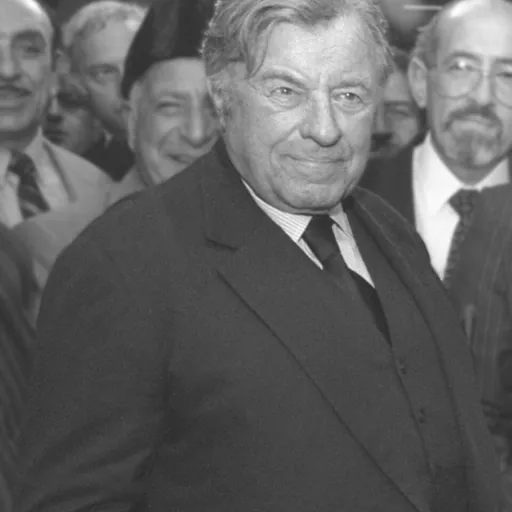
About Teddy Kollek
Lived 1911 – 2007 (aged 95). Teddy Kollek was an Israeli and Hungarian politician.
Theodor "Teddy" Kollek (; 27 May 1911 – 2 January 2007) was an Israeli politician who served as the mayor of Jerusalem from 1965 to 1993.
Early life and marriage Theodor Kollek was born in Nagyvázsony, 120km (75 miles) from Budapest, Hungary. His parents, Alfred and Margaret , named him after Theodor Herzl. The family moved to Vienna in 1918. Growing up in the Austrian capital city, Kollek came to share his father Alfréd's Zionist convictions.
In 1935, three years before the Nazis seized Austria, the Kollek family immigrated to British-controlled Mandatory Palestine. In 1937, he was one of the founders of Kibbutz Ein Gev, on the shore of Lake Kinneret. That same year he married Tamar Schwarz (1917–2013). They had two children, a son, the film director Amos Kollek (born in 1947), and a daughter, Osnat.
Intelligence services The "Hunting Season" In 1942 Kollek was appointed the Jewish Agency's deputy head of intelligence. Between January 1945 and May 1946 he was the Agency's chief external liaison officer in Jerusalem and was in contact with MI5's main representative as well as members of British Military Intelligence. In the 1940s, on behalf of the Jewish Agency (Sochnut) and as part of the "Hunting Season" or "Saison", Teddy Kollek was the Jewish Agency's contact person with the British Mandate MI5, providing information against right-wing Jewish underground groups Irgun and Lehi (known as "Stern Gang"). He succeeded Reuven Zaslani and preceded Zeev Sherf in this function, and was carrying out the Jewish Agency's policy of assisting the British in fighting these groups. On 10 August 1945, he revealed to MI5 the location of a secret Irgun training camp near Binyamina. Twenty-seven Irgun members were arrested in the raid that followed.
Cooperation with the USA From 1947 to 1948, he represented the Haganah in Washington, where he assisted in acquiring ammunition for Israel's then-fledgling army. In 1950, he accidentally encountered Kim Philby, whom he had known from his Vienna days, at the offices of the CIA, and warned James Angleton that Philby was a Soviet agent in the 30s.
In national politics Kollek became a close ally of David Ben-Gurion, serving in the latter's governments from 1952 as the director general of the prime minister's office.
Mayor of Jerusalem
In 1965, Kollek succeeded Mordechai Ish-Shalom as Mayor of Jerusalem. On his motivations for seeking the mayor's office in Jerusalem, Kollek once recalled: “I got into this by accident [...] I was bored. When the city was united, I saw this as an historic occasion. To take care of it and show better care than anyone else ever has is a full life purpose. I think Jerusalem is the one essential element in Jewish history. A body can live without an arm or a leg, not without the heart. This is the heart and soul of it.”
During his tenure, Jerusalem developed into a modern city, Kollek was re-elected five times, in 1969, 1973, 1978, 1983, and 1989, serving 28 years as mayor of Jerusalem. In a reluctant seventh bid for mayor in 1993, Kollek, aged 82, lost to Likud candidate and future prime minister of Israel Ehud Olmert.
Relationship with the Arab community During his tenure as mayor, East Jerusalem, which had been under Jordanian control since 1948, was captured by Israel in the Six-Day War of 1967. Kollek's approach toward the Arab inhabitants of Jerusalem was governed by pragmatism. Following the reunification of Jerusalem, he arranged for the provision of milk for Arab children. Some Israelis considered him pro-Arab.
Kollek's views on the annexation of East Jerusalem softened after leaving office.
Civic and cultural projects Kollek dedicated himself to many cultural projects during his lengthy term in office,
Through a leadership which spanned decades, Kollek raised millions of dollars from private donors for civic development projects and cultural programs. Kollek once remarked that Israel needed a strong army, but it also needed expressions of culture and civilization. of the Jerusalem Biblical Zoo, which occupied a site in Romema from 1950 to 1991. Though the zoo attracted many visitors to its exhibits of animals, reptiles and birds mentioned in the Bible and was successful in breeding and protecting endangered species, it was considered small and inferior to zoos in Tel Aviv and Haifa. Kollek promoted the idea of moving the zoo to a larger location and upgrading it to a state-of-the-art institution. Around 1990, under the auspices of the Jerusalem Foundation, the Tisch family of New York agreed to underwrite the expensive undertaking. The zoo re-opened as The Tisch Family Zoological Garden in Jerusalem on a expanse near the neighborhood of Malha in 1993. He and his wife lived in their walk-up Rehavia apartment until the mid-1990s, when they moved to Hod Yerushalayim, a retirement home in the Kiryat HaYovel neighborhood.
Kollek died on 2 January 2007. He is buried at the Mount Herzl national cemetery.
Awards and distinctions
In 1985, Kollek was awarded the Peace Prize of the German Book Trade. In 1988, he was awarded the Israel Prize for his special contribution to society and the State of Israel. In 1988, he received the Four Freedoms Award from the Roosevelt Institute for the Freedom of Worship. In 1996, Kollek was awarded the Prize of Tolerance of the European Academy of Sciences and Arts. In 2001, he was honoured with the title of Honorary Citizen of Vienna. In Jerusalem, the Teddy Stadium in Malha and Teddy Park are named after him.
Publications
Kollek, Teddy; Pearlman, Moshe (1968): Jerusalem: A History of Forty Centuries, Random House, New York City, Kollek, Teddy; Kollek, Amos (1978): For Jerusalem: A Life, Weidenfeld & Nicolson, London,
Don’t just read it —
keep it.
Full-length biographies made to live with: read them, listen on the way to work, watch them tonight.
- E-book
- Audio
- Video
Instant download · yours to keep · every purchase keeps this site free
Important facts
People in Teddy Kollek's life
Named in this biography and alive at the same time



Related people
Same field, nearest in time





Contemporaries
People whose lives overlapped Teddy Kollek's





Frequently asked questions
Who was Teddy Kollek?
Israeli politician (1911–2007)
When was Teddy Kollek born?
Teddy Kollek was born on 27 May 1911 in Nagyvázsony.
When did Teddy Kollek die?
Teddy Kollek died on 2 January 2007 in Jerusalem.
What was Teddy Kollek's occupation?
Teddy Kollek was a politician.
What nationality was Teddy Kollek?
Teddy Kollek was Israeli and Hungarian.
Sources & further reading
Cite this page
APA: Biography.guide. (2026). Teddy Kollek. https://biography.guide/teddy-kollek/
MLA: "Teddy Kollek." Biography.guide, https://biography.guide/teddy-kollek/.
Chicago: "Teddy Kollek." Biography.guide. https://biography.guide/teddy-kollek/.
Data last updated: 2026-09-22 · Spot an error? Report a correction.
Portrait: Wikimedia Commons · author & licence
Page generated 2026-09-27 05:02 UTC