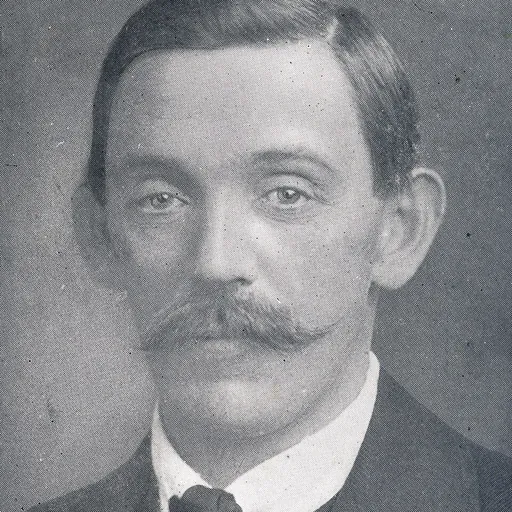
About Tadhg Barry
Lived 1880 – 1921 (aged 40–41). Tadhg Barry was an Irish journalist and politician.
Tadhg Barry (1880 – 15 November 1921) was a veteran Irish republican, leading trade unionist, journalist, poet, Gaelic Athletic Association official, and alderman on Cork Corporation who was actively involved in, and eventually was killed during, the Irish revolutionary period.
Background Tadhg Barry was born in 1880 to a working-class family in Cork, Ireland. He was schooled at the Blarney Street National School and later the North Monastery. After school, Barry worked for four years at Our Lady's Asylum until 1909, when his interest in journalism led to him becoming a staff writer at the newly founded Cork Accent. Between 1910 and 1916, he worked at the Cork Free Press, a paper which competed with the Redmondite (Home Rule advocating) Cork Examiner.
Barry had an interest in the Gaelic Athletic Association and reported upon the sports of hurling and camogie under the penname "An Ciotóg" (meaning the "left-hander" or "clumsy one"). He was also a delegate to both county and national GAA boards, a referee, and he trained the first camogie team in Cork. In 1916, Barry wrote the first book on the subject of hurling, entitled Hurling and how to play it.
Entry into politics In the 1900s, Barry began to be drawn into the world of politics. In 1906 he became a founding member and secretary of the Cork Branch of Sinn Féin as well becoming a leading member of the Cork Branch of the Irish Transport and General Workers' Union (ITGWU). In 1911, alongside fellow prominent nationalists in Cork Tomas MacCurtain and Sean O’Hegarty, he had become part of Fianna Éireann, a Boy Scout organisation with an Irish nationalist political outlook. Taking his Fianna experience forward, In 1913 he helped found the Cork Corps of the Irish Volunteers, an armed Irish nationalist organised primary founded to fight the Ulster Volunteers should they have attempted to resist Home Rule in Ireland. In 1914, when the Volunteers split into two factions, Barry aligned with rump Volunteers who vowed not to fight for the British Empire during World War I but instead remain in Ireland.
Tadgh shared a platform with James Connolly in Cork on two separate occasions and was on active service during the 1916 Easter Rising, when Irish nationalists rose up in rebellion in Dublin. In 1917, Barry was selected as a Cork delegate to the historic October Sinn Féin convention in the Mansion House, a meeting which attempted to unify all elements of the now surging nationalist movement into one force which would advocate (and fight) for an independent Irish Republic free of control from the British Empire. That same year, Barry was arrested by British authorities on the ground he had delivered a "seditious speech" and was imprisoned for a time until he was freed following a hunger strike.
Upon his release in 1919, he became the full-time Branch Secretary to the ITGWU in Cork and was involved with the Irish soviets, a series of strikes by rural Irish workers mainly across Munster. In 1920, Barry was elected to the position of Alderman in Cork, placing him in a position of power alongside the now Lord Mayor Tomas MacCurtain and newly elected MP Terence MacSwiney.
1920 was a tumultuous year all around in Cork. The Irish War of Independence had erupted and Munster was a particular hotbed of activity. On 20 March 1920, Tomás Mac Curtain, whom had become an officer in the newly formed Irish Republican Army, was killed in front of his wife and children in an assassination by members of the Royal Irish Constabulary, the British controlled police force in Ireland. This incident caused widespread unrest in Cork. Terence MacSwiney succeeded Mac Curtain as Lord Mayor of Cork, only to die in October following a hunger striker protesting his own arrest. MacSwiney's death was a matter not just of national but also of international news, particularly in the United States of America. Barry attempted to keep busy while incarcerated. He taught Irish to his fellow prisoners as well as preaching Socialism. He kept a Red flag flown over his quarters, much to his jailers' chagrin. An eyewitness account of Barry's death was provided by another inmate, Seán D. MacLochlainn, who by his own account was standing next to Barry when he was shot. According to MacLochlainn's account Barry was standing in a line of inmates waving farewell to those leaving when they were asked to move back, when the group refused Barry was shot dead. The statement also describes the shooting of two other prisoners named as Tormey and Sloane. A coroner's inquest into his death was inconclusive, and a trial held on his death resulted in a jury unable to agree on a verdict. The British authorities failed to produce either the sentry or his superiors for cross-examination. A secret report on Barry's death, created by the army's 6th Division for the inquest, recalled him memorably as ‘a mischievous socialist, Bolshevist, or Sinn Féiner, as the occasion demanded’, and as an ‘utter disloyalist’.
Thousands turned out in every town to view the funeral cortege en route to Dublin where, on 19 November, 30,000 marched with the coffin. As the train bringing his body home to Cork passed through Kilmallock, County Limerick, 300 creamery strikers and supporters paraded through the town under the red flag. Barry's death was one of the last during the Irish War of Independence, peace talks led to the ratifying of the Anglo-Irish Treaty (6 December 1921). Tadgh Barry is buried in St. Finbarr's Cemetery, Cork.
Don’t just read it —
keep it.
Full-length biographies made to live with: read them, listen on the way to work, watch them tonight.
- E-book
- Audio
- Video
Instant download · yours to keep · every purchase keeps this site free
Important facts
People in Tadhg Barry's life
Named in this biography and alive at the same time

Related people
Same field, nearest in time


Contemporaries
People whose lives overlapped Tadhg Barry's


Frequently asked questions
Who was Tadhg Barry?
(1880-1921)
When was Tadhg Barry born?
Tadhg Barry was born in 1880 in Cork.
When did Tadhg Barry die?
Tadhg Barry died on 15 November 1921 in Abercorn Barracks.
What was Tadhg Barry's occupation?
Tadhg Barry was a journalist and politician.
What nationality was Tadhg Barry?
Tadhg Barry was Irish.
Sources & further reading
Cite this page
APA: Biography.guide. (2026). Tadhg Barry. https://biography.guide/tadhg-barry/
MLA: "Tadhg Barry." Biography.guide, https://biography.guide/tadhg-barry/.
Chicago: "Tadhg Barry." Biography.guide. https://biography.guide/tadhg-barry/.
Data last updated: 2026-09-22 · Spot an error? Report a correction.
Portrait: Wikimedia Commons · author & licence
Page generated 2026-09-27 05:04 UTC