
Sviatlana Tsikhanouskaya
Belarusian politician, educator, and pro-democracy activist (born 1982)
About Sviatlana Tsikhanouskaya
Born 1982. Sviatlana Tsikhanouskaya is a Belarusian and Russian civil rights advocate, translator, language teacher, interpreter, politician and philologist.
Sviatlana Hieorhiyeuna Tsikhanouskaya (; born 11 September 1982) is a Belarusian opposition leader and political activist. Since running in the 2020 presidential election against President Alexander Lukashenko, she has led dissidence to his authoritarian rule through an alternate government operating from Lithuania and Poland.
Tsikhanouskaya became an opposition leader after her husband, Syarhei Tsikhanouski, sought to run in the 2020 presidential election. He was arrested, along with most other opposition leaders and – since she could not file for the presidency on his behalf – Tsikhanouskaya entered herself as a candidate. Lukashenko allowed her candidacy because he believed a woman could not create a legitimate opposition.
She ran on a platform of constitutional reform, seeking free and fair elections with term limits on the presidency, and she pledged to step down once this was implemented. After Lukashenko was declared the victor, she was held by Belarusian authorities and then forced into exile in Lithuania. Observers consider the election result to have been fraudulent, and Lithuania has recognized Tsikhanouskaya as Belarus' legitimate head of state.
Since fleeing to Lithuania, Tsikhanouskaya has established an opposition government. In 2020 she set up a Coordination Council and in 2022 a United Transitional Cabinet. As representative of a democratic Belarus, Tsikhanouskaya has met with several world leaders to negotiate sanctions against Lukashenko's government and to deny him recognition as a legitimate head of state.
Since the Russian invasion of Ukraine, she has advocated increased Western support for Ukraine, while warning that Russia's actions should not overshadow opposition to the dictatorship in Belarus. In 2023 Tsikhanouskaya was tried in absentia by the Belarusian government and sentenced to fifteen years of prison.
Early life Sviatlana Pilipchuk was born on 11 September 1982, in the village of Mikashevichy. Her father was a driver at a concrete factory, and her mother was a cafeteria cook. She grew up in a Soviet prefabricated apartment building, where she spent much of her time reading.
Pilipchuk's village was near the Chernobyl exclusion zone. When she was twelve years old, she was taken to Roscrea, Ireland, by the Chernobyl Lifeline charity, which helped children travel so as to reduce their exposure to radiation. Though Pilipchuk was not as affected by radiation as other students, her proficiency in school earned her a spot.
Pilipchuk attended Mozyr State Pedagogical University to study teaching. She retired so she had more time to raise her children.
Tsikhanouskaya initially had no interest in building a campaign. When her husband was released, he continued the campaign even though it was her name on the paperwork. He sometimes brought a life-size cutout of Tsikhanouskaya when he campaigned. She easily acquired the 100,000 signatures that were needed to run—a high limit that was expected to block opposition candidates from running.
Tsikhanouski was arrested a second time, accused of assaulting a police officer in an incident that was later found to be staged. Most opposition candidates were removed from the race, either through arrest or disqualification. She also received support from 2010 presidential candidate Mikola Statkevich, Tsikhanouskaya's shared experience with the other wives of arrested dissidents earned her many supporters among women. recounting threatening phone calls from unknown numbers, which said, "We will put you behind bars and place your children in an orphanage". and threats by authorities to take children away from opposition figures and send them to state-run orphanages. Worried for the safety of her children, Tsikhanouskaya had them hidden abroad in Lithuania. She ran on only three political issues: the release of political prisoners, constitutional limitations on the presidency, and new elections. Once these three things happened, she said, she would step down from the presidency. She also vowed to move away from the union treaty with Russia.
Tsikhanouskaya's economic platform emphasized increasing the importance of small and medium-sized businesses in the Belarusian economy. She planned to offer interest free loans to small and medium-sized businesses, cancel state inspections of private entities, and provide legal protection for foreign investors. She planned to allow profitable state owned enterprises to continue to operate, while requiring unprofitable state owned enterprises to take advice from outside professionals.
Election day and departure from Belarus
The night before the election, police detained senior staffers from Tsikhanouskaya's campaign and she chose to go into hiding in Minsk, before re-emerging on election day at a polling station. When the results were announced, Tsikhanouskaya officially received only ten percent of the vote. Poll workers were required to engage in electoral fraud to ensure Lukashenko's victory over Tsikhanouskaya, After Belarusian state television released an exit poll showed Lukashenko winning by an overwhelming margin, Tsikhanouskaya said that she didn't trust that poll, saying, "I believe my eyes, and I see that the majority is with us".
Tsikhanouskaya and her lawyer went to the Central Election Commission the following day, where they were confronted by armed guards, and Tsikhanouskaya was forced to meet with Lukashenko's enforcer Andrei Pavlyuchenko. She was given an ultimatum to either leave the country, or to go to prison and have her children taken.
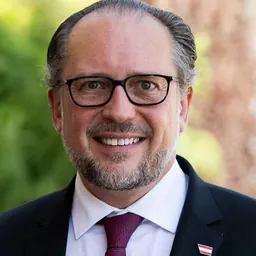
Exile Establishing an opposition government-in-exile Sviatlana Tsikhanouskaya and Austrian Foreign Minister Alexander Schallenberg in Vienna in October 2020On 11 August 2020, Lithuanian foreign minister Linas Linkevičius announced that Tsikhanouskaya was safe in Lithuania while also acknowledging that she had "few options". She felt that she had "betrayed" her supporters by leaving the country.
Days after she left the country, Tsikhanouskaya declared herself the "leader of democratic Belarus". Applications for membership in the council were open only to Belarusian authority figures, such as respected professionals, authors, or sportspeople. Tsikhanouskaya considered herself to be an "interim-leader" of Belarus, but she has not claimed an entitlement to the presidency. She has indicated that she will not seek the presidency again, instead continuing her diplomatic work until fair elections can be held. She has also sought sanctions against Belarus, speaking with world leaders in an effort to get them applied. After a period of protest, Lukashenko regained de facto control over the nation. Tsikhanouskaya has denied that she leads a government in exile, saying that she wished to create a "permanent opposition inside Belarus".
On 31 January 2021, Norwegian parliamentarians Vervik Bulestad and Harek Elvesen nominated Svetlana Tikhanovskaya for the Nobel Peace Prize in 2022 for being a symbol of the ongoing struggle of Belarusian citizens for their freedom. .
On 9 August 2022, at a conference held in Vilnius, Tsikhanouskaya announced the creation of the United Transitional Cabinet. It initially consisted of Pavel Latushko (responsible for the transition of power), Aliaksandr Azarau (responsible for the restoration of law and order), Valery Kavaleuski (foreign affairs), and Valery Sakhashchyk (defense and national security). Belarus declared Tsikhanouskaya's organizations to be extremist formations in January 2023, making her subject to prison time should she be captured by the Belarusian government. Two months later, she was tried in absentia and sentenced to fifteen years in prison.
The European Parliament and several governments recognize Tsikhanouskaya and her structures as legitimate representatives of the Republic of Belarus. Tsikhanouskaya is often referred by foreign government representatives, diplomats and parliamentarians as "President", "President-elect", "Leader of Democratic Belarus", while her Cabinet is referred to as "government in exile." In August 2024, Tsikhanouskaya, her administrative Office, the Coordination Council, and the United Transitional Cabinet, negotiated an agreement describing principles and procedures of their respective roles, power relations, and dispute resolution procedures. Article 4.1 of the agreement defines Tsikhanouskaya as holding the role of National Leader, based on the 2020 presidential election, until "a free and fair election is held in Belarus" or until Tsikhanouskaya "decides to cease" her role.
The Council of Europe, the European Union and the United States have established formal cooperation with the structures led by Tsikhanouskaya.
Tsikhanouskaya's husband was one of fourteen Belarusian political prisoners who were pardoned and released on 21 June 2025. He joined her in Lithuania.
Russo-Ukrainian War
When the Russian invasion of Ukraine took place in 2022, Tsikhanouskaya sought to promote the anti-war movement in Belarus.
Following Belarus's entry into the war, Tsikhanouskaya and her supporters developed the Pieramoha Plan (Victory Plan), a strategy involving underground dissidents in Belarus, engaging in information sharing and sabotage. She has said that the dissidents must wait until "the right moment", when instability allows for a change in power.
Tsikhanouskaya argues that the existence of a dictatorship in Belarus threatens the safety not only of Ukraine, but of the other states bordering Belarus: Latvia, Lithuania, and Poland, as Belarus has been used by Russia to attack neighboring countries like Ukraine. She supports continued political and economic involvement by the West in support of Ukraine's efforts in the Russo-Ukrainian War. She has warned of war fatigue stymieing Western support for Ukraine and Belarusian dissidents.
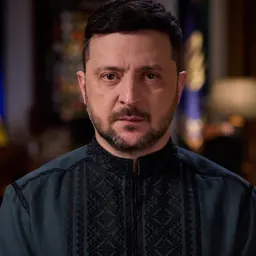
On 25 May 2026, Svitlana Tsikhanouskaya made her first working visit to Kyiv. During her visit, Tikhanovskaya attended the IV International Summit of Cities and Regions. On 26 May Svetlana Tsikhanouskaya met with Ukrainian President Volodymyr Zelenskyy. The two sides discussed Belarusian-Ukrainian relations.
Awards Tsikhanouskaya was on the 2020 list of the BBC's 100 Women, announced on 23 November 2020, and was included in the 2020 edition of The Bloomberg 50. Tsikhanouskaya and other Belarusian opposition leaders were awarded the European Parliament's 2020 Sakharov Prize for Freedom of Thought in a ceremony on 16 December in Brussels. Among dozens of distinctions, she is a recipient of the 2020 Globsec prize for freedom; 2022 International Four Freedoms Award; 2022 International Trailblazer Award; 2022 Tipperary International Peace Award, 2023 IDU Bush-Thatcher Award for Freedom; 2023 NATO PA “Women for Peace and Security” Award; 2023 Anna Lindh Prize laureate. She and other Belarusian opposition leaders won the 2022 Charlemagne Prize.
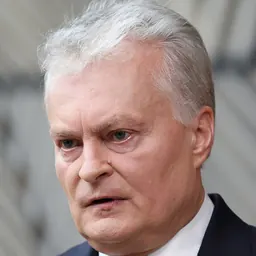
In 2021, she was nominated for the 2021 Nobel Peace Prize by Lithuanian president Gitanas Nausėda and multiple Norwegian members of parliament.
Don’t just read it —
keep it.
Full-length biographies made to live with: read them, listen on the way to work, watch them tonight.
- E-book
- Audio
- Video
Instant download · yours to keep · every purchase keeps this site free
Important facts
Family & relationships
People in Sviatlana Tsikhanouskaya's life
Named in this biography and alive at the same time


Related people
Same field, nearest in time


Contemporaries
People whose lives overlapped Sviatlana Tsikhanouskaya's

Frequently asked questions
Who is Sviatlana Tsikhanouskaya?
Belarusian politician, educator, and pro-democracy activist (born 1982)
When was Sviatlana Tsikhanouskaya born?
Sviatlana Tsikhanouskaya was born on 11 September 1982 in Mikashevichy.
What is Sviatlana Tsikhanouskaya's occupation?
Sviatlana Tsikhanouskaya is a civil rights advocate, translator, language teacher, interpreter, politician and philologist.
What nationality is Sviatlana Tsikhanouskaya?
Sviatlana Tsikhanouskaya is Belarusian and Russian.
Sources & further reading
· Wikipedia: Sviatlana Tsikhanouskaya
· DBpedia: Sviatlana Tsikhanouskaya
Cite this page
APA: Biography.guide. (2026). Sviatlana Tsikhanouskaya. https://biography.guide/sviatlana-tsikhanouskaya/
MLA: "Sviatlana Tsikhanouskaya." Biography.guide, https://biography.guide/sviatlana-tsikhanouskaya/.
Chicago: "Sviatlana Tsikhanouskaya." Biography.guide. https://biography.guide/sviatlana-tsikhanouskaya/.
Data last updated: 2026-09-20 · Spot an error? Report a correction.
Page generated 2026-09-27 05:24 UTC