
About Sutomo
Lived 1920 – 1981 (aged 61). Sutomo was an Indonesian politician and journalist.
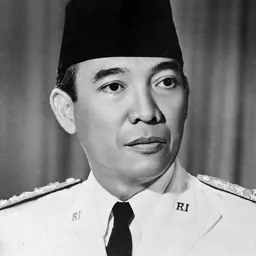
Sutomo (3 October 1920 – 7 October 1981), also known as Bung Tomo (meaning Comrade or Brother Tomo), was an Indonesian revolutionary and military leader best known for his role in the Indonesian National Revolution against Dutch colonial rule. He played a central role in the Battle of Surabaya, which was fought between British and Indonesian forces from October to November 1945.
Early life
Sutomo was born in Kampung Blauran in the centre of Surabaya to a clerk father, Kartawan Tjiptowidjojo, and mother, Subastia, of mixed Javanese, Sundanese and Madurese descent. He had received Dutch secondary education before the Japanese occupation.
Alongside menial jobs, he joined the Indonesian Scouting organisation and at the age of seventeen became only the second person in the Dutch East Indies to achieve the rank of Pramuka Garuda, a rank achieved by only three Indonesians before the Japanese occupation during World War II.
Japanese occupation During the Japanese occupation period, Sutomo worked for the Dōmei Tsushin (the official news agency of the Empire of Japan) in Surabaya. He became famous for setting up (Resistance Radio), which promoted unity and fighting spirit among (Indonesian youth).
In 1944, Sutomo was chosen as a member of the Japanese-sponsored (New People's Movement) and officer of (Youth of Indonesian Republic).
Indonesian National Revolution
Indonesian People's Revolutionary Front On 12 October 1945, Sutomo founded and became a leader of Indonesian People's Revolutionary Front , abbreviated as BPRI, is an Indonesian militia, with its headquarters in Surabaya. BPRI was aimed at realizing and defending the Proclamation of Indonesian Independence, they rallied the people's resistance against the re-establishment of Dutch rule in Indonesia after the Surrender of Japan in World War II.
During the Netherlands Indies Civil Administration (NICA) occupation, in the early stages of the Indonesian National Revolution, in the Bersiap period, Sutomo encouraged atrocities against Indonesians of mixed European–Asian ancestry and personally supervised the summary executions of hundreds of civilians. These are archived eye witness testimony of the events of 22 October 1945.
Battle of Surabaya When the battle broke out in Surabaya between Indonesian nationalists and British forces, he gave rousing speeches. Although the fighting ended in defeat for the Indonesians, the battle served to galvanise Indonesian and international opinion in support of the independence cause. Sutomo spurred thousands of Indonesians to action with his distinctive, emotional speaking-style of his radio broadcasts. His "clear, burning eyes, that penetrating, slightly nasal voice, or that hair-raising oratorical style that second only to Sukarno's in its emotional power".
There are conflicting accounts of Sutomo's whereabouts during the battle. His son claimed that he participated in the battle, but K'tut Tantri wrote in several books that he moved to Malang so he could continue giving radio speeches.
The battle for Surabaya was the bloodiest single engagement of the war, and demonstrated the determination of the rag-tag nationalist forces; their sacrificial resistance became a symbol and rallying cry for the revolution. 10 November 1945, the peak of the Battle of Surabaya, was later known as Hari Pahlawan (Heroes’ Day), to commemorate and honor the struggles of heroes and fighters in defending Indonesian independence.
Post-independence In 1955, Sutomo become a minister of state in the Burhanuddin Harahap Cabinet between August 1955 and March 1956, an appointment which pleased cabinet supporters because of his nationalist credentials. However, his relationship with President Sukarno had already begun to sour in 1952 after he offended the president by asking about the president's personal relationship with Hartini, a married woman who later became Sukarno's fourth wife. Sutomo would later sue Sukarno in 1960, due to the president's decision to dissolve the People's Representative Council.
After the 1956, Sutomo emerged again as a national figure during the 1965 overthrow of Sukarno. Initially, he supported Suharto, but later opposed aspects of the New Order regime. On 11 April 1978, he was detained by the government for his outspoken criticism of corruption and abuses of power; upon his release three years later, however, Sutomo continued to loudly voice his criticisms. He said that he did not want to be buried in the Heroes' Cemetery because it was full of "fairweather heroes" who had lacked the courage to defend the nation at times of crisis, but when peace came appeared in public to glorify their achievements.
Don’t just read it —
keep it.
Full-length biographies made to live with: read them, listen on the way to work, watch them tonight.
- E-book
- Audio
- Video
Instant download · yours to keep · every purchase keeps this site free
Important facts
People in Sutomo's life
Named in this biography and alive at the same time



Related people
Same field, nearest in time




Contemporaries
People whose lives overlapped Sutomo's





Frequently asked questions
Who was Sutomo?
Indonesian military person
When was Sutomo born?
Sutomo was born on 3 October 1920 in Surabaya.
When did Sutomo die?
Sutomo died on 7 October 1981 in Mount Arafat.
What was Sutomo's occupation?
Sutomo was a politician and journalist.
What nationality was Sutomo?
Sutomo was Indonesian.
Sources & further reading
Cite this page
APA: Biography.guide. (2026). Sutomo. https://biography.guide/sutomo/
MLA: "Sutomo." Biography.guide, https://biography.guide/sutomo/.
Chicago: "Sutomo." Biography.guide. https://biography.guide/sutomo/.
Data last updated: 2026-09-20 · Spot an error? Report a correction.
Page generated 2026-09-27 05:32 UTC