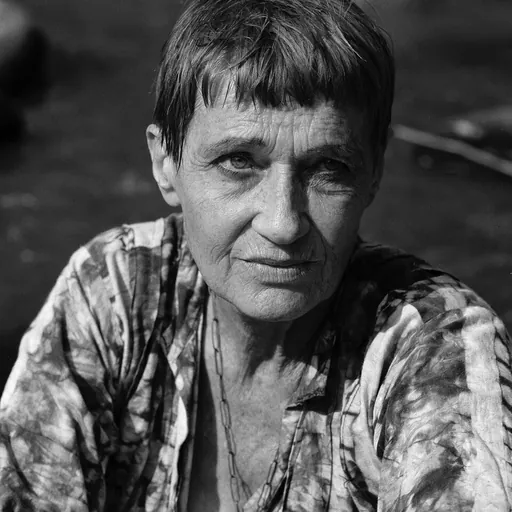
About Susanne Wenger
Lived 1915 – 2009 (aged 93). Susanne Wenger was an Austrian and Swiss painter, printmaker, sculptor, photographer, draftsperson and artist.
Susanne Wenger MFR, also known as Adunni Olorisha (4 July 1915 – 12 January 2009), was an Austrian-Nigerian artist and Yoruba priestess who expatriated to Nigeria. Her main focus was the Yoruba culture and she was successful in building an artist cooperative in Osogbo. She partnered with local artists in Osogbo to redevelop and redecorate the Osun Osogbo Sacred Grove with sculptures and carvings depicting the various activities of the Orishas.
Wenger was a leading advocate for the preservation of the Osun Grove. Due to her efforts, the grove was made a national monument in 1965, and was later marked as a world heritage site.
Early life and career Susanne Wenger was born in Graz, Austria. She is the daughter of an English and French high school teacher and a mother born to a high ranking Austro-Hungarian army officer. Wenger attended the School of Applied Arts in Graz in 1930, specializing in pottery. She later continued her studies, first at the Higher Graphical Federal Education and Research Institute and then at the Academy of Fine Arts Vienna alongside, among others, Herbert Boeckl. While at the academy, she learned the fresco technique and improved on her drawing skills.
After the end of World War II, Wenger was an employee of the communist children's magazine Unsere Zeitung ("Our Newspaper"). She designed the cover of the first edition. In 1947 she was invited by friends to co-found the Vienna Art Club. after which she became more spiritual and turned to the Yoruba religion. She became attracted to the religion after meeting Ajagemo, a priest of Obatala at Ede. Ajagemo introduced Wenger to the Yoruba world view, language and religion, and both individuals soon developed a special bond. Wenger left Ede and moved to Ilobu, before she finally settled at Osogbo in 1961. While living in the town, she became interested in the shrines dedicated to Orishas; she later rebuilt many of the religious carvings within sacred places and was also commissioned by the Osogbo District Council to renovate many of the local shrines, in particular the shrine dedicated to the river goddess, Oshun. a branch of the wider Oshogbo school, and became the guardian of the Sacred Grove of the Osun goddess on the banks of the Osun River in Oshogbo.
Osun grove
Wenger's sculptural works can be found in Osun Grove, an area parallel to the Osun River. Her involvement with the grove dates back to the 1960s.
Her works at the grove are influenced by traditional Yoruba religion, but deviate from previous pieces that concentrated on gods and goddesses. Sometimes called New Sacred Art, Wenger's works not only express the activities and functions of the specific orishas but also depict the social life of adherents and non adherents of the traditional religion.
Personal life Chief Wenger lived in a three-storey residence in Osogbo originally leased by her first husband Chief Ulli Beier when he was with the Institute of Mural Studies. In 1965, she shared the building with her second husband, the drummer Lasisi: both lived on the first floor while her previous husband Beier lived on the second floor. She continued with the lease after Beier left in 1970, and remained in the house following her divorce from Lasisi. Her residence showcases her art, as many of the house's furniture depicts an aspect of the Yoruba art form that Chief Wenger loved so much.
Death On 12 January 2009, Wenger died at the age of 93 in Oshogbo.
In 2005, the Nigerian government admitted her as a member of the Order of the Federal Republic.
For her efforts on behalf of the Yoruba, she was given a chieftaincy title of the Osogbo community by the king, or Ataoja, of Oshogbo.
Exhibitions 1995: Retrospective of the 80th Birthday, Minoritenkirche Stein an der Donau (outside the Old Town of Krems) 2004: On a holy river in Africa, Kunsthalle Krems 2006: Susanne Wenger - life with the gods of Africa, Graz City Museum 2016: Between the Sweet Water and the Swarm of Bees: A Collection of Works by Susanne Wenger, The Michael C. Carlos Museum at Emory University, Atlanta, GA
Don’t just read it —
keep it.
Full-length biographies made to live with: read them, listen on the way to work, watch them tonight.
- E-book
- Audio
- Video
Instant download · yours to keep · every purchase keeps this site free
Important facts
People in Susanne Wenger's life
Named in this biography and alive at the same time


Related people
Same field, nearest in time



Contemporaries
People whose lives overlapped Susanne Wenger's




Frequently asked questions
Who was Susanne Wenger?
Austrian-Nigerian artist (1915-2009)
When was Susanne Wenger born?
Susanne Wenger was born on 4 July 1915 in Graz.
When did Susanne Wenger die?
Susanne Wenger died on 12 January 2009 in Osogbo.
What was Susanne Wenger's occupation?
Susanne Wenger was a painter, printmaker, sculptor, photographer, draftsperson and artist.
What nationality was Susanne Wenger?
Susanne Wenger was Austrian and Swiss.
Sources & further reading
Cite this page
APA: Biography.guide. (2026). Susanne Wenger. https://biography.guide/susanne-wenger/
MLA: "Susanne Wenger." Biography.guide, https://biography.guide/susanne-wenger/.
Chicago: "Susanne Wenger." Biography.guide. https://biography.guide/susanne-wenger/.
Data last updated: 2026-09-23 · Spot an error? Report a correction.
Portrait: Wikimedia Commons · author & licence
Page generated 2026-09-27 05:06 UTC