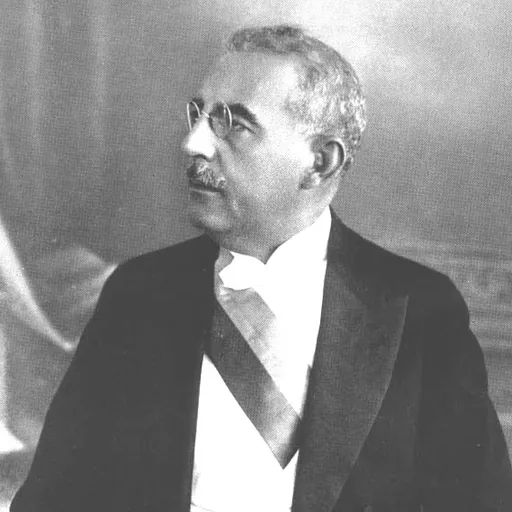
About Stenio Vincent
Lived 1874 – 1959 (aged 85). Stenio Vincent was a Haitian politician, writer and lawyer.
Sténio Joseph Vincent (; February 22, 1874 – September 3, 1959) was President of Haiti from November 18, 1930 to May 15, 1941.
Biography Sténio Vincent was born in Port-au-Prince, Haiti. His parents were Benjamin Vincent and Iramène Brea, who belonged to the mulatto elite.
Presidency In October 1930, while still under occupation by the United States, Haitians elected representatives to the national assembly for the first time since 1918. It elected Vincent as President of Haiti. Sténio Vincent and his team installed themselves in power by exploiting the anti-American sentiment of the popular masses. He had graduated from law school at age 18 before ascending to head of Haiti's Chamber of Deputies by 1915. He supported Haitian nationalism and ran a nationalist campaign for the presidency based on his fierce opposition to the United States occupation of Haiti.
From 1915 to 1934 Haiti was occupied by U.S. Marines; the United States had intervened after the murder of President Vilbrun Guillaume Sam. In August 1934 U.S. President Franklin D. Roosevelt withdrew the Marines; however, the United States maintained direct fiscal control until 1941 and indirect control over Haiti until 1947.
In 1935, Vincent conducted a plebiscite about extending his term in office, receiving a favorable vote to extend it to 1941. The plebiscite also approved an amendment to the constitution so that future presidents would be elected by popular vote.
In 1936, the Haitian Communist Party was disbanded by Vincent.
In October 1937 troops and police from the Dominican Republic massacred thousands of Haitian labourers living near the border in the Parsley Massacre. Vincent had enjoyed a cooperative relationship with and financial support from the government of Dominican President Rafael Trujillo. After two years of relative quiet in Port-au-Prince, Vincent's failure to press for justice for the slain workers prompted protests in the capital. United States president Franklin D. Roosevelt took the case to the Dominican government, which agreed in 1938 to compensate the slain workers’ relatives the following year.
In 1941, Vincent declared his intention to step down. The presidency was peacefully transitioned to his successor, Élie Lescot.
Don’t just read it —
keep it.
Full-length biographies made to live with: read them, listen on the way to work, watch them tonight.
- E-book
- Audio
- Video
Instant download · yours to keep · every purchase keeps this site free
Important facts
People in Stenio Vincent's life
Named in this biography and alive at the same time

Related people
Same field, nearest in time




Contemporaries
People whose lives overlapped Stenio Vincent's

Frequently asked questions
Who was Stenio Vincent?
Sténio Vincent was a President of Haiti. (1874-1959)
When was Stenio Vincent born?
Stenio Vincent was born on 22 February 1874 in Port-au-Prince.
When did Stenio Vincent die?
Stenio Vincent died on 3 September 1959 in Pétion-Ville.
What was Stenio Vincent's occupation?
Stenio Vincent was a politician, writer and lawyer.
What nationality was Stenio Vincent?
Stenio Vincent was Haitian.
Sources & further reading
Cite this page
APA: Biography.guide. (2026). Stenio Vincent. https://biography.guide/stenio-vincent/
MLA: "Stenio Vincent." Biography.guide, https://biography.guide/stenio-vincent/.
Chicago: "Stenio Vincent." Biography.guide. https://biography.guide/stenio-vincent/.
Data last updated: 2026-09-22 · Spot an error? Report a correction.
Portrait: Wikimedia Commons · author & licence
Page generated 2026-09-27 05:03 UTC