
Stella Kübler
Jewish Nazi collaborator
About Stella Kübler
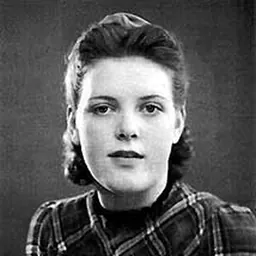
Lived 1922 – 1994 (aged 72). Stella Kübler was a German wartime collaborator, informer collaborator and gestapo agent.
Stella Ingrid Goldschlag (10 July 1922 – 26 October 1994), also known by her married names Stella Kübler, Stella Kübler-Isaaksohn and Ingrid Gärtner, was a German Jewish woman who collaborated with the Gestapo during World War II, operating around Berlin exposing and denouncing Berlin's underground Jews, after being tortured in Gestapo custody and falsely being promised the safety of her family.
Early life Goldschlag was born on 10 July 1922 in Berlin to a middle-class assimilated German Jewish family. Her father, (1889–1944), was a conductor, composer and journalist, and her mother, (née Lermer; 1890–1944), was a singer. ), intending on sharing their fate, but she was taken back to Bessemerstrasse. Goldschlag at first gave up names of Jewish fugitives only under torture, which happened for the first time after her failed escape attempt when she was captured with a list of names that included that of a Jewish man named Mikki Hellmann, who had provided her with a forged passport and whom Goldschlag lured into a trap after which he was captured. She was also referred to as "the blonde ghost".
The Nazis broke their promise regarding sparing Goldschlag's parents and deported them, initially to the Theresienstadt concentration camp on 23 February 1944. Goldschlag pleaded with her superiors to spare her parents, but to no avail, but was promised to become an honorary Aryan after the war. Her parents were later transported to Auschwitz and murdered. Goldschlag's husband, Manfred, was deported in 1943 to Auschwitz, along with his family. It was the belief of his family that Goldschlag had betrayed even her own husband and in-laws to the Nazis. However, the Kübler family was deported before Goldschlag's collaboration with the Nazis began.
While Goldschlag continued to hunt down Jews, she and her fellow "catchers", numbering around 15 to 20 by this time in Berlin, were targeted for revenge by their potential victims. An organization called the Society for Peace and Reconstruction (Gemeinschaft für Frieden und Aufbau or GFA) was actively planning to kill Goldschlag (and her second husband, Rolf Isaaksohn). A plan to poison her coffee was abandoned, as were plans to have her dentist poison her during an appointment and luring Goldschlag and Isaaksohn to an address by a rumor of Jews in hiding living there.
Goldschlag still continued to scout out addresses where Jews were known to have lived. Her loyalty to the cause was also questioned by her superiors and members of her team after she told her superior Dobberke that she could not find any more Jews and wanted to stop being a catcher. This was dangerous, as it put both her and the other catchers at risk of deportation, and Isaaksohn vehemently denied Goldschlag's claims and told his superiors that they were operating very successfully in tracking down Jews. During the second trial, a psychiatrist diagnosed Goldschlag as a "schizophrenic psychopath".
After the war, Goldschlag, according to author Irving Abrahamson, "converted to Christianity and became an open anti-Semite". Goldschlag also tried to make contact with and gain custody of her daughter. When her first foster parents broached the idea of adopting Yvonne, Goldschlag so vehemently contested it that the adoption was called off.
As she became older, her mental and physical faculties deteriorated. By 1984, Goldschlag lived in Berlin-Spandau with her fourth husband. He died that year. Afterwards, she attempted suicide and was briefly hospitalised in a mental ward at University Medical Center Freiburg. She then moved to Freiburg.
Death In 1994, Goldschlag was found dead by drowning in the Moosweiher. The death was judged a suicide.
Personal life
Goldschlag was married five times: following the deportation of her first husband, Manfred Kübler, she married fellow Jewish collaborator and Greifer Rolf Isaaksohn on 29 October 1944, who was shot dead attempting to escape to Denmark as the Soviets advanced. After the war, she was married to three non-Jews, starting with Friedhelm Schellenberg in 1957, then a cab driver twenty years her junior, and around 1972, she married Karl Gärtner, a Berlin train conductor, who died in 1984.
In biographies and fiction
Peter Wyden (formerly Peter Weidenreich), a Berlin schoolmate at Goldschmidt School whose family had been able to obtain US visas in 1937 and who later learned about Goldschlag's role as a "catcher" while he was working for the US Army, tracked down and interviewed Goldschlag in 1988 and 1990, to write Stella, a 1992 biography of her. Wyden said that in regards to the book, Goldschlag requested, mostly likely in jest, that he "not write badly about [her]". and in Berlin at War by Roger Moorhouse (2010).
Fiction In the 2001 novel The Good German, the character Renate Naumann (named Lena Brandt in the 2006 film adaptation) is loosely based on Goldschlag. The book was adapted as the 2006 film titled The Good German directed by Steven Soderbergh and starring George Clooney, Cate Blanchett and Tobey Maguire.
Goldschlag appears in Chris Petit's 2016 novel The Butchers of Berlin. Here, her actions as a "catcher" are in the background of the main story.
Goldschlag is a minor character in the 2017 German docudrama, Die Unsichtbaren – Wir wollen leben (English title The Invisibles).
In 2019, the German journalist Takis Würger published a novel based on Goldschlag's life, , which was published by Carl Hanser Verlag. It received largely negative reviews. Critics described the work as "Holocaust kitsch", but it sold well.
In 2023, a biopic about Goldschlag, Stella. A Life., was released, in which she is portrayed by Paula Beer.
Don’t just read it —
keep it.
Full-length biographies made to live with: read them, listen on the way to work, watch them tonight.
- E-book
- Audio
- Video
Instant download · yours to keep · every purchase keeps this site free
Important facts
People in Stella Kübler's life
Named in this biography and alive at the same time








Related people
Same field, nearest in time


Contemporaries
People whose lives overlapped Stella Kübler's



Frequently asked questions
Who was Stella Kübler?
Jewish Nazi collaborator
When was Stella Kübler born?
Stella Kübler was born on 10 July 1922 in Berlin.
When did Stella Kübler die?
Stella Kübler died on 26 October 1994 in Freiburg im Breisgau.
What was Stella Kübler's occupation?
Stella Kübler was a wartime collaborator, informer collaborator and gestapo agent.
What nationality was Stella Kübler?
Stella Kübler was German.
Sources & further reading
Cite this page
APA: Biography.guide. (2026). Stella Kübler. https://biography.guide/stella-kubler/
MLA: "Stella Kübler." Biography.guide, https://biography.guide/stella-kubler/.
Chicago: "Stella Kübler." Biography.guide. https://biography.guide/stella-kubler/.
Data last updated: 2026-09-20 · Spot an error? Report a correction.
Page generated 2026-09-27 05:31 UTC