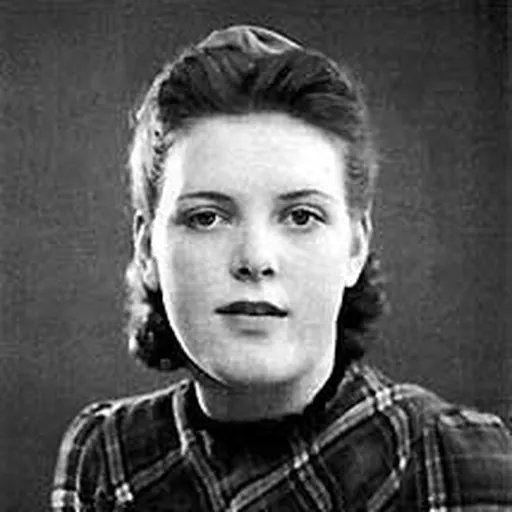
About Grethe Bartram
Lived 1924 – 2017 (aged 92). Grethe Bartram was a Danish wartime collaborator and businessperson.
Maren Margrethe Thomsen, known as Maren Margrethe "Grethe" Bartram and "Thora" (23 February 1924 – 23 January 2017), was a Danish woman who informed on at least 53 people from the Danish resistance movement during the Second World War, resulting in the early communist resistance groups being dismantled and many of their members being sent to Nazi concentration camps. Bartram informed on her brother, husband and close acquaintances.
Bartram was sentenced to death for treason after the war. The sentence was commuted to life in prison in 1947. In 1956 she was released and moved to Halland in Sweden where she lived under her married name.
Background Grethe Bartram was born in Aarhus, and grew up in a poor household, the second of eight children; both her parents were members of the Communist Party of Denmark (DKP), as were the social circles of the family. Her father, Niels Peter Christopher Bartram (born 1896), was from southern Jutland and participated in World War I on the German side. He suffered from shellshock from the war and found it difficult to work but managed to operate a small bicycle repair shop in Midtbyen, Aarhus.
Thereafter, Bartram participated in illegal activities with people involved with the resistance movement. In March–April 1944, she was hired as an agent by the Gestapo and in June the Samsing Group and an affiliated group of University students were arrested and eventually deported to Neuengamme concentration camp. The communist resistance groups in Aarhus and across central Jutland were essentially neutralized.
Resistance members still had high confidence in Bartram at the time and in August 1944 she was sent to Copenhagen as a representative to establish new leadership for the resistance in Aarhus. The resistance subsequently became suspicious of her, so she arranged to be arrested and imprisoned in Frøslev Prison Camp to allay this. It did not help and the resistance attempted to kill her on several occasions, succeeding in wounding her. She was sent to Germany to recover. In March 1945 she was hired by the Gestapo in Kolding where she worked until the surrender of German forces in Denmark. On the day of surrender, 5 May, she was in the Gestapo headquarters in Esbjerg where she was wounded when the resistance detonated bombs there. She recovered quickly and went by bicycle to Kolding to get help but the Gestapo had already evacuated. Bartram then went to Brejning where she was arrested on 10 May.
Don’t just read it —
keep it.
Full-length biographies made to live with: read them, listen on the way to work, watch them tonight.
- E-book
- Audio
- Video
Instant download · yours to keep · every purchase keeps this site free
Important facts
People in Grethe Bartram's life
Named in this biography and alive at the same time

Related people
Same field, nearest in time




Contemporaries
People whose lives overlapped Grethe Bartram's



Frequently asked questions
Who was Grethe Bartram?
Danish wartime collaborator
When was Grethe Bartram born?
Grethe Bartram was born on 23 February 1924 in Aarhus.
When did Grethe Bartram die?
Grethe Bartram died on 23 January 2017 in Vessigebro.
What was Grethe Bartram's occupation?
Grethe Bartram was a wartime collaborator and businessperson.
What nationality was Grethe Bartram?
Grethe Bartram was Danish.
Sources & further reading
Cite this page
APA: Biography.guide. (2026). Grethe Bartram. https://biography.guide/grethe-bartram/
MLA: "Grethe Bartram." Biography.guide, https://biography.guide/grethe-bartram/.
Chicago: "Grethe Bartram." Biography.guide. https://biography.guide/grethe-bartram/.
Data last updated: 2026-09-21 · Spot an error? Report a correction.
Portrait: Wikimedia Commons · author & licence
Page generated 2026-09-27 05:00 UTC